
Services
Knowledge Hub
Resources
Tools
Services







©PropTech Pulse 2025, All rights reserved.

Industrial Legacy of Mumbai
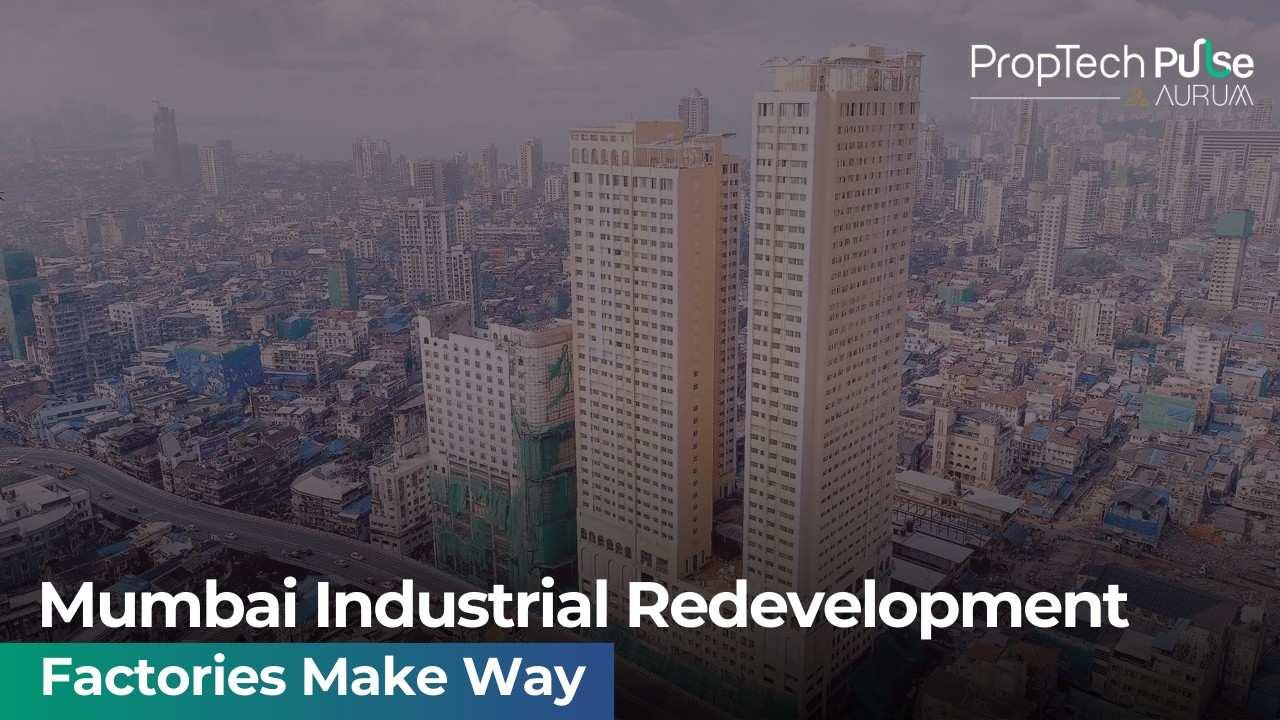
Mumbai’s urban fabric has long been shaped by its industrial past, with textile mills, manufacturing units, and factories spread across central and suburban locations. These industrial establishments once formed the backbone of the city’s economy, providing employment and driving urban expansion. Over time, however, many of these units became unviable due to changing economic structures, rising land values, and shifts in manufacturing activity.
Decline of Manufacturing Activity
The article highlights that several mills and factories gradually shut down or scaled back operations as production costs increased and industrial activity moved to peripheral regions. Ageing infrastructure, regulatory challenges, and land constraints further reduced the feasibility of continuing industrial use within city limits. As a result, large land parcels in prime locations became underutilised.
Transition Toward Real Estate Redevelopment
With industrial operations no longer viable, landowners and authorities began exploring redevelopment opportunities. Former mill lands and factory sites are now being repurposed for residential, commercial, and mixed-use developments. This transition reflects Mumbai’s shift from an industrial economy to a service- and consumption-driven urban model.
Types of Redevelopment Projects
Redevelopment on former industrial land has largely focused on housing projects, including mid-income and premium residential developments, along with office and retail components in select locations. These projects aim to optimise land use while addressing housing demand in areas close to established infrastructure and employment hubs.
Role of Planning Policies and Regulations
Urban planning policies have played a key role in enabling the conversion of industrial land for real estate use. Regulatory frameworks governing land-use change, floor-space index, and rehabilitation obligations have shaped how redevelopment is executed. The article notes that such policies attempt to balance private development with broader urban planning considerations.
Impact on Urban Density and Infrastructure
Redevelopment of industrial plots has contributed to increased residential density in several parts of Mumbai. While this helps address housing supply constraints, it also places additional pressure on civic infrastructure such as roads, water supply, and public transport. Managing this balance remains a key challenge as redevelopment accelerates.
Social and Economic Implications
The transformation of industrial land has altered neighbourhood character and demographics. While redevelopment has introduced modern housing and amenities, it has also raised concerns about the displacement of informal workers and the loss of industrial heritage. The article underscores the need to account for social outcomes alongside economic benefits.
Preservation of Industrial Heritage
In some cases, elements of Mumbai’s industrial heritage have been retained within redevelopment projects through adaptive reuse or design references. However, preservation remains limited, and many historic structures have been fully replaced. This has sparked debate on how cities can modernise while retaining links to their historical identity.
Market Drivers Behind Redevelopment
Rising land values, sustained housing demand, and scarcity of large developable parcels have made former industrial sites attractive for real estate development. Developers view these plots as opportunities to create large, integrated projects within the city, offering scale that is otherwise difficult to achieve.
Future of Industrial Land in Mumbai
The article suggests that redevelopment of industrial land is likely to continue as Mumbai adapts to evolving economic realities. However, future projects will need to address infrastructure capacity, environmental considerations, and inclusive planning to ensure sustainable urban growth.
Conclusion
Mumbai’s shift from mills and factories to real estate redevelopment reflects a broader transformation of the city’s economy and land use priorities. While redevelopment has unlocked valuable land and supported housing supply, its long-term success will depend on balanced planning that integrates infrastructure, heritage, and social considerations.
Enjoyed this update? Visit PropTech Pulse for more real estate news and market insights.


Unlock the Latest in Real Estate
News, Infographics, Blogs & More! Delivered to your inbox.


“Data that drives action. Insight that inspires action. Technology that empowers action.“
“Data that drives action.
Insight that inspires action.
Technology that empowers action.“