New Launch - India Real Estate Report 2026.

Services
Knowledge Hub
Resources
Tools

Ask Pulse Ai
©PropTech Pulse 2025, All rights reserved.



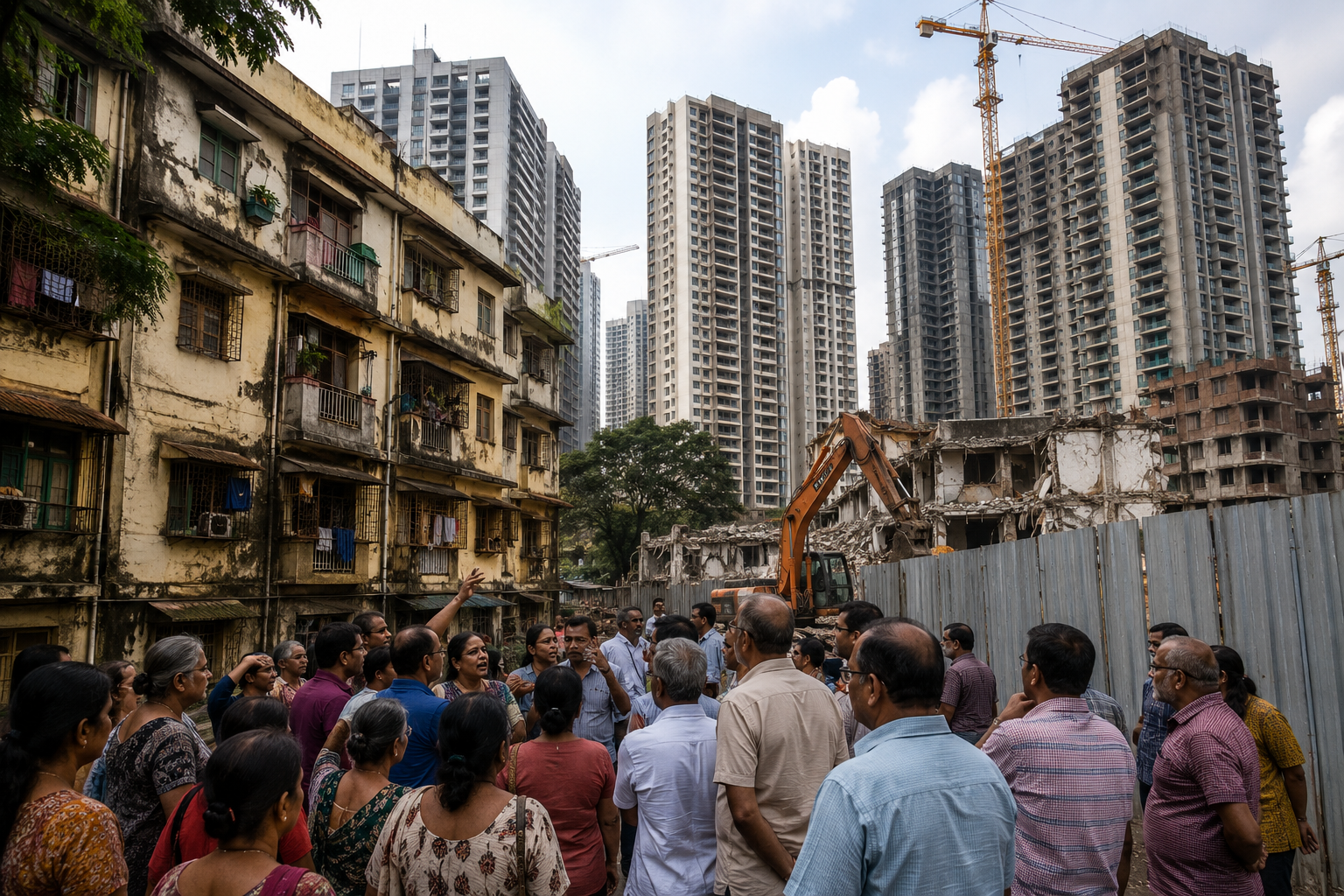
In a developing standoff across the Mumbai Metropolitan Region (MMR), residents and independent housing societies in three premium neighbourhoods have entered a direct collision course with the Maharashtra Housing and Area Development Authority (MHADA). Tensions are escalating over the state agency’s forced implementation of its Construction and Development Agency (C&DA) model, commonly referred to as the cluster redevelopment scheme. Flat owners and residential welfare groups argue that the top-down urban renewal model is non-transparent and coercive, and strips cooperative housing societies of their autonomy to redevelop their properties independently.
Three Prominent Localities Lead the Resistance
The resistance against state-led consolidation is heavily concentrated across three distinct high-value residential layouts, where localised legal battles are unfolding simultaneously within the Bombay High Court:
- SVP Nagar, Andheri West: Spanning 98 chawl structures developed four decades ago, residents accuse MHADA of deliberately blocking and withholding approvals for individual societies that have already finalised independent agreements with private builders since 2007.
- Bandra Reclamation, Bandra West: Tensions escalated significantly after MHADA floated comprehensive redevelopment bids on April 8, prompting at least four elite societies, Suman, Saptarshi, Sagar Kiran, and Kamalpushpa, to seek urgent judicial intervention.
- Adarsh Nagar, Worli: Comprising 863 mid-century homes granted on 99-year subleases in 1982, the MIG Adarsh Nagar Cooperative Housing Society has labelled the state's intervention as "arbitrary, unreasonable, and void ab initio".
The Contentious C&DA Cluster Framework
Under the contested C&DA cluster guidelines, MHADA acts as the absolute land-owning authority, bypassing traditional local society management to directly appoint a private mega-developer through a centralised competitive bidding loop. While the framework promises residents larger apartments and localised infrastructure upgrades, it mandates that MHADA receives a substantial portion of the newly generated redeveloped housing stock, while the private developer retains a free-sale real estate component to generate corporate profits. Furthermore, residents are outraged over the state’s calculated removal of the mandatory 51% homebuyer consent rule, a statutory protection traditionally required for private urban revamps.
Disproportionate Carpet Area Revisions Fuel Anger
Adding to the friction, residents in Andheri's SVP Nagar have flagged stark mathematical discrepancies within the proposed incentive-based carpet area formula. The cluster policy aggressively favours smaller tenements while offering diminishing returns for larger, premium layouts. For instance, basic units measuring 234 sq ft, 278.46 sq ft, and 363.60 sq ft are slated to receive uniform 686.52 sq ft apartments, representing a phenomenal 194% area expansion for the smallest holders. Conversely, owners of High-Income Group (HIG) flats measuring 1,318.25 sq ft will scale up to 2,288.19 sq ft, representing a much lower 74% area appreciation, which HIG members claim is structurally unfair.
MHADA Pushes Ahead with Tendering Process
Despite deep public pushback and accusations of refusing to enter bilateral discussions, MHADA's leadership remains entirely unfazed. MHADA Vice-President and CEO Sanjeev Jaiswal clarified that conventional redevelopment control parameters, such as DCPR 33(5), were financially unfeasible for certain ageing layouts, making the deployment of cluster rules under DCPR 33(9) an absolute necessity to modernise infrastructure. Underscoring this aggressive timeline, MHADA successfully received three separate quotations for each of the three layouts on Monday, placing a total of 206.49 acres of premium city land on the block. While technical scrutiny of these bids begins on Wednesday, residents are banking on the upcoming June 9 High Court hearings to secure critical interim relief and protect their land deeds.
Enjoyed this update? Visit PropTech Pulse for more real estate news and market insights.


