New Launch - India Real Estate Report 2026.

Services
Knowledge Hub
Resources
Tools

Ask Pulse Ai
©PropTech Pulse 2025, All rights reserved.


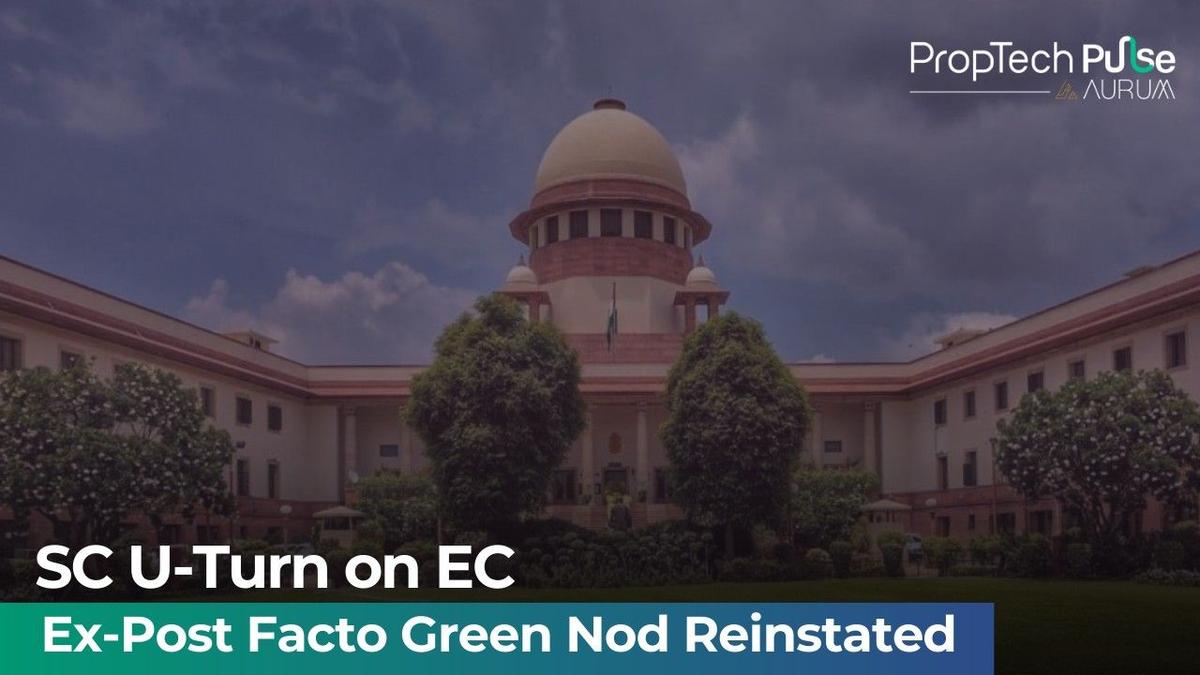
Supreme Court Reinstates Retrospective Environmental Clearances for Projects
The Supreme Court has reversed its earlier May 2025 ruling that prohibited ex post facto environmental clearances (ECs), restoring the potential for retrospective approvals under specific conditions. The decision, made by a 2-1 majority, is expected to reshape the compliance framework for construction, mining, and infrastructure projects.
Key Details of the Judgment
In its review, the court recalled its prior order that had struck down a 2017 government notification and a 2021 Office Memorandum (OM), both of which allowed for regulatory regularisation of ongoing or completed projects through subsequent environmental approvals. The majority opinion noted that an outright prohibition could lead to the demolition of large-scale public projects funded via public finances.
The court has now permitted ex post facto clearances to be issued in “exceptional cases” - subject to environmental damage assessments, remediation plans, and financial penalties. This conditional framework is viewed by some legal experts as a more balanced approach, enabling compliance without disruption.
Split Opinions: Majority vs Dissent
Chief Justice Gavai and Justice Vinod Chandran formed the majority view, arguing that strict cancellation of ECs could waste public funds and destabilise major infrastructure. They emphasised that the 2017 and 2021 rules allowed retrospective clearances under a regulated mechanism, not meant to be misused but applied judiciously.
Justice Ujjal Bhuyan dissented strongly, warning that reinstating retrospective clearances weakens environmental governance. He stressed that the precautionary principle - core to environmental law - cannot be superseded by a compensatory model that relies on penalties alone.
Implications for Real Estate & Infrastructure
The ruling brings immediate regulatory relief for developers, especially those working on large government-backed infrastructure projects, real estate firms, and mining companies that were caught in legal limbo. Projects that risked demolition may now seek regularisation via environmental audits and compliance plans.
On the other hand, environmental advocates and legal experts have expressed concern. Some argue that the decision could encourage a “build first, clear later” mindset, undermining the preventive goals of environmental regulation. This shift will likely lead to further scrutiny and possible litigation in future cases.
Conclusion
The Supreme Court’s reversal on ex post facto ECs signals a significant recalibration of India’s environmental compliance landscape. By permitting retrospective approvals in defined scenarios, the court seeks to balance development imperatives with environmental protection - though critics caution this may compromise ecological safeguards in the long run.
Enjoyed this update? Visit PropTech Pulse for more real estate news and market insights.


