New Launch - India Real Estate Report 2026.

Services
Knowledge Hub
Resources
Tools

Ask Pulse Ai
©PropTech Pulse 2025, All rights reserved.


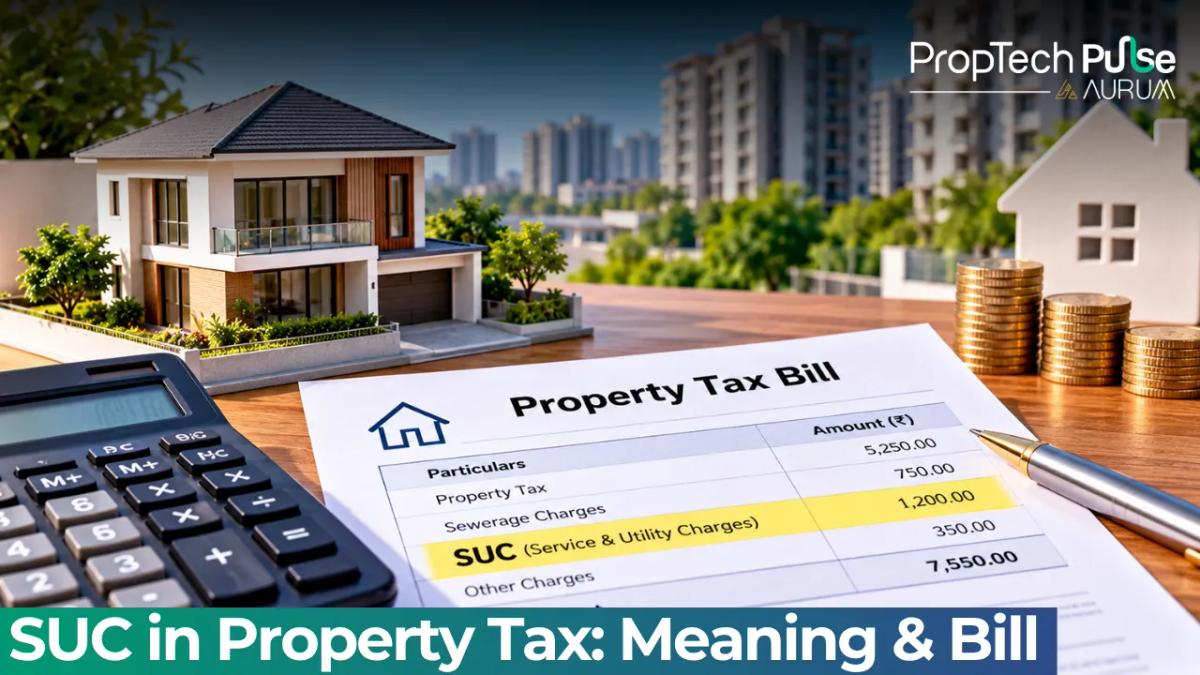
You open your annual property tax statement and spot a new line-item labelled SUC. It pushes your holding costs higher than expected. Instead of paying blindly, you need to know whether this deduction belongs there, what it actually funds, and how to get it removed if the calculation is wrong.
This guide explains exactly what suc in property tax means, how municipalities arrive at the numbers, and gives you a checklist to audit your demand notice before settling the bill. The service user charge or solid waste management fee is not a hidden penalty. It is a separate civic line-item covering trash collection. Understanding the setup saves you from duplicate payments or incorrect slabs.
What Does SUC Mean in Property Tax?
Quick answer
SUC stands for either Solid Waste Management User Charge or Service User Charge. It is a mandatory civic fee collected alongside property tax by most urban local bodies to fund refuse collection and sanitation services. If you see suc listed on your demand notice, it is not a penalty; it is a separate line-item covering municipal waste management.
The acronym causes more confusion than most tax heads because different municipalities expand the same letters differently. When you encounter the term "SUC", it generally refers to one of two things depending on where your property sits. Homeowners often mistake the label for a late fee or an arbitrary surcharge. It is neither.
Solid Waste vs. Service User Charge
State governments have mostly merged individual sanitation levies into the main property tax receipt under a single code. In several states, including Maharashtra and Karnataka, the levy is officially tagged as the Solid Waste Management User Charge. It was introduced following updated environmental directives to ensure that every household contributes directly to the cost of keeping their neighbourhood clean.
In other jurisdictions, most notably areas governed by the Pimpri Chinchwad Municipal Corporation (PCMC) and certain parts of Rajasthan, the same fee carries the Service User Charge label. The underlying concept remains identical. You pay a per-household contribution that finances the public services tracked inside your property tax demand.
Whether the invoice says "Solid Waste" or "Service User Charge", the money flows into the same civic bucket managed by the local municipal corporation. Understanding the suc property tax meaning stops homeowners from panicking when reading digital statements. Recognizing the charge also helps you track budget allocations for street sweeping versus land revenue collection.
Why Is SUC Added to Your Property Tax Demand?
Water and electricity utilities are billed through separate meters because usage varies drastically from house to house. Refuse collection and street sweeping cannot be metered easily. A family of eight generates far more solid waste than a single occupant in a similarly sized flat. Neither resident can install a bin-scale meter at home.
Corporations bundle the sanitation levy into the annual property tax demand to solve this tracking problem. Collectors prefer this structure because securing payment for the waste service becomes significantly easier when attached to the primary property tax bill. As we saw in MCD's latest property tax amnesty scheme, tying civic charges together helps authorities recover long-pending dues that might otherwise go uncollected.
Delaying payment for your sanitation share drains the utility provider's funding for routes, staff, and vehicles. The integrated approach forces compliance while simplifying the annual audit trail for both the citizen and the revenue department.
How Are SUC Charges Calculated Across Indian Municipalities?
City councils use three distinct methods to calculate the suc charges. Your city decides which model applies when its governing council passes a new taxation resolution. The formula directly impacts how much you pay each quarter.
Flat Rate: This remains the most common approach nationwide. Every residential property pays the exact same fixed amount per quarter or year, regardless of built-up area. A standard 1 BHK apartment and a large independent villa pay the identical base fee. Cities use this model to reduce administrative overhead and speed up bill generation.
Per Square Foot / Built-up Area: Larger footprints determine the fee based on actual carpet or built-up square footage. Under this method, a sprawling commercial warehouse pays significantly more than a compact studio apartment. Municipalities simply assign a higher rupee value per square foot to bigger building envelopes. This ensures that properties occupying more public space contribute proportionally more to infrastructure upkeep.
Percentage of Annual Rental Value (ARV): Older valuation frameworks tie the fee directly to the property's assumed annual rent. If your ARV rises during a reassessment cycle, your sanitation contribution rises with it. SUC charges effectively mirror the broader property tax adjustment in these zones.
City-Wise SUC Estimates and Billing Formats
| City | Calculation Basis | Approx Monthly Range | Collection Method |
|---|---|---|---|
| Delhi (MCD) | Fixed Residential Rate | ₹50 – ₹200 | Bundled in Property Tax |
| Mumbai (MCGM) | Built-up Area (sq ft) | ₹50 – ₹120 | Bundled in Property Tax |
| Pune (PMC) | Flat Fee + Commercial Multipliers | ₹30 – ₹100 | Bundled in Property Tax |
| Chennai (MCC) | ARV Percentage | ₹10 – ₹100 | Bundled in Property Tax |
| Bengaluru (BBMP) | Building Zone & Usage Type | ₹30 – ₹500+ | BESCOM Integration / MCG |
Note that figures for Bengaluru often depend on whether you pay through BESCOM or the local municipal corporation. To see the exact calculations for your specific building, refer to a detailed breakdown like our guide on Property tax rates in Mumbai (MCGM) for 2026.
What Exactly Do SUC Funds Pay For?
Generic line-items on invoices usually trigger the default assumption that it is a discretionary tax. Real-world waste funding has very physical endpoints inside your city. Cash covers operational expenses that keep the streets from filling up. Local corporations typically manage this budget through in-house teams or outsourced private vendors.
- Sweeping Staff Salaries: Wage bills for the men and women employed by the ULB to sweep lanes and drain gutters daily.
- Collection Vehicles: Diesel, maintenance, and driver payments for the mechanized sweepers and compactor trucks.
- Landfill and Processing Fees: Costs to transport bins to designated dumping yards, or newer material recovery facilities mandated by environmental clearance norms.
- Graffiti Removal and Park Maintenance: Cleaning of public parks, bus shelters, and removing illegal wall postings.
- Disease Prevention Sprays: Fogging campaigns targeting mosquito breeding sites that accumulate near uncollected waste points.
Bundled Efficiency: Why Property Tax Collectors Prefer SUC Inside the Same Bill
Separating sanitation payments creates massive administrative overhead. By bundling suc charges into the main property tax demand, the municipal collector dramatically improves recovery rates. The trade-off is a lack of transparency on the civic portal, making it harder for homeowners to track how much of their bill actually goes toward cleaning versus land revenue.
Exemptions: Who Doesn't Have to Pay the Service User Charge?
Exemptions exist for the service user charge, though the categories shift slightly. The following properties are typically exempt or enjoy a heavy rebate on sanitation user charges.
- Renting Hospitals and Healthcare Centres: Facilities running entirely on non-profit mandates are frequently granted exemption.
- Religious Institutions: Temples, mosques, and gurudwaras built on charitable trust deeds usually pay zero sanitation fees.
- Government Buildings: Schools, district courts, and army cantonment administration offices do not carry this burden.
- Veterans and Senior Citizens: Many municipal corporations waive the SUC component for retired armed forces personnel and residents over sixty-five living below a stated income threshold.
Formal applications are required for most waivers. Automatic exemptions are rare outside of direct government buildings. Visit the local ward office with proof of ownership, charity registration certificates, or discharge papers. Processing times usually span thirty days.
How to Verify and Dispute Incorrect SUC on Your Tax Bill
An inflated SUC line item or a misclassified vacant plot often signals a billing error. Follow this pre-payment audit to catch discrepancies before the due date passes.
- Check the Category Code: Locate the Use Class or Zone field on your statement. Did the ULB mistakenly tag your independent villa as a multi-storey society? Switching classifications changes the suc charges instantly and can lower your overall liability.
- Verify the Base Area: Compare the square footage listed against your registered sale deed or approved layout plan. Billing departments sometimes copy data from older files that did not account for recent expansions or newly constructed wings.
- Look for Duplicate Levies: Some housing societies collect private waste-management fees separately. While the municipality's SUC remains mandatory, you should never pay both the corporate society charge and the municipal SUC twice for identical services.
- Filing the Grievance: Use the official civic complaint portal. Navigate to the section outlining the property tax appeal process and upload your ownership documents proving why the SUC column is incorrect. Always reference the specific municipal corporation property tax assessment guidelines for your zone while drafting the note.
Manual cashiers accept disputes when digital portals stall. Carry a stamped copy of your tax demand notice and request a manual override. Insist on a written acknowledgment of your grievance so the deadline does not expire while the case sits in review.
Final Decision Rule: Is the SUC Deduction Legitimate?
Stop and run through three quick checks before clearing the dues. First, does my municipality actively run a solid waste pickup route past my gate? Second, is my property categorised correctly as residential or commercial on the portal? Third, am I paying a private society fee on top of this demand? If the first answer is yes, and the second and third answers are no, the deduction is legitimate. Pay it promptly, and request a digital receipt that explicitly lists the sanitation component so your records stay accurate for future appeals.
Frequently asked questions
What does SUC stand for in property tax?
SUC generally expands to either Solid Waste Management User Charge or Service User Charge. Both terms describe the exact same civic fee, just applied under different nomenclatures by various Urban Local Bodies across India. When municipalities merge sanitation duties into your main holding bill, the resulting line item carries this abbreviation.
Why is the service user charge added to my property tax bill?
Because municipal waste collection cannot be metered like water or electricity, local corporations bundle it into the property tax demand. Attaching the sanitation fee to the primary tax receipt ensures higher compliance rates and simplifies the billing cycle for both the homeowner and the municipal collector.
Is the SUC charge refundable if I don't use the services?
No. Since SUC is not an optional utility subscription, opting out of municipal waste collection provides no legal grounds for a refund. Even if your property is temporarily vacant or you manage private trash disposal, the levy remains active to fund the broader street-sweeping infrastructure of the ward.
How do municipalities calculate SUC charges?
Cities deploy three main formulas: a flat per-household fee, a calculation based on your built-up area in square feet, or a percentage tied to your property's Annual Rental Value. Your specific city council determines which methodology is used during each budget session.
Which properties are exempt from SUC?
Non-profit hospitals, religious institutions operating under charitable trusts, all government-run schools and office complexes, and veteran residences are frequently eligible for SUC waivers. You must submit a formal written application to the municipal commissioner's office along with the required trust deeds or service certificates.
Sources
- Ministry of Environment, Forest and Climate Change (MoEFCC): Solid Waste Management Rules framework context (accessed October 2026)
- Municipal Corporation of Delhi (MCD): Online property tax calculation parameters and citizen grievance portals (accessed October 2026)
- Municipal Corporation of Greater Mumbai (MCGM): Property tax billing schedules and user charge slabs (accessed October 2026)
- Bruhat Bengaluru Mahanagara Palike (BBMP): Integrated e-services portal detailing municipal tax structures (accessed October 2026)
- Environment Clearance Portal: Guidelines on material recovery facilities and municipal waste mandates (accessed October 2026)
Enjoyed this blog article? Visit PropTech Pulse for more interesting blogs.





Ask Pulse Ai anything about real estate

Unlock the Latest in Real Estate
News, Infographics, Blogs & More! Delivered to your inbox.

