New Launch - India Real Estate Report 2026.











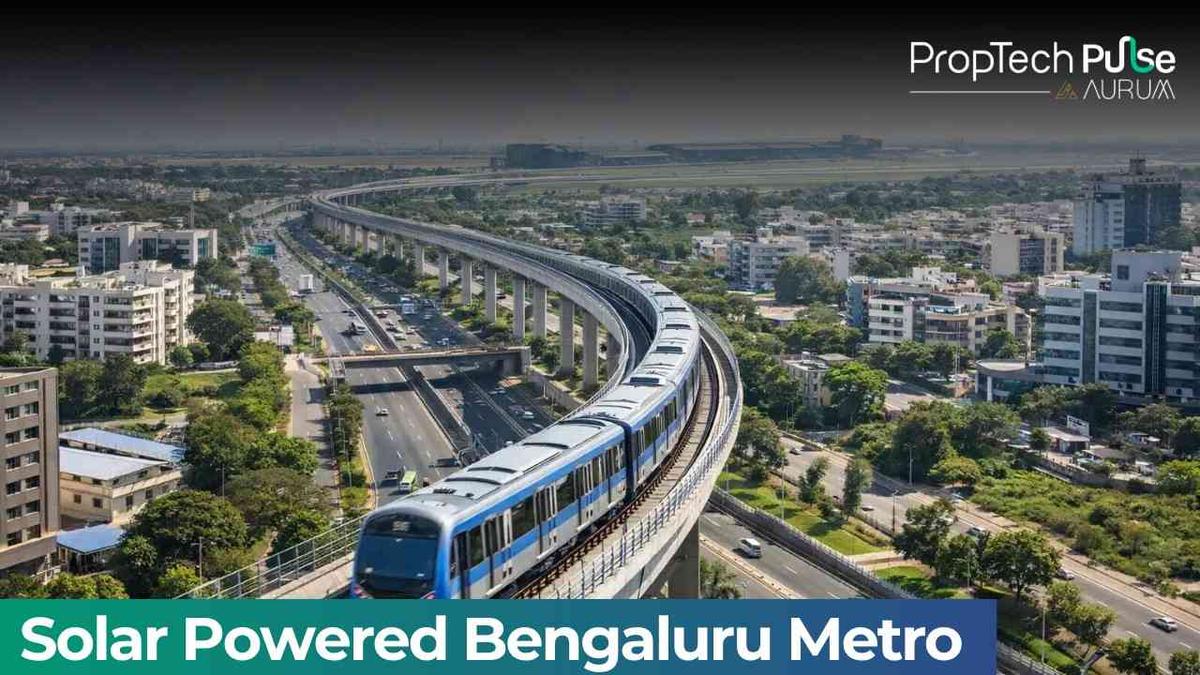
In a landmark development for green urban mobility, Bengaluru’s upcoming Namma Metro Blue Line could become one of India’s first large-scale mass transit corridors capable of operating entirely on solar energy on a net annual basis. The findings were established through a comprehensive engineering study conducted by researchers at the Indian Institute of Science (IISc) in close collaboration with the Bangalore Metro Rail Corporation Limited (BMRCL). The technical report marks a major milestone for decarbonising public transport systems, showing that mega infrastructure projects can achieve structural energy self-sufficiency without placing additional burdens on commercial state grids.
Feasibility Metrics and Traction Energy Balancing
The specialised study focused explicitly on the direct integration of renewable infrastructure across the nearly 55 km Blue Line corridor, which is currently being constructed under Namma Metro Phases 2A and 2B to connect the high-density Central Silk Board node with Kempegowda International Airport. Researchers rigorously modelled the corridor's future peak operations, projected at full-scale capacity with trains running at high-frequency two-minute intervals. The underwritten energy metrics highlight high capital efficiency:
- Annual Energy Requirements: The complete operational layout of the Blue Line is estimated to consume approximately 152 Gigawatt-hours (GWh) of electricity annually.
- Necessary Generation Capacity: To match this traction demand on a net annual basis, the study concludes that a dedicated solar infrastructure capacity of 83.3 Megawatt-peak (MWp) is required.
- Available Asset Real Estate: Evaluation of BMRCL-owned real estate confirms that the metro network possesses an aggregate solar hosting potential of up to 89 MWp, comfortably exceeding the corridor's absolute consumption thresholds.
Spatial Distribution and Immediate Rooftop Rollout
The IISc study highlights that BMRCL can achieve this net-zero milestone by optimising its existing physical footprint, avoiding the need for expensive outside land acquisitions. The proposed 89 MWp generation potential will be decentralised across four primary built asset classes: metro station rooftops, train depot structures, elevated viaduct parapets, and passenger station canopies. Crucially, the authors note that nearly 30 MWp of rooftop solar infrastructure can be deployed immediately without requiring any structural changes or modifications to the existing metro engineering layout, paving the way for low-friction, early-stage clean energy generation.
Substantial Financial and Carbon Offsets
Transitioning the Blue Line to a standalone solar model is projected to introduce significant fiscal and environmental benefits for the city's transport administration. By substituting conventional fossil-fuel-derived traction energy with decentralised solar power, the project is anticipated to generate massive long-term operational savings. While the 18 km elevated stretch between Central Silk Board and KR Pura is moving steadily toward a December 2026 completion deadline, the timely implementation of the IISc solar blueprint will allow BMRCL to insulate its financial balance sheet from volatile commercial electricity tariffs, directly improving the long-term economic viability of the transit system.
Future Outlook for India's Green Transit Frontier
As Indian metropolitan centres accelerate the expansion of their transit networks to counter intense urban congestion, the integration of public real estate with clean energy generation has become a critical policy mandate. The collaborative framework between IISc and BMRCL demonstrates that transit-oriented developments can transition from heavy energy consumers into active clean energy producers. By establishing a highly replicable, data-backed template for zero-carbon mass transit, the Bengaluru Metro Blue Line is setting a powerful national benchmark, proving that the future of Indian infrastructure lies at the exact intersection of technological scale and environmental responsibility.
Enjoyed this update? Visit PropTech Pulse for more real estate news and market insights.


