New Launch - India Real Estate Report 2026.











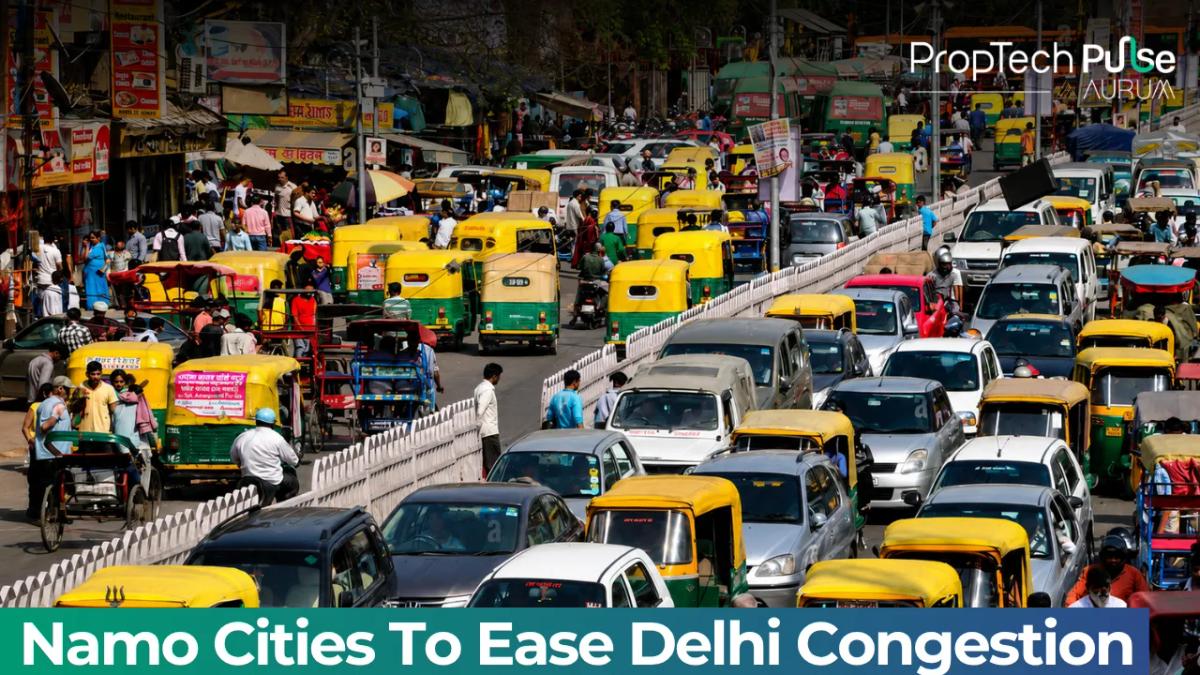
The Centre's proposal to develop Namo Cities, also referred to as Namo Nodes, is being viewed as an ambitious attempt to decentralise development in the National Capital Region (NCR) and reduce pressure on Delhi's urban infrastructure. The proposed cities are planned as mixed-use, transit-oriented development hubs that will be built around existing and proposed stations on the Namo Bharat RRTS network.
The initiative forms part of the Regional Plan 2041 for NCR, which envisions four semi-greenfield cities designed to function as self-sustaining urban centres. The cities are expected to integrate residential, commercial and social infrastructure while leveraging high-speed regional connectivity to encourage balanced growth beyond Delhi's core areas.
Transit-Led Urban Development Strategy
The proposed Namo Cities are intended to become growth magnets by combining transit infrastructure with planned urban development. Experts believe such cities could help unlock the development potential of peripheral regions, improve labour mobility and create new opportunities for economic activity across NCR. The model seeks to reduce excessive concentration in Delhi by encouraging businesses and residents to move towards emerging urban centres.
The scheme includes a ₹5,000 crore performance-linked incentive, comprising grants, loans and guarantees, including a grant component of ₹1,000 crore. The funding support from the National Capital Region Planning Board is expected to catalyse investments and accelerate the development of these new urban nodes.
Execution Challenges Remain
Despite the potential benefits, experts have raised concerns about implementation. Previous attempts to decongest Delhi through decentralised development models have often struggled due to coordination gaps among participating states and delays in translating planning proposals into on-ground execution. According to industry experts, the gap between policy announcements and implementation has historically remained significant in NCR's urban development initiatives.
The Regional Plan 2041 leaves critical aspects such as transit-oriented development delineation and floor area ratio norms to individual states. Experts believe this could result in varying approaches across Haryana, Uttar Pradesh and Rajasthan, potentially affecting the integrated development of the proposed corridors.
Implications For Real Estate And Infrastructure
Delhi-NCR real estate could witness significant opportunities if the proposed cities are implemented effectively. Developers expect the creation of new urban centres to drive residential, commercial and mixed-use projects in emerging locations such as Faridabad, Sonipat and Panipat. Improved infrastructure and employment generation could further attract homebuyers and investors seeking long-term growth opportunities.
The NCR currently spans 55,083 square kilometres across Delhi and 27 districts in Haryana, Uttar Pradesh and Rajasthan and contributes around 8 per cent of India's GDP. Given the scale of the region, experts believe the success of the Namo Cities initiative will ultimately depend on strong inter-state coordination and timely execution.
Key Highlights
- Namo Cities are proposed as four transit-oriented growth hubs under NCR Regional Plan 2041.
- Namo Bharat RRTS will act as the backbone of the proposed developments.
- The scheme includes a ₹5,000 crore performance-linked incentive package.
- Delhi-NCR real estate could benefit through new residential and commercial opportunities.
- Experts believe execution and inter-state coordination remain the biggest challenges.
The Namo Cities proposal presents a long-term vision for managing Delhi's urban expansion through planned, transit-linked development. While the concept offers significant opportunities for infrastructure and real estate growth, its success will largely depend on coordinated implementation and the ability of participating states to translate policy ambitions into functioning urban centres.
Enjoyed this update? Visit PropTech Pulse for more real estate news, investment insights, and property market trends.