New Launch - India Real Estate Report 2026.

Services
Knowledge Hub
Resources
Tools

Ask Pulse Ai
Services
FOR BUYERS & RENTERS
FOR REAL ESTATE DEVELOPERS








Refer other Connectors &
Multiply IncomeRefer other Connectors
& Multiply Income
Refer KuberX & earn
commission on every
loan they get
disbursed.


Scan & Download
©PropTech Pulse 2025, All rights reserved.


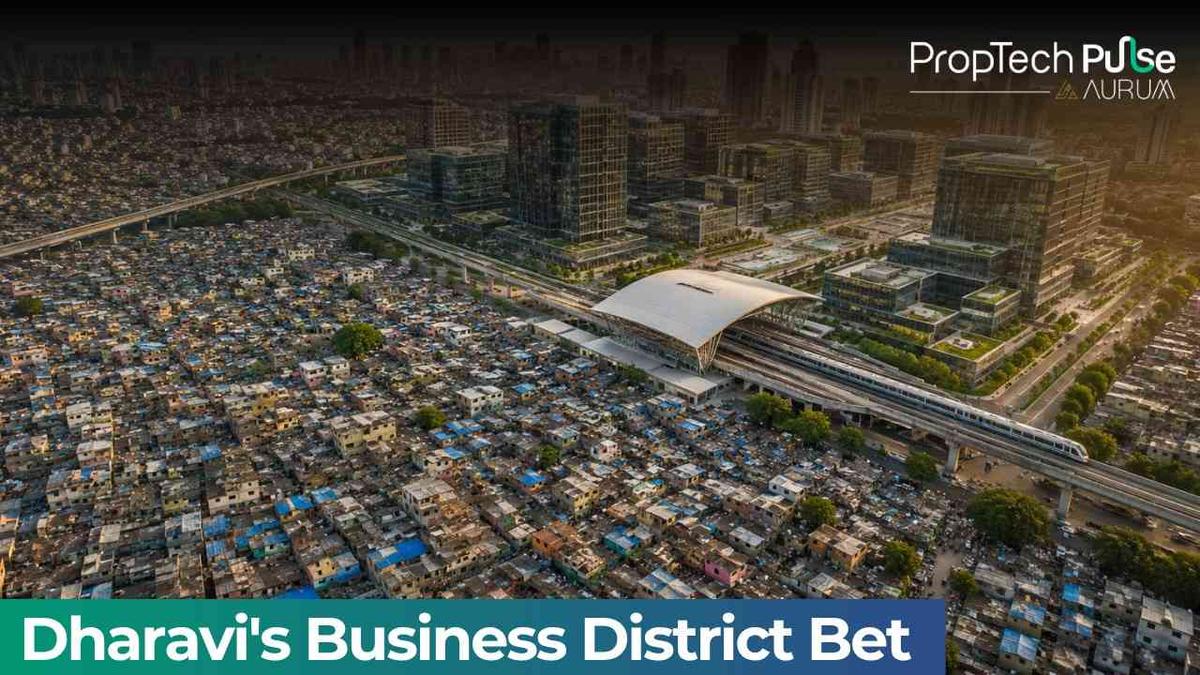
Housing has dominated the Dharavi conversation for years. What's easy to miss underneath that story is a second, quieter ambition: turning Asia's largest informal settlement into one of Mumbai's major commercial and transit nodes. The project's backers have described the investment scale at Rs 2 to 3 lakh crore, and increasingly, the plan reads less like rehabilitation and more like city-building.
A business district built where a slum once stood
Reports on the redevelopment describe Dharavi being positioned to house India's next prime business district. That's a striking reframe for a settlement long defined by informal manufacturing and low-rise density. Commercial and industrial land use isn't an afterthought in the plan; it's structural, with eligible commercial and industrial units given the option to secure additional space at construction cost rather than market rate. For a settlement whose economy has always run on small-scale manufacturing, that detail matters. It suggests continuity of livelihoods rather than displacement of the businesses that built Dharavi's informal economy in the first place.
The MMRDA multi-modal hub
The Mumbai Metropolitan Region Development Authority has been appointed nodal agency for a multi-modal transit hub planned within Dharavi itself, and the area is set to get Mumbai's first metro interchange station connecting multiple major corridors. Streets are being planned for interconnection every 125 metres, a granular detail that speaks to genuine urban design intent rather than a loose masterplan sketch. A transit hub of this scale doesn't just move Dharavi's own residents. It repositions the entire settlement as a connectivity node for the wider Mumbai Metropolitan Region, which is precisely what turns adjacent land into commercially valuable real estate.
Why the investment figure matters more than it looks
Rs 2 to 3 lakh crore is not a housing-scheme number. That's infrastructure-plus-real-estate-plus-transit money, the kind of capital commitment that only makes sense if the plan genuinely intends to build a functioning business district and not just rehabilitation housing with better plumbing. Whether that figure holds up against actual construction costs over a multi-year build is the real test; project costs in India have a well-worn habit of expanding well past initial estimates. But the scale of ambition behind the number is unmistakable, and it changes how the surrounding real estate market should be read.
What this means for Mumbai's commercial geography
Business districts in India tend to form around transit access, and transit access tends to follow wherever land is available at scale. Dharavi has both a metro interchange in the plan and hundreds of contiguous acres freed up through phased redevelopment. If the business district ambition holds, expect the ripple effect to extend well beyond Dharavi's boundaries into Sion, Mahim and the wider central Mumbai corridor, the same pattern that played out around Bandra-Kurla Complex two decades ago. That's the real story hiding underneath the housing headlines: Dharavi isn't just being rehabilitated. It's being repositioned as infrastructure Mumbai will build around for the next generation.
Enjoyed this update? Visit PropTech Pulse for more real estate news and market insights.


