New Launch - India Real Estate Report 2026.











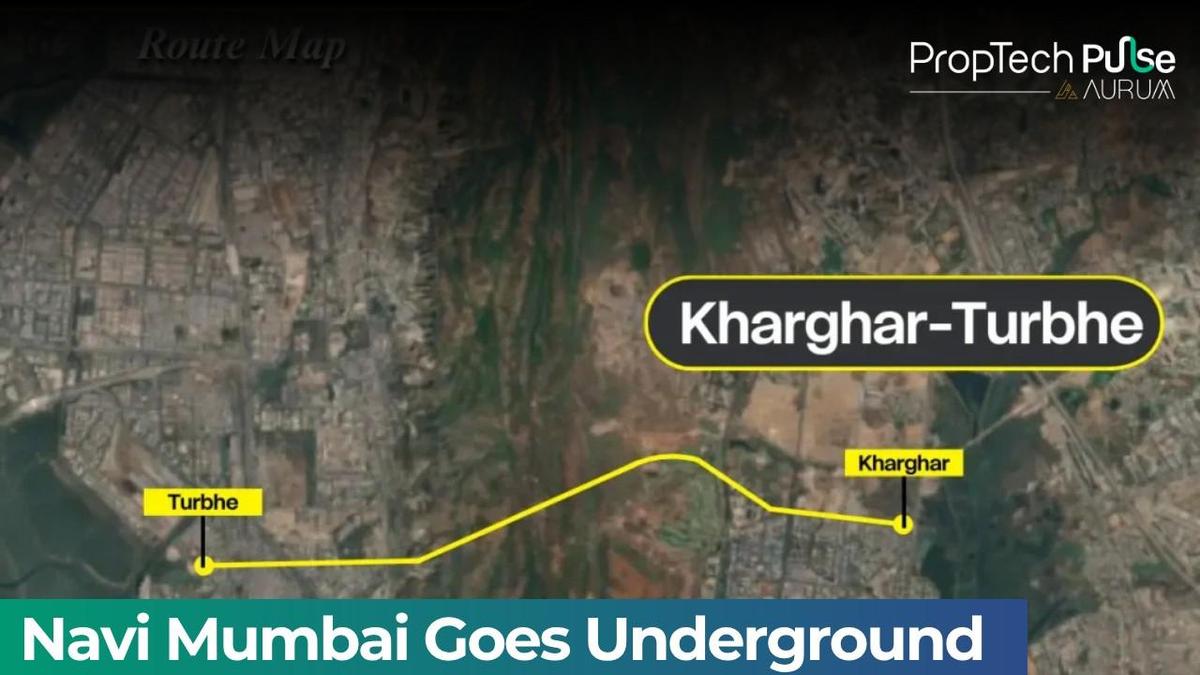
A quick clarification first. There's no project literally called the Turbhe-BKC Tunnel, whatever the buzz suggests.
What actually exists is the Kharghar-Turbhe Tunnel Link Road, a CIDCO-led project that doesn't physically bore its way to Bandra-Kurla Complex but is designed to improve connectivity toward it by feeding into the region's broader transit network, including the upcoming bullet train terminal at BKC. That distinction matters if you're trying to understand what's actually being built underground in Navi Mumbai right now.
What's actually being built
KTLR is one of the largest road tunnel projects currently under construction in Maharashtra. The problem it solves is specific: Navi Mumbai's northern and southern nodes are separated by hill ranges, which forces all traffic onto the increasingly congested Sion-Panvel Highway. This tunnel cuts straight through that geography instead of routing around it.
The numbers, per CIDCO's project presentation, are substantial. A total corridor length of roughly 5.96 km, including twin tunnels running 1.76 km each, four lanes wide at 18.8 metres and 10.23 metres tall. Approach viaducts and ramps add another 3.46 km, with a 700-metre cut-and-cover section. Design speed sits at 80 km/h. The estimated cost is ₹2,099 crore, with target completion around September 2028. The Rithwik-Evrascon joint venture is executing the project, with TCE-Hill JV as project management consultant.
Why this tunnel matters beyond travel time
CIDCO expects the tunnel to cut travel time between Kharghar and Turbhe by nearly 50%, while also decongesting the Sion-Panvel Highway, one of the most heavily used arterial roads feeding Navi Mumbai.
That's not a convenience upgrade. Rapid urbanisation around the Navi Mumbai International Airport and the International Corporate Park at Kharghar means planners see this as essential capacity, not a nice-to-have. Turbhe sits along the corridor developing toward BKC and the bullet train terminal, which is why this functions as a feeder link in a much larger regional network rather than a standalone shortcut.
Project Snapshot
|
5.96 km Total corridor length |
₹2,099 Cr Estimated project cost |
Sept 2028 Target completion |
Tunnel Specifications
|
Twin tunnels |
Approach viaducts and ramps |
|
Design speed |
Safety infrastructure |
Kharghar to Turbhe: The Time Cut
|
~50% Expected reduction in travel time between Kharghar and Turbhe |
Challenges CIDCO Has Flagged
|
1.4 million m³ |
Encroachment relocation |
|
Restricted blasting windows |
Watercourse diversion |
The engineering is genuinely complex
This isn't a bore-and-done job. The alignment runs through Deccan basalt formations with varying weathering and fracturing, which demanded detailed geological investigation before construction even began.
The project uses the New Austrian Tunnelling Method, an approach built around continuously observing, measuring and adjusting support systems as excavation proceeds rather than assuming uniform rock conditions throughout. Engineers classified the rock mass into three support categories and applied rock bolts and fibre-reinforced shotcrete accordingly. The permanent lining includes a protective felt layer, a PVC waterproofing membrane and a 300mm reinforced concrete shell, built for durability given Navi Mumbai's monsoon exposure.
Five cross-passages sit at roughly 300-metre intervals for emergency evacuation. The finished tunnel will run CCTV, fire and smoke detection, and full traffic management systems.
What CIDCO isn't hiding
Credit where it's due, CIDCO's own reporting doesn't dress up the difficulties. Relocating encroachments near the tunnel portals. Disposing of an estimated 1.4 million cubic metres of excavated rock and soil. Land acquisition delays. Restricted blasting windows given the dense population nearby. Diverting natural watercourses.
None of this is unusual for urban tunnelling in India. But it's exactly the kind of friction that has pushed timelines on comparable projects before, and the 2028 target is still two years out.
The bigger bet underneath the bigger bet
KTLR is one small piece of a much larger strategy. MMRDA has separately been developing plans for a roughly 70-km underground tunnel network across Mumbai, estimated at ₹1.05 trillion, meant to link the Coastal Road, BKC and the airport as a third mode of travel beneath the city, still at the detailed project report stage as of late 2025.
KTLR isn't formally part of that network. But both projects are answering the same question in the same way. Mumbai and Navi Mumbai are running out of surface-level room, and increasingly, the region's answer is to stop building around the geography and start building through it.
Enjoyed this update? Visit PropTech Pulse for more real estate news and market insights.