New Launch - India Real Estate Report 2026.











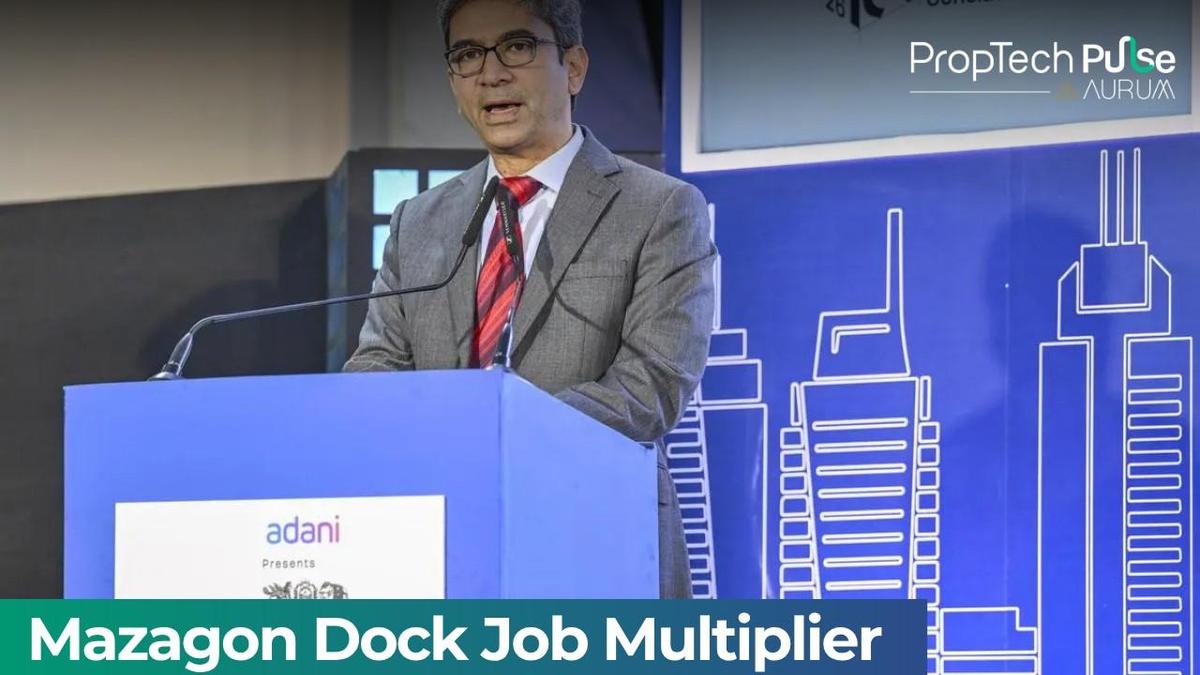
In a detailed analytical briefing presented at The Hindu Infrastructure Conclave 2026 in Mumbai, Captain Jagmohan (Retd.), Chairman and Managing Director of Mazagon Dock Shipbuilders Limited (MDL), outlined the massive workforce impact anchoring India's maritime defence sector. Jagmohan revealed that the industrial footprint of defense shipbuilding creates a powerful economic ripple effect, where every single direct job established at Mazagon Dock generates an additional 6.4 jobs across the wider Indian economy. This operational multiplier highlights how centralised defence infrastructure capex transforms local manufacturing and service industries.
Project 17A Frigate Serves as a Live Industrial Model
To validate this high-velocity job creation matrix, Captain Jagmohan cited the execution of the Project 17A frigate program as a primary case study. Within the shipyard's direct tracking loops, an active base of 4,500 core MDL workers effectively supports and sustains nearly 28,000 downstream positions across a highly distributed network of supply chain partners and ancillary engineering firms. This massive economic absorption proves that the domestic defence manufacturing value chain acts as a critical anchor for the country's broader industrial ecosystem.
The ₹69,725 Crore Cabinet Stimulus Backing
This employment scaling is heavily supported by the Union Cabinet's landmark ₹69,725 crore specialised maritime pack implemented to drive long-term structural upgrades. The comprehensive funding framework includes distinct fiscal pillars:
- Shipbuilding Financial Assistance Scheme: Backed by a substantial allocation of ₹24,736 crore to incentivize local shipyard operations.
- Maritime Development Fund: Deploying an institutional capital pool of ₹25,000 crore to support high-capacity greenfield and brownfield transit assets.
- Shipbuilding Development Scheme: Infusing ₹19,989 crore into core design and structural research.
- Interest Incentivisation Fund: Providing a ₹5,000 crore liquidity buffer to cushion developers from high borrowing costs.
The Maritime Amrit Kaal Vision 2047 Blueprint
The core objective behind these coordinated capital injections is the achievement of the Maritime Amrit Kaal Vision (MAKV) 2047. The policy blueprint explicitly aims to place India among the world's top five shipbuilding nations by 2047, targeting an annual domestic capacity of 4.5 million gross tonnage (GT) fueled by an aggregate investment outlay of ₹4.5 lakh crore. To support this rapid expansion, town planning and maritime boards are deploying mega-shipbuilding clusters with capacities of 1 to 1.2 million GT each. These hubs will feature integrated trunk connectivity, state-backed dredging support, and a highly competitive 10-year land rent holiday, with the broader goal of generating 30 lakh skilled jobs over the next two decades.
A Three-Pronged Structural Mandate for Maharashtra
Turning to localised implementation parameters, Captain Jagmohan outlined three critical mandates that the Maharashtra state government must deliver to capture this maritime boom. First, the state must secure a contiguous and expandable waterfront layout aligned with the national cluster zoning policy. Second, the administration must establish a single-window task force to guarantee time-bound environmental and Coastal Regulation Zone (CRZ) clearances through parallel processing pipelines. Finally, the state must deliver robust trunk infrastructure, specialised technical skilling institutions, and an integrated MSME supply network. By linking small-scale engineering units directly with heavy shipyards, the state can transition from a mere project host into a dominant global leader for maritime manufacturing.
Enjoyed this update? Visit PropTech Pulse for more real estate news and market insights.