New Launch - India Real Estate Report 2026.









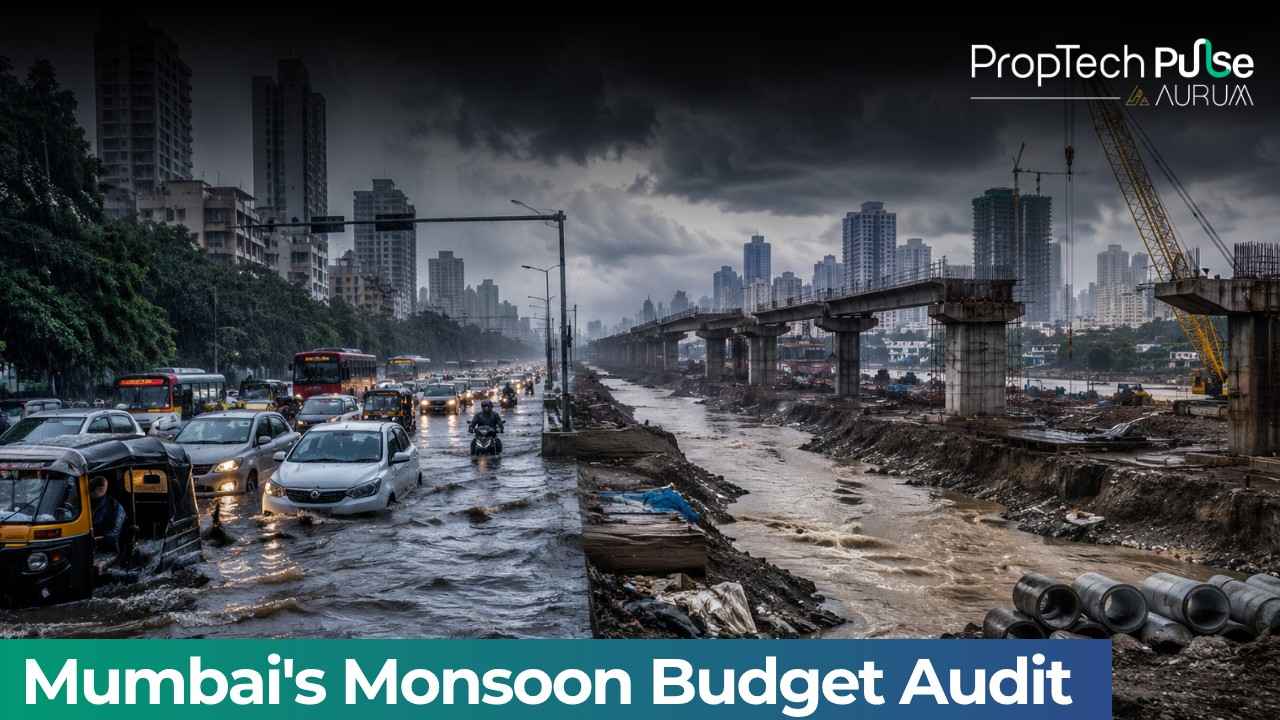
Every year, the first heavy spell of Mumbai's monsoon does something the city's civic machinery cannot: it audits itself. Roads that looked fine in April cave in by June. Freshly inaugurated infrastructure buckles within weeks. And the human cost- electrocutions, manhole deaths, falling trees keeps repeating with a grim familiarity that has stopped feeling like bad luck and started looking like a pattern. 2026 has been a particularly sharp illustration, not because anything new went wrong, but because so much of what went wrong was tied to money that had already been spent to fix it.
Pothole complaints are down, but Mumbai does not feel it
The headline number sounds like progress. The BMC received 3,108 pothole complaints this monsoon, compared to 3,770 in the same period last year. A separate count put complaints between June 10 and July 12 at 2,633, with BMC claiming over 90% were resolved. Behind those figures sits a ₹17,700 crore road concretisation programme launched in 2023, aiming to concretise roughly 700 km of Mumbai's roads. The 2026-27 budget alone allocated ₹5,520.48 crore covering 2,121 road patches spanning nearly 692 km. BMC expects the shift from asphalt to concrete to cut future repair costs by around 45%.
Infrastructure Failures
|
₹6,695 Cr Missing Link |
₹17,700 Cr road programme |
|
Mid-conversion roads exposed |
Contractors fined ₹20L each |
Human Cost
|
Open manhole death |
Two electrocutions |
|
Deepak Pillai, 17 |
Student, Nalasopara |
|
One day in Mumbai: roughly 90 tree-fall incidents and 30 short-circuit reports logged in 24 hours. |
|
By The Numbers
|
₹17,700 Cr Road concretisation programme |
₹5,520 Cr Allocated in 2026-27 budget |
₹6,695 Cr Missing Link project cost |
|
700 km Target road concretisation |
3,108 Pothole complaints (down from 3,770) |
45% Expected cut in future repair costs |
But the completion date keeps sliding, most recently pushed to end-2026 or early 2027, years after the original targets. Residents in Bandra and Santacruz have been warned they could face the worst of this monsoon precisely because their stretch of road is mid-conversion: neither properly asphalted nor properly concreted. A pothole that opened up on Andheri's SV Road recently became a flashpoint for commuters who see the "fewer complaints" statistic as disconnected from what they are actually driving over.
The Missing Link that broke in nine weeks
If one image captures the credibility gap between infrastructure announcements and infrastructure reality, it is this: the Mumbai-Pune Expressway Missing Link, a ₹6,695 crore project designed to shorten the journey by cutting through the ghat section, was inaugurated on May 1, 2026. Nine weeks later, on July 6, a landslide shut it down. Reporting on the project has surfaced allegations that contractors violated basic construction specifications, from excavation depths and curing time to compaction and material quality, without consequence. For a project literally named for closing a gap in Mumbai's connectivity, a monsoon-triggered shutdown weeks after opening is difficult to frame as anything other than a failure of execution oversight.
Mumbai's monsoon infrastructure failures carry a body count
The most serious part of this story is not cosmetic. A man died after falling into an open manhole on July 2, an incident serious enough that BMC suspended four officials over it. The same week, two people were electrocuted in separate incidents in Dombivli and Mumbra during heavy rain, part of three fatal incidents in a single day across the Mumbai Metropolitan Region.
A 17-year-old, Deepak Pillai, died in Bhandup after contact with a live high-tension wire. A student in Nalasopara died after touching a live, wet metal ladder connected to a faulty inverter. On one particularly bad day, the city logged roughly 90 tree-fall incidents and 30 short-circuit reports in 24 hours. Every one of these deaths traces back to infrastructure that should have been insulated, covered or maintained: exposed cables, uncovered manholes, unmanaged trees near power lines.
The material quality question
This is where the story stops being about weather and starts being about specifications. A watchdog foundation has formally accused the BMC of misusing funds in the road concretisation programme, alleging substandard materials and poor oversight. The BMC itself fined two road contractors ₹20 lakh each in an earlier crackdown on shoddy concretisation work, an admission that the quality-control problem is real and not just public perception.
Allegations around the Missing Link project echo the same theme: contractors reportedly cut corners on curing time and material quality with no consequence. Much of what breaks down in the rain each year was not built to survive it in the first place. And the accountability mechanisms meant to catch that before monsoon arrives keep proving too weak or too slow.
Rain is predictable; what is not is whether the money worked
Mumbai's monsoon arrives at roughly the same time every year, with roughly the same intensity. What is not predictable, apparently, is whether the previous year's repairs, the current year's budget allocations and the specifications contractors are supposed to follow will hold up when tested. Large budgets announced, deadlines quietly extended, quality complaints surfacing mid-project, and then every June and July the same headlines about potholes, electrocutions and landmark expressways shutting down weeks after their ribbon-cutting. The ₹17,700 crore concretisation programme and the ₹6,695 crore Missing Link are not small commitments. The question Mumbai's monsoon keeps asking is not whether the city is spending enough. It is whether anyone is checking what the spending actually built.
Enjoyed this update? Visit PropTech Pulse for more real estate news and market insights.