New Launch - India Real Estate Report 2026.











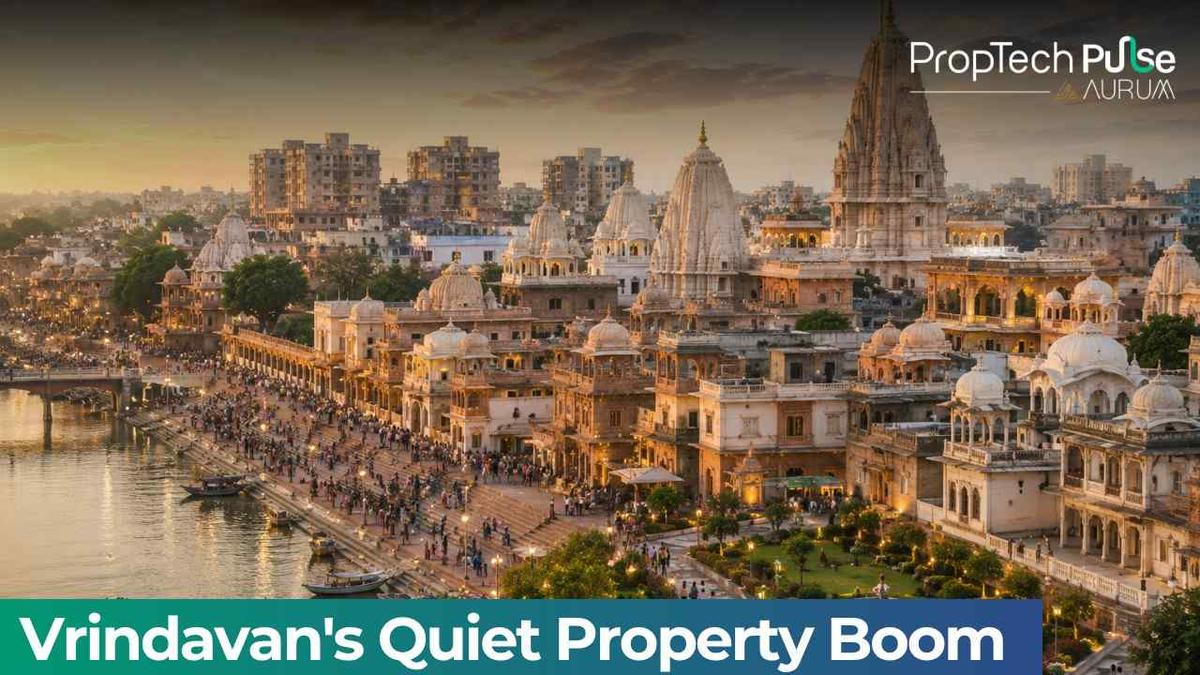
Vrindavan has drawn pilgrims for centuries, but for most of that time, the city's economy was built around devotion rather than duration. That is changing. With approximately 2.45 crore visitors in 2024 alone and a growing share of those visitors choosing to stay longer rather than pass through, Vrindavan is beginning to behave less like a pilgrimage stop and more like a functioning year-round economy, and the real estate market is repricing accordingly.
Vrindavan real estate: the infrastructure case
The repricing thesis rests on a convergence of infrastructure commitments that are moving from announcement into execution. The six-lane, access-controlled Vrindavan Bypass, approved at Rs 1,645.72 crore, is designed to ease chronic congestion and improve regional connectivity. The Banke Bihari Corridor, discussed at around Rs 500 crore, targets pilgrim movement and safety and has remained under active judicial and administrative scrutiny, which underlines its centrality to the city's long-term urban planning rather than diminishing it. At the broader regional level, the Ministry of Road Transport and Highways has outlined plans to develop the 84 Kosi Parikrama Marg of Braj as a National Highway under Bharatmala Phase II, with an investment scale of approximately Rs 5,000 crore. Together, these initiatives place the region close to the Rs 7,000 crore mark in planned and executed infrastructure commitments.
🛕
Tourism Fuels Growth
With 2.45 crore visitors in 2024, Vrindavan is evolving into a year-round destination, boosting demand for residential and hospitality real estate.
🛣️
₹7,000 Cr Infrastructure Push
Major projects including the Vrindavan Bypass, Banke Bihari Corridor and 84 Kosi Parikrama Marg are strengthening regional connectivity.
🏙️
Spiritual Economic Zone
A ₹30,000 crore Braj master plan aims to integrate tourism, housing, hospitality and retail into a planned growth ecosystem.
📈
Land Values Climb
Radhakund recorded nearly 29% CAGR in plotted land values over five years, reflecting sustained infrastructure-led appreciation.
🏡
Developers Eye Opportunity
Better infrastructure, policy support and digital land transactions are attracting organised developers, NRIs and long-term investors.
Policy visibility and the Spiritual Economic Zone
Infrastructure is being reinforced by policy frameworks that give investors a longer planning horizon. In August 2025, the Uttar Pradesh government announced a Rs 30,000 crore master plan for the holistic development of the Braj region, alongside 118 development projects worth Rs 646 crore for Mathura-Vrindavan specifically. The cumulative effect of these commitments is to position the region as what developers are increasingly calling a Spiritual Economic Zone — an integrated destination where religious tourism, hospitality, retail, local services and residential development are planned in a more coordinated way rather than growing organically around pilgrimage flows alone. Connectivity is further supported by the Noida International Airport at Jewar, which reduces travel friction for NCR-based visitors and converts day trips into overnight stays.
What land prices are already showing
The market data is beginning to reflect these structural shifts. Radhakund, in the Vrindavan region, has recorded nearly 29% CAGR over the past five years in plotted land values, a figure that sits well above the 21% rise in residential prices across India's top seven cities recorded in 2024. That differential is not incidental. It reflects the pattern that emerges when well-located land aligns with visible infrastructure, improving planning certainty and a shift in visitor behaviour from peak-day surges toward more predictable, repeat visitation. These are duration-led repricing cycles rather than sentiment-driven spikes, and they tend to hold rather than correct once the underlying demand drivers are in place.
Why organised developers are moving in
Historically, land markets in pilgrimage cities remained fragmented, title-heavy and difficult for institutional developers to underwrite confidently. As access improves and policy visibility increases, the risk profile changes materially. Organised developers are now evaluating Vrindavan not as a speculative play but as a long-duration asset, with digital-first models that address title clarity, regulatory approvals, zoning certainty and transparent transaction processes, significantly lowering the barriers to entry for domestic buyers and NRIs alike. Ankit Aggarwal of Devika Group noted that enhanced connectivity, planned residential projects and improved civic infrastructure have strengthened Vrindavan's appeal among professionals, NRIs, retirees and families seeking destinations that combine cultural heritage with real estate growth potential. Once a market of this kind reaches the stage where utilisation becomes predictable, the capital that follows is typically patient, compounding capital, the kind that consolidates a market rather than destabilising it.
Enjoyed this update? Visit PropTech Pulse for more real estate news and market insights.