New Launch - India Real Estate Report 2026.

Services
Knowledge Hub
Resources
Tools

Ask Pulse Ai
©PropTech Pulse 2025, All rights reserved.


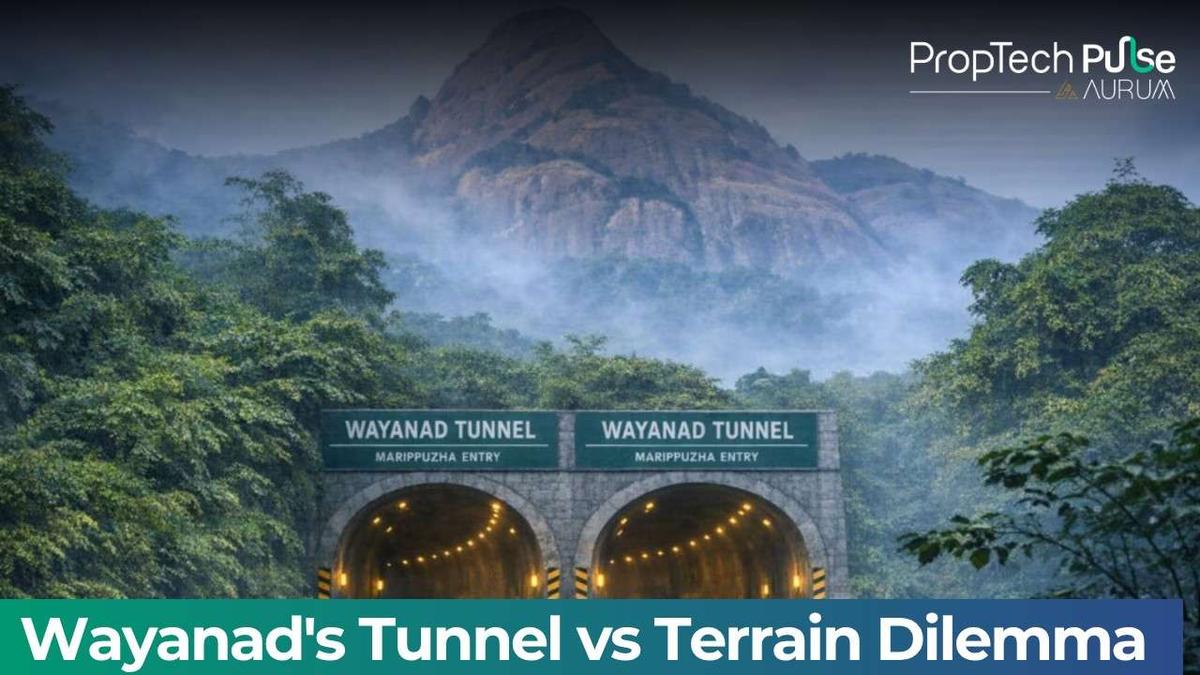
Infrastructure decisions in ecologically fragile terrain rarely come without controversy, and the ₹2,043.74 crore tunnel road connecting Wayanad's Kalladi with Kozhikode's Anakkampoyil is no exception. The project received environmental clearance from Kerala's State-Level Expert Appraisal Committee on 2 March 2025, covering an 8.753 km tunnel through some of the state's most sensitive and landslide-prone terrain. A fresh landslide in the region has since reignited the debate about whether the clearance was the right call, and what obligations it places on those building and regulating the project.
What the Wayanad tunnel project involves
The tunnel is a Public Works Department project designed to improve connectivity between Wayanad and Kozhikode, two districts separated by terrain that makes road travel slow and dangerous, particularly during the monsoon. The proposed alignment passes through the Kalladi-Anakkampoyil corridor, a stretch of Western Ghats terrain characterised by steep slopes, high rainfall and a documented history of landslides. The SEAC granted environmental clearance based on an environmental cost-benefit ratio of 23.7, reflecting a judgement that the project's connectivity benefits outweigh its ecological costs, provided mitigation conditions are met.
📌 Wayanad Tunnel Project at a Glance
- Project Cost: ₹2,043.74 crore
- Tunnel Length: 8.753 km
- Route: Kalladi (Wayanad) to Anakkampoyil (Kozhikode)
- Environmental Clearance: 2 March 2025
- Environmental Cost-Benefit Ratio: 23.7
- Sensitive Zone: Nilgiri Biosphere Reserve within 10 km
- Key Risks: Landslides, biodiversity impacts, groundwater seepage, tribal communities
- Engineering Measures: TBM/NATM tunnelling, controlled blasting, groundwater monitoring, vibration control and slope stability assessments
- The Big Question: Can better connectivity be achieved without compromising one of Kerala's most ecologically fragile landscapes?
The ecological concerns the clearance committee itself raised
Even while granting the clearance, the SEAC flagged serious concerns that went on record. The tunnel alignment passes through terrain where major landslides occurred in 2019 at Puthumala and in 2024 at Mundakkai-Chooralmala, both of which caused significant casualties. The project area overlaps with rich biological diversity: part of the Nilgiri Biosphere Reserve falls within 10 km of the alignment, and the region is home to endangered species including the Banasura Chilappan and Nilgiri Sholakili birds. Four tribal colonies are located within the project's influence zone, raising questions about displacement, livelihood disruption and access to forest resources. The committee's decision to proceed despite these acknowledged risks reflects a balancing act that critics argue was resolved too quickly in favour of connectivity over conservation.
What the PWD committed to in response
The Public Works Department addressed the committee's concerns through a detailed technical report covering seismicity, drainage characteristics, groundwater seepage risks, landslip potential above the tunnel alignment, ground vibration from blasting, overburden characteristics and tunnel stability. On construction methodology, the PWD assured that careful drilling and controlled blasting would be used and proposed either the New Austrian Tunnelling Method or a Tunnel Boring Machine as the primary excavation approach. Both methods are designed to minimise surface disruption, reduce vibration propagation and manage the risk of unexpected water ingress during tunnelling, all of which are elevated concerns given the geological profile of the Wayanad terrain.
Why the debate has intensified now
The latest landslide in the region has put the committee's decision under fresh scrutiny. Critics argue that granting clearance for a major tunnelling project through terrain that has experienced two significant landslides in five years, while acknowledging those risks in the clearance document itself, represents an inadequate standard of precaution for infrastructure in ecologically sensitive areas. Supporters of the project counter that improved connectivity is itself a safety measure, since the existing road network leaves Wayanad isolated during emergencies and monsoon disruptions. The tension between those two positions is not new, but the human cost of the latest landslide has sharpened it considerably and is likely to generate renewed pressure on both the state government and the environmental clearance process.
The infrastructure planning question it raises
The Wayanad tunnel case is a specific instance of a broader challenge facing infrastructure development in the Western Ghats: how to balance genuine connectivity needs against ecological fragility in a region where climate-driven rainfall intensity is increasing. An environmental cost-benefit ratio of 23.7 is a number that reflects a methodology, and methodologies can be contested. What the tunnel debate is ultimately about is who bears the risk when infrastructure is built in high-hazard terrain, and whether the conditions attached to environmental clearances are robust enough to make the project genuinely safer rather than simply clearing a regulatory hurdle.
Enjoyed this update? Visit PropTech Pulse for more real estate news and market insights.


