New Launch - India Real Estate Report 2026.

Services
Knowledge Hub
Resources
Tools

Ask Pulse Ai
©PropTech Pulse 2025, All rights reserved.


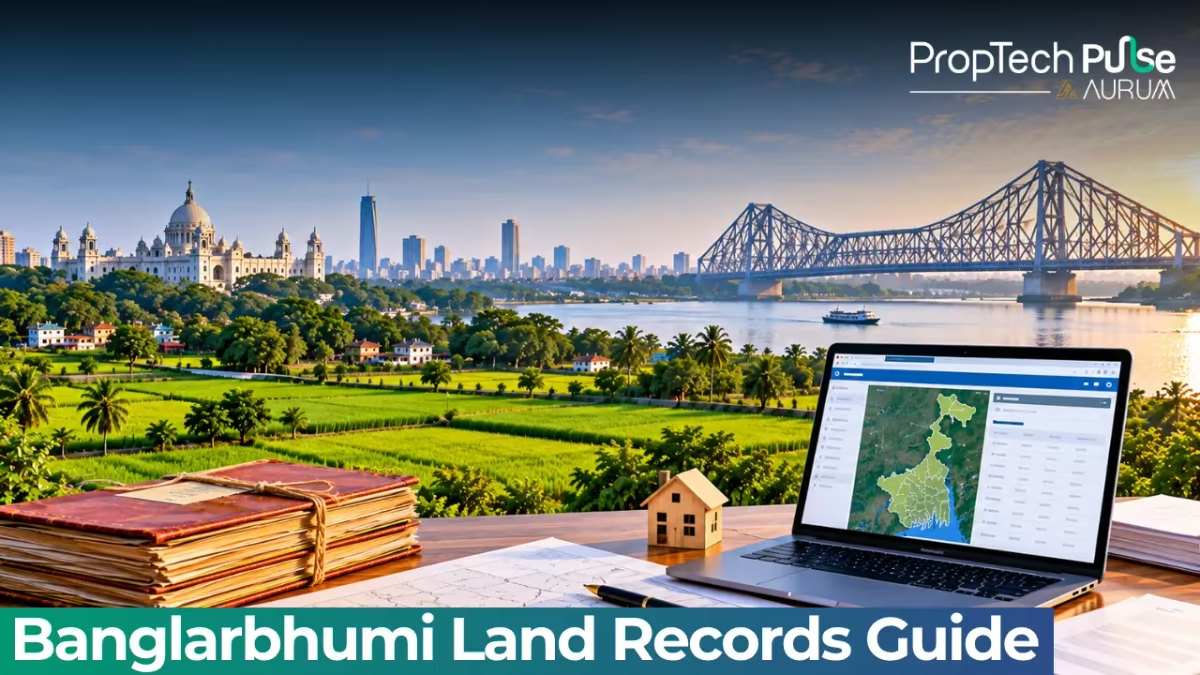
If you are buying land or a farm plot in West Bengal, or trying to fix ownership details in your family name, you start at banglarbhumi.gov.in.
The portal is the central hub where the state maintains every record from village boundaries to individual plot numbers. Knowing how to read what is shown there saves you from visiting the BL&LRO office repeatedly, and it stops you from missing red flags in a seller's title.
This platform covers over 4.3 crore Khatians across 42,000 Mouzas. It handles everything from simple status checks to formal requests for certified copies.
But the interface uses terms like RS Khatian, LR Khatian, Dag, and Warish that trip up most first-time users. Get the terminology wrong and you might order the wrong certificate or assume a plot is free of encumbrances when it is not.
What is Banglarbhumi and Why Does It Matter?
Quick answer
Banglarbhumi is the official digitised land records portal for West Bengal. Launched in 2010 by the Local Self Government, Land and Land Reforms Department, it holds 4.3 crore Khatians.
You can use it to check property details, apply for mutation (Dakhil-Kharij), track inheritance transfers (Warish), and request certified copies of Record of Rights (RoR) and Mouza maps. For pure land revenue payments and document tracking, visit banglarbhumi gov in.
Before Banglarbhumi, verifying a piece of land meant standing in queues at the Block Land and Land Reforms Office (BL&LRO) with folders of paper documents.
The portal moved almost all transactional and verification work online. Buyers, sellers, and legal teams now rely on it to establish who owns what before money changes hands.
The database operates independently. It feeds into the e-Porcha application, which generates the official sale deed once the transaction is approved at the Sub-Registrar's office.
Both systems talk to each other, but they remain separate stages of the process. Checking your data on Banglarbhumi first ensures that when you head to IGRWB for registration, the names on your deed actually match the government's master record.
Understanding West Bengal Land Records Terminology
Indian land records vary wildly by state, and West Bengal brings its own vocabulary. The portal sorts data using four core identifiers. If you do not know what they mean, you cannot verify a title properly.
Decoding the Banglarbhumi Khatian (RS vs LR and Bargadar Rights)
The Khatian is the single most important document you will pull up. It works like a title summary for a specific parcel of land. There are two types, and they sit side by side in the system:
- RS Khatian (Record of Rights): This is your ownership certificate. It lists the current owner, their ancestors back four generations, the share held by each person, and any sharecroppers registered on the plot. Every registered buyer must have an updated RS Khatian.
- LR Khatian (Land Revenue): This tracks who is responsible for paying the land tax, known as khajna. In most residential cases, the owner and the taxpayer are the same person. On agricultural land, however, a tenant might hold the LR Khatian while the landlord holds the RS Khatian.
Look closely at the 'Bargadar' column in the RS Khatian. A Bargadar is a recognised sharecropper. Active names in this column create usage rights that complicate sales.
You cannot sell a plot with active Bargadar entries without clearing those rights through proper channels first.
Never assume empty columns mean the property is clean. Cross-reference it with local inquiries.
This is why keeping your mutation entry up to date matters so much. If a death occurs and the Khatian is not updated, the chain of ownership breaks on paper. Why is mutation entry in land records important for homeowners explains exactly where the break happens and how it stalls future sales or loans.
Mouza, JL Number, and Dag Explained
Village boundaries in West Bengal are mapped using three layers:
- Mouza (or Moujasar): A group of villages that share water sources or market areas. Think of it as a historic catchment zone rather than a strict administrative block.
- JL Number (Jama List Number): Every Mouza has one or more JL Numbers. Each JL Number covers a cluster of plots within that Mouza. It groups the land for billing purposes.
- Dag Number: The Dag is the actual plot. One JL Number contains multiple Dag Numbers. When searching Banglarbhumi mouza records, you drill down from Mouza to JL, then to the specific Dag.
If you are looking at a survey map for a plot in North 24 Parganas or Bankura, the coordinates on the ground must match the Dag number on the screen.
Mismatches happen frequently in rural transactions where old boundaries shift with river erosion or new fencing. Always verify the Dag number against the physical site survey.
How to Access and Search Land Records on Banglarbhumi Gov In
You do not need an account to look up basic details. The public search function is open to everyone. However, applying for certificates, checking payment statuses, or filing grievance complaints requires you to register first. Registration takes two minutes and asks for a mobile number for OTP verification.
Using the 'Know Your Property' Tool (Step-by-Step)
The primary navigation button for buyers is labelled 'Know Your Property'. Here is how you use it without getting lost in the menus:
- Select State: It usually defaults to West Bengal. Click 'Next' immediately.
- Select District: Choose from the list. The dropdown includes metropolitan districts like Kolkata and South 24 Parganas alongside rural ones like Darjeeling and Jalpaiguri.
- Select Block and Village: Narrow down until you hit the exact BL&LRO circle relevant to the land.
- Select Type of Document: Choose either 'Document' or 'Map' depending on what you need. Selecting 'Document' pulls up the Khatian details.
- Select Plot Number: Enter the Dag number here. If you only know the JL number, the system may prompt you to select a broader range, though direct Dag searches are faster.
Once you click 'Get Details', the screen populates with the RS Khatian summary, the current owner's name, and the land area.
The data shows clearly whether the plot falls under non-agricultural (NA) status or remains agricultural. Note what is displayed on-screen carefully. This preview gives you the headline figures fast, but it is not a legally binding document. Banks will still require the official printed copy.
Pro tip The 'Know Your Property' tool updates daily, but legacy corrections in older years sometimes lag by a few weeks. If a name looks slightly off, do not panic immediately. Request the full year-wise record to see the correction trail.
Applying Online: Mutation, Warish, and Land Conversion
Ownership changes trigger three distinct applications on the portal. You can track their progress without calling your local clerk.
Mutation (Dakhil-Kharij): This moves the record from the old owner to the new one after a sale. Once the sale deed is registered, the seller applies for Kharij (removal of name) and the buyer applies for Dakhil (addition of name).
These are processed by the BL&LRO. You upload the verified sale deed, the previous Khatian, and identity proof. The officer marks the application as accepted or returned within a set timeframe.
Warish (Inheritance Transfer): When an owner passes away without a sale, the legal heirs use Warish to transfer the record.
You must attach the succession certificate or probate order issued by the civil court. Without that court order, the portal will reject a Warish application automatically.
Land Conversion (Agri to Non-Agri): If you are buying farmland to build a house, the land must switch from agricultural to non-agricultural status first.
You submit the conversion application directly through the portal. The approval comes from the Deputy Commissioner's office based on town planning regulations. Once converted, the classification on the Khatian updates permanently.
Getting Official Documents: Downloading Maps and RoR Certificates
The portal allows you to request official hardcopies delivered by post, plus digital PDF versions that carry a government electronic signature. The digital version holds the same weight as the stamped paper for most banking and legal purposes.
| Service Requested | Approximate Fee |
|---|---|
| Request RoR Certificate / Khatian Copy | ~ ₹20 |
| Request Mouza Map Extract | ~ ₹150 per sheet |
| Mutation Application Service Fee | ₹50 – ₹200 |
| Typical total for a single plot investigation | Under ₹200 |
After paying the fee online, you receive a token number. The physical office prepares the document, stamps it, and posts it to your registered address. Processing usually takes between five and fourteen working days depending on the district volume.
Always cross-check the downloaded RoR with the encumbrance status. While Banglarbhumi tracks ownership, a separate check clears any outstanding bank mortgages or court stays on the property. What is EC in land records details exactly where the Encumbrance Certificate fits into this verification pipeline.
Navigating Recent Changes: Simplified Khajna Payments and Portal Updates
One of the biggest friction points for landowners has been paying the annual land revenue tax, known locally as khajna. Previously, the payment flow forced users through mandatory email OTP verifications that often failed due to server delays or slow mail delivery.
The recent update stripped out that rigid email gate. Payments now process directly via net banking, UPI, or debit cards with standard SMS OTPs, cutting down failed transactions significantly.
The portal also introduced a live grievance tracking grid at the bottom of the dashboard.
Instead of waiting months for a manual response from the collectorate, applicants can now watch their complaint status move from 'Received' to 'Action Taken' in real time. This transparency has reduced duplicate calls to the BL&LRO offices.
When Banglarbhumi Isn't Enough: Deeds, Stamp Duty, and IGRWB
A common mistake buyers make is expecting to register a sale deed or pay stamp duty on Banglarbhumi. It does not handle execution of contracts.
Banglarbhumi manages the revenue ledger and the mutation record. The actual sale deed, along with the payment of stamp duty and registration charges, belongs to the Directorate of Registration and Stamp Revenue (IGRWB).
The two portals connect at the backend. Once IGRWB registers your deed, the data syncs back to Banglarbhumi automatically to trigger the mutation queue.
Until that sync happens, your name will not appear on the official record even if you hold signed papers.
Refer to our detailed guide on West Bengal stamp duty and registration charges 2025 for current rates at the sub-registrar office.
Metro cess and women buyer concessions shift the final bill significantly.
Final Precautions Before Buying Land in West Bengal
While the digital tools put immense power in the buyer's hands, they cannot replace physical due diligence. Digital records can show you who the government thinks owns the land. They cannot always show you who is physically occupying it, especially in contested boundary cases.
Follow this sequence before handing over any token amount: verify the Dag number matches the site survey, check the Bargadar column for hidden claims, pull the full Year 4 history from the Khatian, confirm the NA status if building, and pay stamp duty only at IGRWB.
Do not treat a printed Khatian as the end of your search. It is the starting line.
Decision Rule: Should You Rely Solely on the Portal?
If you are a homebuyer or a farmer settling an inheritance, the portal covers 90% of your needs. Pull the RS Khatian, pay your khajna, and apply for mutation.
You only need a lawyer or a physical site visit when the Bargadar column is populated, the Dag boundaries look disputed on the map, or the seller demands upfront cash before the official mutation reaches the system.
Frequently asked questions
Frequently asked questions
How to check West Bengal land record on Banglarbhumi?
Visit banglarbhumi.gov.in and click 'Know Your Property'. Select your district, then your block and village. Enter the specific plot number (Dag Number) and choose 'Document' from the dropdown menu. Click 'Get Details' to view the current owner's name, land area, and Khatian type instantly.
Difference between RS Khatian and LR Khatian?
The RS Khatian is the official Record of Rights listing the legal owner, ancestral history, and any recognised sharecroppers (Bargadars). The LR Khatian tracks liability for land revenue (khajna). Usually, the owner and taxpayer are identical, but on large farms, a tenant might hold the LR Khatian while the landlord keeps the RS Khatian.
Can I download my Khatian certificate online?
Yes. After creating an account, navigate to the 'Request RoR Certificate' section. Pay the nominal fee of approximately twenty rupees electronically. The government prints the certified copy, affixes the official seal, and mails it to your registered postal address within roughly ten working days.
How to pay land revenue (Khajna) online in West Bengal?
Log into your dashboard, find the Khajna payment module, and enter your Jamabandi or JL number. The portal shows your outstanding balance. Complete the transaction via net banking or UPI. New system changes cleared the path by dropping the clunky email OTP requirement in favour of instant SMS checks.
What are JL and Dag numbers?
They act as GPS coordinates for government records. A Mouza is a historical village cluster. Inside a Mouza, land is grouped by JL (Jama List) Numbers. Each JL number is subdivided into specific plot IDs called Dag Numbers. Sellers must provide the exact Dag number to prevent you from viewing the wrong parcel on the map.
Sources
- Banglarbhumi Official Portal: Website architecture, 'Know Your Property' tool steps, service listings (accessed October 2026)
Enjoyed this blog article? Visit PropTech Pulse for more interesting blogs.




Ask Pulse Ai anything about real estate

Unlock the Latest in Real Estate
News, Infographics, Blogs & More! Delivered to your inbox.

