New Launch - India Real Estate Report 2026.

Services
Knowledge Hub
Resources
Tools

Ask Pulse Ai
©PropTech Pulse 2025, All rights reserved.


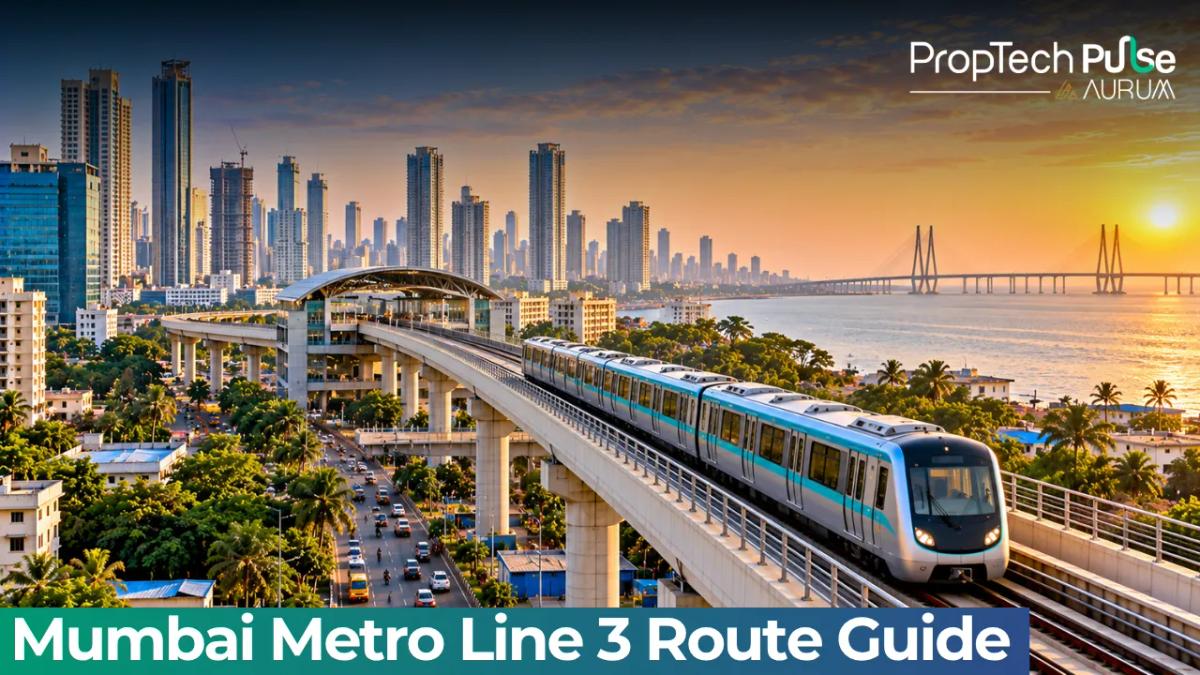
Commuting across Mumbai used to mean three hours of squeezing onto local trains or watching traffic bleed away on arterial roads. Now the underground metro system has changed the math entirely.
Mumbai Metro Line 3 is fully open and moving passengers between the airport, Bandra-Kurla Complex, Cuffe Parade and central hubs like Chhatrapati Shivaji Maharaj Terminus every single day.
If you are buying a flat near the corridor or tracking rental yields in areas previously starved of rapid transit, the valuation logic has shifted.
This guide maps every station and lays out the operational timeline. We break down peak-hour travel times against the suburban rail. You will also find how the new municipal restriction blocks construction work near the tunnel alignment.
Mumbai Metro Line 3 Status & Quick Facts
Quick answer
Mumbai Metro Line 3, commonly called the Aqua Line, is fully operational as of October 2025. The thirty-three kilometre underground network covers twenty-seven stations across two main corridors, linking the international airport to the financial districts and connecting with six other suburban and metro lines.
Maintenance crews work on the line round the clock. Commercial services run from six in the morning until eleven at night.
Ridership hit one lakh fifty thousand daily in the first quarter of 2026. That volume proves commuters trust a service that ignores surface traffic and monsoon floods. The total project cost stands at thirty seven thousand crore rupees following budget adjustments.
Funding comes jointly from the state government and the Japan International Cooperation Agency. Interest rates on the foreign loan sit close to zero per cent, keeping per-kilometre civil costs lower than comparable projects in Delhi or Bangalore.
The Complete Aqua Line Mumbai Route Map & Station List
Phase-wise Opening Timeline
The project split into two parallel works tracks early on. L3A runs east-west from Madhova Nagar to Cuffe Parade and the airport spur, while L3B extends north-south from Bandra Kurla Complex down to CSMT.
Phase 1 opened the central stretch in stages throughout 2023 and 2024, allowing partial trials.
The remaining sections, including the difficult marine clay tunnelling south of Opera House and the steep gradients entering Sion, finished ahead of schedule. Full opening happened on eight October 2025 with all platforms commissioned simultaneously.
All 27 Stations Explained
The entire alignment sits underground except for the maintenance depot at Madhwa Rao Park. Every station features platform screen doors, which improve climate control and prevent accidents on the deep platforms. Here is the breakdown of the key stops across both corridors.
| Sr. | Station Name | Marathi Name | Interchange / Key Link |
|---|---|---|---|
| 1 | Versova | वर्सोवा | Harbour Line (local) |
| 2 | Carter Road | कार्टर रोड | – |
| 3 | Bandra West | बांद्रा पश्चिम | Western Line |
| 4 | Mahim | माहीम | Harbour Line |
| 5 | Cuffe Parade | कफ परेड | South Mumbai residential hub |
| 6 | Nariman Point | नरीमान पॉइंट | Financial District |
| 7 | Opera House | ऑपरा हाउस | Kalbadevi market access |
| 8 | Kalbadevi | कालबादेवी | Old Textile Mills zone |
| 9 | Dhobi Talao | धोबी तलाव | Local Market / Street vendors |
| 10 | Grant Road | ग्रँट रोड | Harbour Line |
| 11 | Charni Road | चर्णी रोड | Harbour Line |
| 12 | Girgaon | गिरगांव | Panjrapole / Zoo proximity |
| 13 | Mazgaon | माजागाव | Shipsyard / Dock area |
| 14 | Wadi Bunder | वाडी बंदर | – |
| 15 | Prabhadevi | प्रभानदेवी | Metro Line 2 (Pink) |
| 16 | Dadar | दादर | Central & Harbour Lines |
| 17 | Parel | परळ | Pharmaceutical hub |
| 18 | Khetwadi | खेडवाडी | – |
| 19 | Lower Parel | लोअर परेल | Metro Line 4 (Yellow) |
| 20 | Dr. Baba Saheb Ambedkar Karve Marg | डॉ. बाबासाहेब आंबेडकर कार्के मार्ग | Industrial belt |
| 21 | Sion | सीवन | L3 Extension Spur |
| 22 | Madhwa Rao Park | माधवरॉ पार्क | Maintenance Depot |
| 23 | Bandra East | बांद्रा पूर्व | Western Line |
| 24 | Kurla Marol | कुर्ला मरोळ | IIT-Bombay gate proximity |
| 25 | Bandra Kurla Complex | बांद्रा कुर्ला समुच्चय | Corporate hub / Metro Line 2A |
| 26 | Deonar | दीवण | Trans-Harbour extension link |
| 27 | Chhatrapati Shivaji Maharaj International Airport | छत्रपती शिवाजी महाराज आंतरराष्ट्रीय विमानतळ | Airport terminal connector |
| Total length covered | 33.5 km (fully underground) | ||
Station names reflect the local Marathi spelling alongside the English version.
Exit points at Nariman Point and Opera House feed directly into office towers, while the southern exits near Cuffe Parade require a short walk through older residential lanes. Every platform provides step-free lift access and dedicated seating for elderly passengers.
Commuter tip Carry a physical token or load your smart card before the turnstile. While tap-and-go works widely now, peak queues at the few remaining manual machines drop by half if you bypass the queue entirely.
Connectivity: Airport, Suburban Rail & Other Metro Lines
The strongest advantage of the underground metro mumbai setup is depth.
By digging forty metres below sea level in places, engineers avoided flooding issues that trapped surface networks during heavy rains.
The alignment cuts straight under the congested middle ring road and skips the bottleneck at Mahim Bay crossing altogether.
Travel time from Versova to CST drops to twenty-eight minutes, compared to forty-five minutes on the Western Line local during evening rush hour. You still catch the local at CST, but you arrive fresh instead of exhausted.
Interchanges happen at Prabhadevi for the Pink Line heading towards Sion and Kurla, and at Lower Parel for the Yellow Line pushing east toward Mulund.
The new connection also touches the Trans-Harbour route at Deonar. Commuters from Thane or Panvel can now transfer once instead of juggling three crowded trains.
Airport passengers walking from Terminal 2 cover barely five hundred metres to reach the metro concourse. This removes the need for expensive app-based cabs for domestic arrivals.
If you work in IT parks off Eastern Freeway, the link at Lower Parel saves roughly twenty minutes over the usual road route.
Property values along these feeder corridors shift when people realise they can park closer to their workplace and ride the last mile underground.
Commuter Essentials: Fares, Timings & Payment Methods
Fare calculation follows a distance-based slabs model. Entry stands at ten rupees. Every additional five kilometres adds roughly fifteen rupees to the base ticket.
A round trip from Bandra West to CSMT costs seventy-two rupees total for daily workers. Monthly passes apply a twelve per cent discount over the equivalent daily tickets, making them cheaper for anyone commuting more than fourteen days a month.
Payment methods cover UPI scans at automated gates, contactless credit and debit cards issued by all major banks, and the Mumbai One smart card.
Cash counters remain open, but the machine read-time slows the queue considerably after nine in the morning. Children above three feet tall require half-fare tokens.
Peak frequency runs every three minutes on weekdays between seven and ten AM, and five PM to eight PM. Off-peak intervals stretch to eight minutes. Last trains leave terminal stations at ten forty-five PM, with special services added on weekends leading up to midnight during festival weeks.
Cost warning Never buy a monthly pass from third-party street sellers. Passports linked to biometric verification trigger immediate blacklisting. Use the official MMRC kiosks inside stations only.
Property Impact & The New 50-Metre Development Zone
Flat prices near the route rose by eight to twelve per cent in the second half of 2025 as traders front-ran the opening. But the headline appreciation hides a structural constraint that affects developers and existing owners alike.
The Maharashtra Metropolitan Region Development Authority and the Railway Safety Commission enforced a strict fifty-metre protection zone around the new underground tunnel axis. Any plot sitting inside that band faces heavy restrictions on rebuilding.
Developers cannot raise basements for additional parking, dig new foundations for podium structures, or demolish load-bearing walls of heritage homes without a separate geotechnical clearance.
Stability studies take four to six months to process. This pushes typical redevelopment timelines forward by eighteen to twenty-four months.
If you own a building in that shadow zone, factor the delay into your cash flow projections.
For buyers of older flats, ask the seller whether the society has already submitted the stability drawings. Stalled clearances freeze resale prices indefinitely.
Rental demand surges near intermediate stops like Wadi Bunder, Prabhadevi and Khetwadi. Young professionals here prefer smaller units over large family apartments. Vacancy rates dropped to three point four per cent along the eastern corridor last quarter.
Luxury inventory in South Mumbai trades slower. High-net-worth buyers still weigh the noise of ventilation shafts and emergency exit staircases against prestige pricing.
Before committing capital, review the current stamp duty rates in Mumbai to offset transaction costs. Also understand the difference between carpet area versus built-up area so you do not overpay for useless common space inflated by developers.
Track actual asking prices against transactions using the live rates and trends tool. Filter outcomes by micro-market using the Cuffe Parade locality guide. Compare gross rental returns with the rental yield calculator before choosing between holding for income or flipping within three years.
What Buyers Should Do Next
Target ready-to-move units or projects in the fourth phase of construction near stations two through ten. Skip off-plan launches within the fifty-metre safety strip until the builder produces signed stability clearance paperwork.
Pay attention to ceiling heights at older conversions, as drilling through reinforced concrete for ductwork sometimes reduces net height by fifteen centimetres.
Verify the exact exit location relative to your building entrance. The tunnel curves sharply under Marine Drive, so some exits spill into side alleys rather than facing the main promenade.
Frequently asked questions
Is Mumbai Metro Line 3 fully open?
Yes. The complete thirty-three kilometre alignment operating under the peninsula reached full commissioning on eight October 2025. Both L3A and L3B corridors run continuously from Versova through Bandra, Cuffe Parade, Dadar and Lower Parel to CSMT and the airport junction. Trains operate between six in the morning and eleven at night across all twenty-seven stations, with platform screen doors active at every stop.
How many stations are on the Aqua Line?
There are twenty-seven stations in total. Most sit nearly forty metres below ground, with only the maintenance depot at Madhwa Rao Park appearing at surface level. The count includes critical transfers at Dadar, Prabhadevi and Lower Parel, plus the direct terminal link inside the international airport complex. Counting both western and eastern branches, the route spans roughly thirty-three kilometres of underground track.
What is the maximum fare for the Mumbai underground metro?
Tickets start at ten rupees for entry. The distance meter adds approximately fifteen rupees for every five kilometres travelled. A standard round trip between Bandra West and CSMT currently costs seventy-two rupees per day. Monthly travel passes cut the equivalent daily ticket price by twelve per cent, making them cheaper for commuters who board the train more than fourteen days each calendar month.
Does the metro connect directly to Chhatrapati Shivaji Maharaj International Airport?
It does. The eastern terminus terminates inside the airport precinct, placing the metro concourse five hundred metres from Terminal 2 departures. Domestic travellers leaving from the terminal can walk straight to the ticketing level without crossing busy highway intersections or queuing for app-based taxis. Freight and cargo handling remains entirely outside the rail network.
Will prices rise further for flats near Cuffe Parade?
Upside potential remains capped because of the fifty-metre tunnel protection rule. Developers cannot rapidly clear sites or dig deeper basements without separate stability approvals, which stretches rebuild timelines by nearly two years. Investors chasing quick flips may face longer hold periods, while end-users benefit from steady rental demand and reliable weekday frequency. Prices will stay stable until surrounding older buildings secure redevelopment permissions.
Sources
- Government of Maharashtra Gazette Notifications: Tunnel protection zone advisory and redevelopment restrictions (accessed October 2026)
Enjoyed this blog article? Visit PropTech Pulse for more interesting blogs.



Ask Pulse Ai anything about real estate

Unlock the Latest in Real Estate
News, Infographics, Blogs & More! Delivered to your inbox.

