New Launch - India Real Estate Report 2026.

Services
Knowledge Hub
Resources
Tools

Ask Pulse Ai
©PropTech Pulse 2025, All rights reserved.


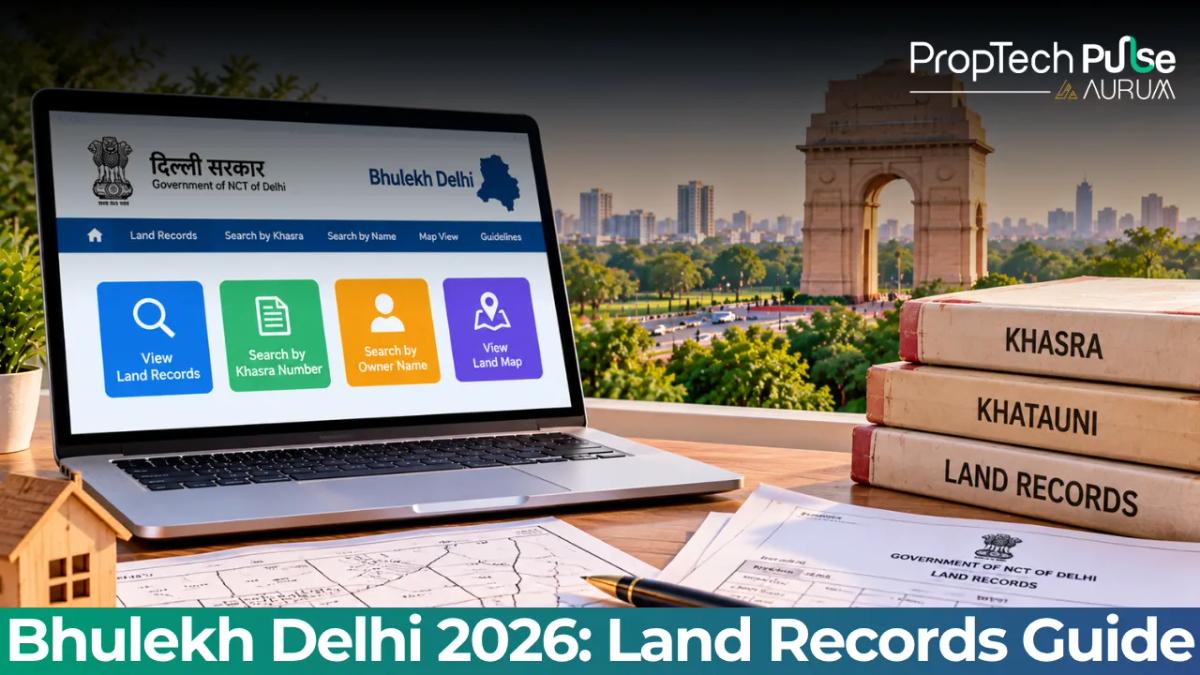
Buying a plot in North or West Delhi often starts with a single question: who actually owns the land right now? The easiest way to find out is by checking the Bhulekh Delhi portal, also known as the Delhi Land Resources Centre.
It pulls together ownership history, boundary coordinates, and tenancy rights into one searchable database.
Pulling up the district name, subdivision, and village code takes two minutes. Always do this before sending a token amount or signing an agreement for sale to avoid fraud.
We cover the exact steps to access the DLRC Delhi interface. You will learn why newly purchased plots sometimes disappear from the map temporarily. The guide also covers the offline steps certified copies and mutation that turn a web screen into legally recognised ownership.
What is Bhulekh Delhi and What Are Delhi Land Records?
Delhi land records are the government’s official ledger of who owns what piece of earth in the National Capital Territory.
The system operates under two different Acts depending on where the plot sits. In revenue villages, the Delhi Land Revenue Act governs the entries. In urbanised areas planned by municipal corporations, the Punjab Land Revenue Act controls the records.
Both feed into the same public dashboard so you don’t have to hunt through two separate systems.
Quick answer
Bhulekh Delhi is the government portal that holds all recorded ownership data, boundaries, and tenancy rights for plots in the National Capital Territory. You can check ownership history, identify encumbrances, and get basic plot dimensions here before making any payment or filing a mutation request.
| Land Regime | Governing Act | Where data appears |
|---|---|---|
| Revenue villages | Delhi Land Revenue Act | Main DLRC portal |
| Urbanised / Municipal wards | Punjab Land Revenue Act | Main DLRC portal |
| Lal Dora colonies | Mixed local statutes | Main DLRC portal |
| Planned or unauthorised settlements | Varies by developer scheme | Often missing; requires physical settlement register |
Plot owners in fourth-category settlements face different hurdles. An unauthorised colony or a private developmental scheme might show blank cells or refuse to load on the Bhulekh screen.
That happens because the land hasn’t been mapped to the government survey grid yet, or it remains trapped in old settlement paperwork. Seeing nothing on the website doesn’t prove a dispute exists, but it does mean you cannot rely on the portal for due diligence.
Understanding what a khasra number in land records means matters just as much as hitting the buttons. These identifiers show up on your screen instantly.
How to Access Delhi Khasra Khatauni on the DLRC Delhi Portal
Go to the DLRC Delhi homepage. Desktop users should click ‘View Land Records’ at the top of the dashboard.
Mobile visitors can tap the identical link or use the parallel search portal hosted on the main government domain for easier touch interactions.
Search results follow a strict hierarchy. Start by selecting your District. Buying near Palam or Vasant Kunj? Pick South West Delhi. Looking at Wazirpur or Seelampur? Select North Delhi.
Once the district loads, choose the Subdivision. This acts as the primary sorting hat for the local tehsil office. Next, pick the Village or Town name. Even urban wards carry a village designation in the backend mapping software.
Select the record type, usually Khatauni for ownership ledgers, and hit Search.
The display shows the current holder’s name, plot size, and crop classification. Drill deeper using the Khasra number the seller provides, or search by the owner’s name instead. Match the spelling exactly against their ID. One extra syllable drops the result.
Understanding Your Results: Khasra vs. Khatauni vs. Jamabandi
Keep these three definitions front and centre when the portal throws up a page full of Hindi and English terminology. They describe different slices of the same dataset.
Khasra is the individual plot identifier. Think of it like a vehicle registration number applied to a piece of ground. It tracks the physical boundaries and current cultivation or construction status of a single parcel.
If you are verifying dimensions against a builder’s brochure, the Khasra record is your anchor point.
Khatauni is the owner’s summary ledger. A single Khatauni groups every Khasra held by one person or family.
When you buy half a village plot from a joint heir, only part of the Khatauni changes hands. You need to verify that the seller’s signature matches the co-owners listed on the same Khatauni sheet. Without matching signatures, the registry will reject the file later.
Jamabandi is the official revision of the land record produced every few years after field verification. It captures permanent changes like partition, inheritance, or court-ordered swaps.
Most online searches pull the latest Jamabandi snapshot automatically. If the portal shows an older entry, request the department run the last revision locally.
Why Your Plot Might Not Show Up on Bhulekh Delhi
Beyond basic menu errors, four common realities push land off the public dashboard. None of these mean the property is illegal, but all of them demand a manual workaround.
First, recent sub-division cuts. When a large agricultural holding gets carved into smaller residential sizes, the new tiny plots don’t get assigned a fresh Khasra number until the next Jamabandi revision cycle.
Sellers still advertise them using old master plots. Ask the seller for a reference to the upcoming revision or a physical layout plan stamped by the local tehsildar.
Second, ongoing litigation freezes. A court injunction or an objection letter sitting with the Patwari will lock the entire Khatauni. The portal displays the restriction notes but prevents public edits or transfers until the freeze lifts.
Third, transfer to corporate housing boards. Plots allocated through Delhi government schemes for police, teachers, or defence personnel sometimes shift to separate corporate databases.
The main Bhulekh index loses the live thread until ownership passes back to individual hands through auction or resale clearance.
Fourth, pending mutation applications. A previous buyer might have signed the sale deed six months ago but never submitted Form 6 to update the registry. The portal still shows the seller’s name under a ‘pending transfer’ flag in those cases.
The record exists, but the active control belongs to the applicant waiting for approval.
Can You Use the Online Bhulekh Delhi Record for Registration or Loans?
Printed screenshots and web dashboards hold zero legal weight in a bank branch or the sub-registrar’s office. The portal explicitly states that its data serves reference purposes only.
Lenders demand physical certified copies bearing the district collector’s digital seal and the executing officer’s wet ink signature.
Banks cross-check the certified copy against the original hard files stored at the Tehsil archive before releasing any funds. Similarly, registration counters will not accept the printed web page for updating the sale deed’s schedule of properties.
Visit the local Tehsil office with your appointment slip and pay the nominal fee for a certified extract. Turnaround usually runs three working days. Peak summer months stretch it to a week.
Verification required Never hand over more than a 10% token deposit until you hold the physical certified copy of the seller’s current land record, alongside a fresh encumbrance certificate covering the last thirty years.
How to Apply for a Certified Copy of the Land Record
Head to the Tehsil office attached to the district you selected on the portal. Carry a valid photo ID, a photocopy of the seller’s ID, and an application form requesting a certified extract for the specific Khasra and Khatauni numbers.
Fill the form legibly since clerks rarely decode shorthand. Pay the prescribed fee at the cash counter and treat the receipt as your tracking token.
Submit the receipt along with the filled form to the usher at the record window. Queue checks happen quickly.
The clerk verifies your position, enters the Khasra into the archival computer, prints the sheet, and stamps it with the vertical authority seal. Collect the paper immediately.
If the line stretches beyond twenty people, ask whether the district offers e-copies generated directly at the window kiosks to skip the manual desk entirely.
What Happens Next: Processing Mutation (Intkal) After Buying Land
Once the sale deed hits the registry, the clock starts ticking on changing the government ledger. You cannot simply assume the property shifts into your name because the builder handed over keys or a neighbor updated a gate sign.
The formal update is called Intkal, or mutation. Failing to process it leaves the original holder liable for unpaid taxes or illegal construction penalties in your name.
You can complete the process via the e-Dharti portal hosted by the Directorate of Economics and Statistics. Log in with your mobile number and email. Upload the scanned sale deed, original IDs, and your certified land record. Select your ward and block from the drop-downs, submit the application, and wait for the automated dispatch.
Your application then moves through three distinct checkpoints online. First, it lands in the Patwari’s virtual inbox for field verification.
The Patwari visits the site, measures the fence lines, confirms no boundary disputes exist, and forwards approval digitally. Second, the inspection reaches the Kanungo for independent cross-checking. Third, the Tehsildar signs the final mutation order electronically.
Check progress daily using the ‘Status Enquiry’ tab on the login page. You receive SMS alerts at every stage.
Physical follow-ups become necessary only if the app hangs at ‘Patwari Verification’ past three weeks. That signals a backlog rather than a rejection.
File the approved mutation order with your builder or society management immediately. Maintenance dues and utility connections must reflect your name correctly.
Confirm whether your intended plot falls within the designated zones covered by RERA in Delhi, especially if the developer claims compliance. Calculate your total acquisition cost against current stamp duty and registration charges in Delhi. Ensure the budget accounts for all levies before the transaction closes.
Before You Pay the Token Amount
Treat the Bhulekh screen as a starting checklist, not a final verdict. Verify the seller’s identity matches the registered name perfectly on the Khatauni sheet.
Confirm whether the plot falls under a standard revenue regime or a special development zone that requires separate approvals. Check the current status for pending mutations or litigation flags.
Pull the physical certified copy before money touches the seller’s account. Cross-reference these details on Bhulekh Delhi one final time before booking the property.
Then log onto the mutation portal and lodge Form 6 while the ink is still fresh on the sale deed. Doing both keeps your investment legally untethered from anyone else’s name.
Frequently asked questions
What is Bhulekh Delhi?
Bhulekh Delhi is the centralised online land record platform operated by the Delhi Revenue Department. It stores verified ownership details, plot dimensions, and tenancy rights for properties across the National Capital Territory. Users access it through the DLRC portal to research historical data, identify existing co-owners, and confirm boundary maps before committing capital to a purchase.
How do I download a certified copy of my land record in Delhi?
Head to your local Tehsil office carrying a valid photo ID, the seller’s ID photocopy, and a completed application form requesting a certified extract. Pay the mandatory fee at the cash counter, submit the receipt at the record window, and collect the stamped document once the clerk processes your Khasra number. Expect a three-day turnaround, though peak seasons may extend this slightly.
What is the difference between a Khasra and a Khatauni?
A Khasra represents an individual plot’s unique identification number linked to specific physical boundaries and current land usage. A Khatauni acts as a financial ledger grouping every Khasra owned by one person or family unit. When purchasing a partial share of land, you must verify the buyer’s signature aligns with all co-signatories currently listed on that shared Khatauni sheet.
Is the online land record enough for property registration in Delhi?
Absolutely not. Printed screenshots and web dashboards hold zero legal standing at banks or the sub-registrar’s office. Financial institutions demand physical certified copies bearing the district collector’s digital seal and the executing officer’s signature. Similarly, registry counters require the official extract to accurately populate the schedule of properties inside your sale deed.
How long does it take to mutate land records after buying a plot?
The digital mutation workflow moves through three phases: initial Patwari field verification, independent Kanungo cross-checking, and final Tehsildar approval. Tracking via e-Dharti shows the status advancing every few days. Delays typically surface only when the file stalls at the Patwari stage past three weeks due to seasonal backlogs, requiring polite physical follow-ups to nudge the file forward.
Enjoyed this blog article? Visit PropTech Pulse for more interesting blogs.




Ask Pulse Ai anything about real estate

Unlock the Latest in Real Estate
News, Infographics, Blogs & More! Delivered to your inbox.

