New Launch - India Real Estate Report 2026.

Services
Knowledge Hub
Resources
Tools

Ask Pulse Ai
©PropTech Pulse 2025, All rights reserved.


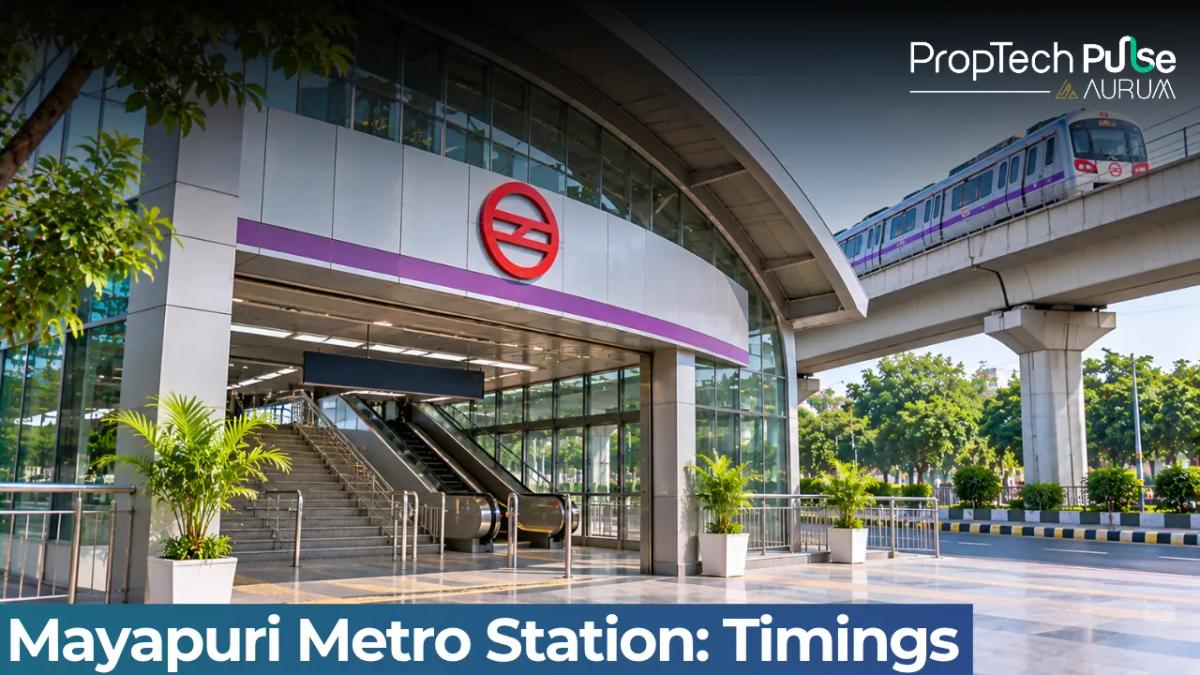
Standing outside Mayapuri metro station with a bag full of samples or paperwork, you need one quick piece of information: which gate leads where? Gate 1 covers the government press. The alternative drop-off handles the timber yard and the DTC interchange.
Mayapuri Metro Route & Pink Line Connectivity
Quick answer
Mayapuri metro station (code MYPI) sits on the Pink Line between Naraina Vihar and Kirti Nagar. Gate 2 serves the bus depot, timber and marble markets. Gate 1 heads toward government presses and quieter residential lanes. Trains run from 06:11 to 23:22 IST daily.
Mayapuri carries the station code MYPI and forms part of the raised stretch of the Delhi Metro Pink Line.
The corridor opened in March 2018 under Phase III. Positioned at the mid-point of the eastern spur, it slots between Naraina Vihar and Kirti Nagar stations.
For anyone tracing a mayapuri metro route map, the station acts as a commercial hinge point rather than a purely residential node. Traders, government employees, and factory workers all feed into its morning rush.
The Pink Line runs a dual-service pattern across most of its span. From Mayapuri, you can board a train bound for the full ring connection towards Shaheed Sthal via the central segment.
Alternatively, you can stay on a local semi-circle service. The critical distinction comes when heading north-east toward Shyam Park or Shiv Vihar.
Those trains actually originate from earlier branches. You usually have to change direction at Maujpur-Babarpur.
This routing model explains why checking mayapuri nearest metro options matters during rush hour. Catch a late morning train if your destination lies on the eastern arc. It avoids the worst transfer crowding at Maujpur-Babarpur.
Gates, Exits & Walking Distances to Key Markets
Unlike underground stations where the street level is just glass doors above pavement, Mayapuri is a raised concrete structure. Both exits drop you down staircases directly onto distinct ground-floor zones.
Mixing up Gate 1 and Gate 2 wastes roughly fifteen minutes. The street layout wraps around the industrial zone rather than forming a continuous mall-style plaza.
| Gate | Key Landmarks & Direction | Walk Time |
|---|---|---|
| Gate 1 | Priyadarshni Park, Braham Kumari Ashram, Govt of India Press Main Gate, North-Western approach toward Kirti Nagar | 2–4 min |
| Gate 2 | DTC Mayapuri Bus Depot, Marble Market (Kachi Bhitti), Timber Market, Industrial Area side streets | 1–3 min |
| Practical Tip | Gate 2 covers the heavy commercial footfall. Gate 1 handles government offices and quieter residential pockets. | Plan accordingly |
Stepping out of Gate 2 places you within sight of the marble suppliers shipping stone across North India.
The timber yards feeding construction firms throughout Delhi and Haryana are also right there.
If you live in nearby flats and check how does proximity to a metro station affect apartment pricing, you will notice West Delhi commercial hubs command tighter rental yields.
Walkability to a station like this feeds both day traders and salaried staff.
Switching to Gate 1 opens toward administrative plots and calm residential lanes.
Pavement widens quickly here, giving clearer signage pointing toward Kirti Nagar.
Travelers arriving from Nangloi metro station guide or Uttram Nagar often prefer this exit.
They head toward the western arc while avoiding the heavier goods traffic near the bus depot.
Train Timings & Frequency at Mayapuri Metro
The Pink Line does not run a single constant clock across all hours.
Peak commutes see tight spacing, while evening and Sunday services spread out noticeably.
First train windows depend on your chosen direction.
| Direction | First Train Departure | Last Train Departure |
|---|---|---|
| Towards Shaheed Sthal (New Bus Adda) | 06:11 IST | 23:22 IST |
| Towards Majlis Park | 06:30 IST | 00:16 IST (next day) |
| Avg. Weekend Interval | 8 minutes | |
Weekday mornings bring tight spacing on the heavily utilized segments. Rakes arrive roughly every five to six minutes, compressing further when school and office shifts overlap near Connaught Place and Rajouri Garden interchanges. Miss a train during a peak window and you rarely wait longer than seven minutes.
Sundays and public holidays stretch gaps to eight minutes.
Night services slow down noticeably past 22:00 IST as the system prepares for maintenance cycles.
Trains do not operate after midnight on regular schedules.
Engineering work often triggers partial shutdowns on weekends.
Since Mayapuri sits next to active factories and transport depots, major repairs to overhead feeder lines or track switches here ripple across the eastern branch.
Check the DMRC portal for advance closure notices. Planning special deliveries around these weekend repairs requires a quick browser check beforehand.
Current Fares, Smart Card Discounts & Journey Planner Tips
Fare calculation follows the Delhi Metro slab system based on distance traveled.
The minimum charge starts at ₹11 for short hops under three kilometers.
Long-distance journeys hitting the maximum threshold cost ₹64 on normal weekdays.
Holiday fares sometimes dip slightly, reflecting reduced operational loads.
Vending machines automatically accept notes and coins.
Carrying a rechargeable smart card saves both time and money.
Reloaded cards grant a small percentage discount on every ride compared to counter tickets.
The savings add up noticeably over quarterly commutes.
Tourists and occasional visitors still buy paper tokens.
Regular users stick to plastic cards for faster lane passage through the turnstiles.
| Card Type | Min Load Amount | Discount Rate |
|---|---|---|
| Regular Adult Smart Card | ₹100 | Roughly 1% to 5% off base fare |
| Student Card (Valid ID Required) | ₹100 | Significant slab reduction on eligible routes |
| Trip Estimate | Use the DMRC journey planner to preview exact charges before boarding | |
Travel frequently to business districts?
Pair your metro pass with a weekly auto-rickshaw subscription for the final mile.
It cuts overall transport costs considerably.
Many West Delhi landlords bundle transport convenience into rental negotiations.
Tenants value direct line access.
In the broader context of West Delhi transit, navigating the mayapuri metro station layout saves considerable commuting time for residents who weigh property choices against connectivity.
Parking, DTC Bus Connect & Station Facilities
The station design intentionally merges three modes of surface transit.
Directly beneath the Gate 2 staircase lies the DTC Mayapuri Depot interchange, where buses from across the western arc converge.
Commuters enjoy smooth transfers without crossing busy intersections, while pedestrian ramps shield walkers from heavy truck movement in the timber zone.
Two-wheeler and car parking sit clustered near the Gate 2 vicinity.
The combined capacity holds approximately 143 vehicles across the designated lots.
Space runs tight between 08:30 and 17:30 IST.
Factory supervisors, government clerks, and stone merchants compete for the same racks.
Parking Note: Overflow spaces spill onto adjacent service roads during peak months. Keep registration documents handy; traffic wardens patrol regularly near the bus bay entrance.
The station includes functional escalators linking the concourse to the raised platform.
Elevators serve passengers with limited mobility.
Security checks remain standard.
Dedicated lanes help smart card holders breeze through the turnstiles.
Water dispensers and basic waiting chairs populate the concourse level.
Summer heat radiates off the concrete floor.
Early morning rides beat midday waits.
Before You Plan Your Trip
Decide your destination first, then pick the gate.
Gate 1 suits government offices and quiet residential crossings toward Kirti Nagar.
Gate 2 drops you straight into the commercial artery serving the bus depot, marble yards, and timber warehouses.
Use the online journey planner to lock in exact fare and transfer points.
For anyone weighing a West Delhi address against transit perks, factoring in ground-level access explains why proximity discounts hold firm here more reliably than in newer suburban corridors.
Commuters relying on mayapuri metro station daily appreciate how clearly the gates separate commercial traffic from residential flows.
Frequently asked questions
What time does the Mayapuri metro station open and close?
The first train departing toward Shaheed Sthal leaves at 06:11 IST, while the initial rake bound for Majlis Park heads out at 06:30 IST. Last passenger trains run until roughly 23:22 IST and 00:16 IST depending on direction. Night operations cease well before midnight to allow routine track inspections and overhead wire maintenance crews to finish their work safely.
Which gate of Mayapuri metro leads to the DTC depot?
Gate 2 connects directly to the DTC Mayapuri Bus Depot. Stepping out of that exit places you on the ground floor alongside the bus bay, marble market entrances, and the main freight access lanes. If you need to catch a cross-city bus to West Patel Nagar or Dwarka, plan to exit here rather than crossing the industrial junction from the opposite side.
How much is the fare from Mayapuri to Rajiv Chowk?
A single journey covering that central stretch costs between ₹30 and ₹42 depending on exact boarding and alighting points, falling well within the standard middle-distance slab. Loading a rechargeable smart card trims the printed ticket price slightly, and reloading in bulk removes the need to queue at the counter during morning rush periods.
Is there parking at Mayapuri metro station?
Yes. Combined car and two-wheeler spots total around 143 spaces concentrated near the Gate 2 vicinity. The lot fills fastest between 08:30 and 17:30 IST because nearby factories and government offices draw heavy commuter traffic. Outside those windows, overflow space appears along permitted service roads, but keep vehicle papers accessible for routine traffic patrols.
Do trains run after midnight at Mayapuri?
No regular passenger service operates past 00:16 IST. After the final outgoing rake clears the platform, the control room locks the section for overnight switch checks, signal testing, and ballast cleaning. If you miss the last connection, alternative auto-rickshaw networks and late-night DTC buses continue operating through the commercial belt until morning hours.
Sources
- Delhi Metro Rail Corporation official site: Station overview and platform configuration (accessed November 2026)
- DMRC Journey Planner: Fare slabs, timing matrices and route branching data (accessed November 2026)
- DMRC News & Notices: Latest schedule updates and engineering maintenance bulletins (accessed November 2026)
Enjoyed this blog article? Visit PropTech Pulse for more interesting blogs.




Ask Pulse Ai anything about real estate

Unlock the Latest in Real Estate
News, Infographics, Blogs & More! Delivered to your inbox.

