New Launch - India Real Estate Report 2026.

Services
Knowledge Hub
Resources
Tools

Ask Pulse Ai
©PropTech Pulse 2025, All rights reserved.


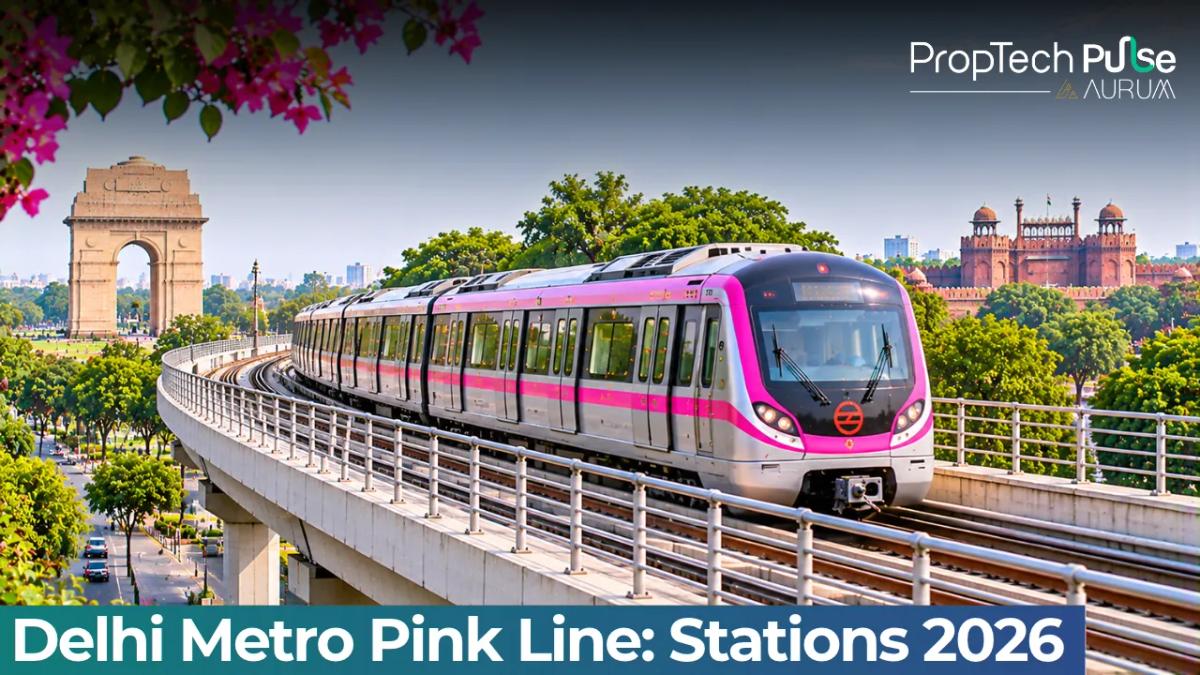
The Delhi Metro Pink Line connects the western suburbs of Majlis Park in Rohini to the eastern periphery of Maujpur-Johri Enclave in Seelampur. As of November 2026, the corridor is fully operational across all four phases, spanning roughly 73 kilometres and serving 46 stations.
It forms a critical ring route through the capital, linking major commercial hubs like Rajouri Garden and Karkardooma with high-density residential areas such as Lajpat Nagar, Botanical Garden, and Vasundhara.
Delhi Metro Pink Line Route Overview
Quick answer
The corridor spans roughly 73 km across forty-six stations. It connects Majlis Park in north-west Delhi to Maujpur-Johri Enclave in the east, linking key hubs like Kashmere Gate, Rajouri Garden, and Karkardooma. Phase 4 extensions opened in March 2026, completing the ring-route loop and integrating previously disconnected eastern and northern pockets into the daily metro network.
Phase one started as a simple north-to-south connector in 2018, when the first stretch between Vishwavidyalaya and Majlis Park entered service. Subsequent phases pushed the line south to Lajpat Nagar and further southeast to Botanical Garden, Noida.
The most recent addition in early 2026 extended the route back towards the northeast, closing the loop from Trilokpuri through Jahangirpuri and finally to Maujpur-Johri Enclave.
Actual operational distance now sits closer to 73 km rather than the initial 59 km figure quoted during phase three handovers.
That extra length comes entirely from the eastern and northeastern branches added last year.
The line operates under the same green and white livery as other DMRC corridors, with six to eight coach rakes running at intervals dictated by peak-hour demand.
If you are planning a commute or evaluating a property along this track, understanding how the eastern branch changes the daily travel math matters more than knowing every single stop.
The new stretches cut travel times to Vasundhara and Shahdara significantly compared to older road-only routes.
Full Pink Line Metro Stations List
The complete pink line metro route covers four main directional segments. Reading them in order makes it easier to visualize the path, especially if you only need to map two points along the way.
North-West Segment
Starting at Majlis Park, which sits deep inside the Rohini residential grid, the line cuts straight through densely populated neighbourhoods before touching the city centre:
- Majlis Park
- Rohini Sector 7
- Paschim Vihar
- Ashok Vihar
- Vishwavidyalaya
- Keshav Puram
- Kashmere Gate (interchange: Red, Yellow, Airport)
- Chandni Chowk
- Jama Masjid
- Kashi Vi Nath
- Sadar Bazar
- Darya Ganj
- Cantonment
- Rajouri Garden (interchange: Blue)
Rajouri Garden marks a natural midpoint for many daily travellers because it sits right next to the popular mall and serves as a gateway to west Delhi's newer developments.
Commuters heading further south usually transfer to the Blue Line here instead of riding all the way to Central Secretariat.
South & Central Corridor
After leaving Rajouri Garden, the line moves towards the southern suburbs, threading past some of Delhi's oldest residential blocks and major IT offices:
- Rani Jhansi
- Anand Vihar
- Karkardooma (interchange: Violet)
- Kanhaiya Nagar
- Nit Faridabad
- Laxmi Nagar (interchange: Yellow)
- Shakurbasti
- Hauz Quthib
- Green Park
- Hauz Khas
- Maulana Azad
- JLN Stadium
- Mahatma Gandhi Marg
- Kalkaji Mandir
- Lajpat Nagar (interchange: Violet)
- Jangpura
Karkardooma handles massive afternoon rush volumes because it sits directly above the bus terminal and industrial area. If you work near Shakti Nagar or the Defence Colony side, transferring at Karkardooma or Laxmi Nagar saves considerable time compared to crossing the city by road.
Southeast Extension
Heading southeast, the track pushes out into the satellite towns of south-east Delhi and west Noida:
- Kalkaji Najafgarh
- Sector 21
- Friendermohan Das
- Guru Govind Singh Marg
- Dhanarpur Nangal
- Basant Lok
- Botanical Garden
Botanical Garden acts as a crucial bridge for Noida commuters who don't want to route through the Yellow Line's heavy traffic bottleneck at Rajouri Garden or Kalyanpuri.
Many office-goers in sectors 15 to 23 switch to the Pink Line specifically to avoid these chokepoints.
East & Branch Loop
Closing the circuit towards the east, the route picks up passengers from Vasundhara, Shalimar Puri, and the northern periphery before finishing at Seelampur:
- Vaishali (interchange: Aqua Line)
- Pratap Nagar
- Vikaspuri
- Trilokpuri Sanjay Lake
- Shahbad Daulatpur
- Rudarpur Kalan
- Mayur Vihar
- Vivek Vihar
- Seelampur
- Palam Vihar
- Sushant Lok Phase 1
- Sushant Lok Phase 2
- Uttam Nagar West
- Uttam Nagar East
- Palam
- Tughlakabad
- Dilshad Garden
- Nehru Nagar
- Maujpur-Bobghapur
- Inderlok
- Jahangirpuri
- Model Town
- Keshav Puram
- Shastri Park
- Madanpur Khadar
- Maujpur-Johri Enclave
The eastern loop integrates thousands of households that previously relied on outdated shared autos or long walkable distances to reach a metro.
The last few stations added in 2026 handle steep weekday footfall because they serve both industrial workforce clusters and dense residential wards.
| Zone | Number of Stations | Key Stops Included |
|---|---|---|
| Zone 1 (West & North West) | 14 | Majlis Park to Cantonment |
| Zone 2 (Central & South) | 16 | Rajouri Garden to Green Park |
| Zone 3 (South East & East) | 16 | Hauz Khas to Maujpur-Johri Enclave |
| Total | 46 | Including branches and interchanges |
This holds true across the entire pink line corridor, where properties sitting within a five hundred metre radius of active stations generally command a premium over parallel roads lacking direct access.
Buyers renting near the eastern extension typically report shorter commuting hours compared to legacy bus routes, which translates directly into willingness to pay slightly higher rents.
Pink Line Interchange Stations: Where You Can Switch Lines
Efficient transfers matter far more than speed on the Pink Line itself. Delhi Metro passengers rely on direct platform connections to cover distances that would otherwise require multiple bus rides. Here is how the major junctions function day-to-day:
- Kashmere Gate: The original hub. Connects directly to Red Line, Yellow Line, and the Airport Express. Expect severe crowd management drills between 8 AM and 10 AM; follow floor markers, not announcements.
- Rajouri Garden: Links cleanly to the Blue Line. The foot-over bridge connects directly to the mall concourse level, making it one of the few truly weather-proof interchange points in winter.
- Karkardooma: Interfaces with the Violet Line. Platform widths are narrower here, so standby carriages (usually carriage 2 or 5) offer faster boarding during weekday surges.
- Laxmi Nagar: Connects to the Yellow Line via a dedicated underground passage. Avoid switching during evening rush unless necessary; the Yellow Line headways widen slightly here.
- Lajpat Nagar: Meets the Violet Line again. Excellent road connectivity outside for auto aggregators, though the staircases are steep for elderly passengers.
- Vaishali: Transfers to the Aqua Line towards Ghaziabad. Highly structured crowd flow due to separate ticketing counters at each terminal end.
If you live near any of these nodes, checking exit signs before descending helps. Delhi Metro exits are numbered sequentially, and picking the closest number saves ten minutes of walking inside sprawling terminals.
Timings, Fares & Peak Hour Tips
Services run from 6:00 AM to roughly 11:40 PM on weekdays. The final departure sometimes pushes past midnight on weekends when city events extend travel windows. Frequency drops to eight-minute intervals between 10 PM and midnight.
Fare pricing follows a flat-rate system capped at ₹65 for long-distance riders covering all three zones, though precise amounts vary slightly based on the entry and exit gates chosen.
| Distance Bracket | Base Fare | Max Fare |
|---|---|---|
| Up to 2 km | ₹19 | ₹19 |
| 2 km to 8 km | ₹21 | ₹35 |
| 8 km to 14 km | ₹35 | ₹51 |
| Over 14 km | ₹51 | ₹65 |
Commuters relying on card swipes get automatic discounts ranging from 10% to 24% depending on monthly travel volume.
Physical smart cards remain the cheapest option, while OLA Money or NFC tap-and-go on phones charge base rates but offer maximum convenience during monsoon crowds.
The morning peak between 8:30 AM and 10:00 AM packs trains heavily between Kashmere Gate and Rajouri Garden.
Carriages beyond Green Park carry more breathing room. Evening peaks reverse this trend, flooding the line outbound from Lajpat Nagar and Botanical Garden.
Weekend reality check: The Pink Line carries massive family footfall on weekends heading towards Botanical Garden and the malls near Rajouri Garden. If you prefer empty carriages, aim for mid-morning slots between 11:30 AM and 2:30 PM on Saturdays.
How the Pink Line Changes Connectivity & Property Catchments
Transit corridors reshape housing values predictably. This rule applies firmly to the pink line corridor, where proximity to an operating platform consistently lifts asking rents.
Buyers renting near the eastern extension typically report shorter commuting hours compared to legacy bus routes, which translates directly into willingness to pay slightly higher rents.
which locations near metro stations have higher rental premiums provides a detailed breakdown of how distance to the nearest gate impacts monthly asking prices. In broader terms, a seven-minute walk to a functioning platform still counts as transit proximity.Developers recognise the shift immediately. Plots near stations get converted or expanded into mixed-use buildings quickly. what is a mixed use tod around metro stations explains how Transit Oriented Development zoning allows ground floors to host shops while upper levels hold apartments, creating self-contained neighbourhoods along the corridor.
Older residential pockets like Uttam Nagar see renewed buyer interest because the dual entry gates (West and East) solve historic accessibility gaps. New projects near these upgrades tend to sell faster because infrastructure improvements reduce friction in the home buying process.
uttam nagar metro station 2026 east vs west access fares covers practical navigation details for anyone touring flats in the sector. Similarly, vaishali metro station guide lines timings parking outlines the surrounding amenities that complement the transit access for families looking at Ghoramahal and Vasundhara boundaries.
For investors tracking long-term appreciation, the completed loop removes previous dead-end anxieties. A station once treated as peripheral now functions as a central node.
Rental yields stabilise around 3% to 4% annually in established clusters, while speculative land near newly minted platforms offers wider but riskier upside over a five-year horizon.
Before you commit to a commute or property near this line...
Verify exact platform configurations before signing leases or booking agreements. Map out your specific origin and destination points on the pink line route before committing.
Not all gates offer elevator access, and construction adjacent to stations sometimes shifts pedestrian paths temporarily. Cross-check proposed apartment listings against actual station maps rather than marketing brochures, which frequently exaggerate walking distances.
For residents prioritising predictable daily travel, choosing a building within three blocks of an interchange station reduces dependency on road transport entirely.
Frequently asked questions
Does the Pink Line run to Anand Vihar?
Yes. The station appears centrally along the southern segment, positioned directly above the ISBT complex and railway terminal. Commuters transferring from interstate buses reach the metro concourse level almost instantly, avoiding street-level crossings completely. Peak-hour crowd control measures activate here routinely because bus and rail arrivals sync with metro start times.
What is the latest fare cap on the Pink Line?
The maximum cost for a single trip spanning the entire corridor remains capped at ₹65 under the standard three-zone pricing model. Daily commuters benefit from discounted smart card rates that lower costs significantly over a month. Mobile wallet passes and physical tokens charge base fares without loyalty reductions. Always verify gate-specific rates using the official app before entering.
Which interchange allows access to the Airport Express Line?
Kashmere Gate provides the direct connection. Riders transferring to the purple-coded airport corridor enter through the designated passage linked to the Red Line platform. Walking time stays under three minutes during normal operations. The route remains highly visible, making it reliable for early morning departures heading to Terminal 3 without navigating road traffic.
Is the eastern branch currently open for passenger travel?
It opened fully in early 2026 after completing the loop back towards Seelampur and Mazdoorabad zones. All platforms along the eastern extension feature functional escalators, automated gates, and air conditioning units matching mainline standards. Train frequencies operate smoothly across these stops throughout the day, handling steady weekday growth efficiently.
How crowded do trains get during Monday morning rush hour?
Expect tight capacity between Kashmere Gate and Rajouri Garden from 8:30 AM to 10:00 AM as corporate workers board together. Carriages beyond Green Park clear noticeably after 11:00 AM due to fewer scheduled stops. Standing space remains safe overall, but keeping bags low helps maintain movement speed. Avoid middle carriages if carrying umbrellas or large parcels.
Sources
- Delhi Metro Rail Corporation (DMRC): Official operating timelines, fare structure, and corridor length confirmation (accessed November 2026)
- Ministry of Railways, Government of India: General urban mass transit policy context (accessed November 2026)
Enjoyed this blog article? Visit PropTech Pulse for more interesting blogs.




Ask Pulse Ai anything about real estate

Unlock the Latest in Real Estate
News, Infographics, Blogs & More! Delivered to your inbox.

