New Launch - India Real Estate Report 2026.

Services
Knowledge Hub
Resources
Tools

Ask Pulse Ai
©PropTech Pulse 2025, All rights reserved.


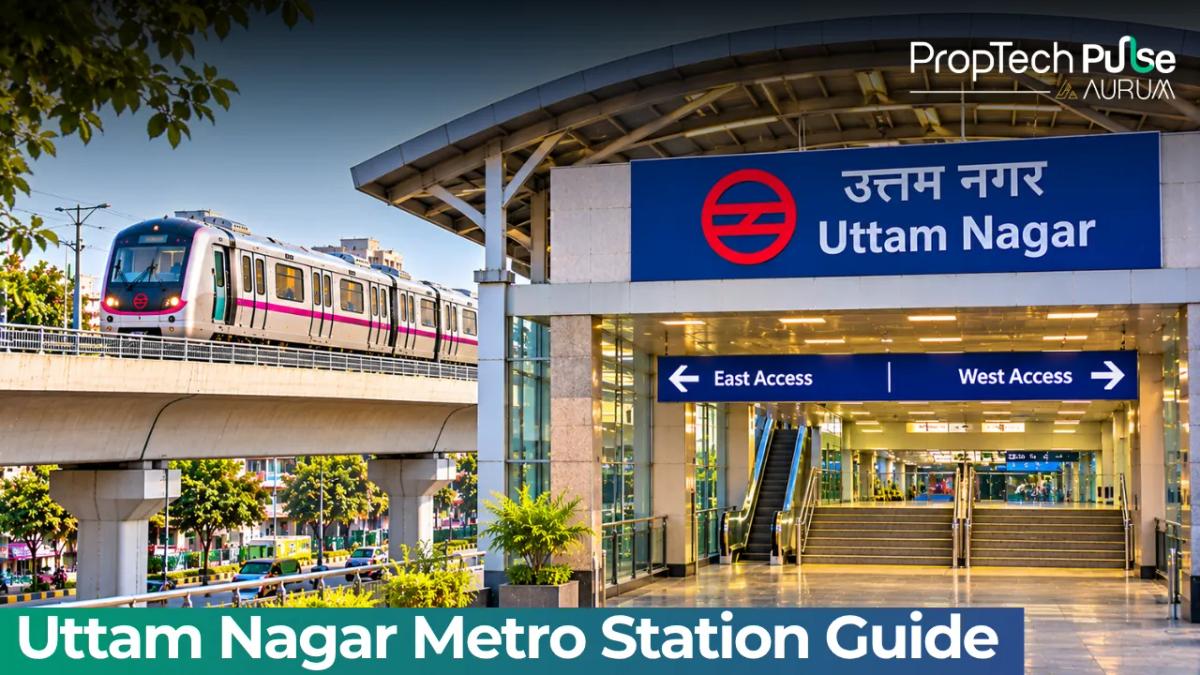
Daily commuting in western Delhi often hinges on one heavily trafficked intersection: Najafgarh Road. For investors evaluating the new delhi uttam nagar pin code, reliable transit access changes everything. The uttam nagar metro station acts as the corridor's primary lifeline. It funnels thousands of passengers onto the Blue Line network every single day.
Scouting a rental in Vikas Nagar or catching an evening bus requires knowing the exact split between transit nodes.
Both East and West stations operate independently yet share fare structures. This guide breaks down operational realities, current fare slabs, the upcoming ₹7.98 crore infrastructure upgrade, and property premiums tied to the uttam nagar delhi transit hub.
Uttam Nagar Metro Station: East vs West Overview
Quick answer
The uttam nagar metro station operates as two distinct physical nodes on the same Blue Line corridor. Uttam Nagar East (UNE) handles three gates facing Pankha Road. Uttam Nagar West (UNW) manages four gates spilling onto Dal Mill Road. First trains depart between 5:06 AM and 5:08 AM. Both stations share identical fare structures and feeder connections.
Understanding the split between the East and West stations matters more than most guides acknowledge. They do not sit on opposite sides of a single street. Instead, they anchor different intersections serving entirely different micro-markets.
Uttam Nagar East (UNE) sits closer to the active market strip along Pankha Road. It sits directly above the busy junction feeding into Najafgarh Road.
Three numbered exit gates manage passenger flow. Gate 1 opens toward the residential blocks of Vikas Nagar Phase I. Gate 2 drops you straight onto the pedestrian plaza leading to the major bus terminal. Gate 3 faces quieter side streets near Dal Mill.
East carries heavier footfall during morning rush hour. Expect a crowded concourse level by 8:30 AM on weekdays. Trains arriving from Janakpuri Park load quickly before heading east.
Uttam Nagar West (UNW), visible in any directory listing for delhi uttam nagar west uttam nagar delhi, anchors the northern edge of the market belt. Four gates spread out wider than the East node. Gates 1 and 2 serve wholesale electronics markets and heavy retail stretches along Dyalsar Road. Gate 3 opens toward Main Market colonies, while Gate 4 provides access to newer infill developments near Pankha Road.
Commercial activity keeps demand consistent throughout the day. Morning office crowds disperse easily when retail shoppers take over. West remains steady until evening closing hours.
Your choice depends on your next commute destination. If your workplace sits south of the railway overbridge, East is the logical drop-off point.
Pushing north toward the University of Delhi or broader Najafgarh? Use West to beat signal jams. Platforms run underground at both locations. Stairs and escalators link concourse to track level.
Escalator outages happen monthly without warning. Add five minutes to your schedule if managing luggage or wheelchairs during breakdowns. Always locate the nearest guard rail before stepping off the platform.
Train Timings, Frequency and Blue Line Journeys
The Blue Line runs end-to-end from Dwarka Sector 21 to Noida Electronic City.
It passes through some of Delhi's busiest transfer hubs. Knowing your window is essential because platform crowding spikes hard between 8:15 AM and 9:45 AM. Evening congestion follows between 6:00 PM and 8:00 PM.
Trains leaving East and West converge into the same block section. Inter-train headways dictate whether you wait four minutes or twenty.
Monday through Friday peaks shrink the gap to 2 minutes 46 seconds. Non-peak weekday hours stretch to 3 minutes 30 seconds. Weekends push this slightly wider.
Rush Hour Platform Strategy
Metro staff deploy barriers at ticket gates when capacity hits ninety per cent. This slows entry to prevent track-level overcrowding.
Stand behind the yellow tactile paving strips. Do not crowd the platform edge. Trains arrive packed during peak windows.
Squeeze into middle coaches rather than front or rear cars. Middle sections balance weight distribution and exit easier at crowded stops like Rajiv Chowk.
Saturday mornings see 3 minutes 15 seconds gaps. Sunday evenings relax to 4 minutes 15 seconds.
The operator adjusts dynamically based on live passenger counters. Occasional bunching remains normal during festival seasons or sudden rain showers. Keep your token handy to scan at exit turnstiles promptly.
Here is a straightforward breakdown of the actual travel duration you should expect from boarding at either East or West:
| Destination | Approximate Duration |
|---|---|
| Rajiv Chowk (Central Delhi transfer) | 25 minutes |
| Connaught Place (CP) | 28 minutes |
| I.G.I. Airport (IGS) via Dwarka Mor transfer | 35 minutes |
| Noida Electronic City | 55 minutes |
| Vaishali | 48 minutes |
| Dwarka Sector 21 | 22 minutes |
Commuters routinely underestimate the transfer friction at Dwarka Mor or Janakpuri West. If you are heading to the airport, plan an additional twelve minutes for the Red Line switch.
Walk across the concourse briskly. Those added minutes matter more when chasing 8:30 AM flights. Carry a printed ticket backup inside your wallet whenever digital scanners fail.
Fares, Parking Capacities and Passenger Amenities
The fare structure follows a flat distance-based grid. There is no surcharge for sitting in specific coaches or paying extra for peak seating.
Your token price depends entirely on how many zones you traverse between entry and exit. UPI payments work at automated vending machines. Cash counters remain open for manual issuance.
| Destination | Adult Single Journey (₹) | Commute Pass Monthly Equivalent (₹) |
|---|---|---|
| Dwarka Sector 21 | 40 | 1,500 |
| Janakpuri West / Rajiv Chowk | 30 | 1,100 |
| Vaishali / Karkarduma | 55 | 2,200 |
| Noida Electronic City | 60 | 2,400 |
Parking arrangements tell a sharper story. Uttam Nagar East dominates the two-wheeler storage game with nearly 1,000 dedicated bike slots alongside 120 car spaces.
Factory workers and tuition coaches park there and hop on the metro. Uttam Nagar West offers a quieter but fully functional setup with roughly 385 motorcycle bays and 37 car spots.
Drive a four-wheeler to the West station? Arrive before 8:45 AM on workdays.
Otherwise, you will circle the perimeter looking for a slot. Mark your vehicle location clearly. Concrete pillars carry painted numbers near each bay row. Phone signal drops inside covered parking areas. Use offline maps to navigate back out.
The bus terminal connecting to East Gate 2 operates on a tight schedule. Key feeder routes include the 283A link to Kalkaji Mandir.
The 278 and 68 services head toward Rohini. The rapid bus 294N runs straight to Dwarka. Buses arrive in clusters. You might wait eight minutes for the platform to clear, followed by a rapid boarding window of four minutes.
Auto-rickshaws lining the external curb generally charge fixed tariffs to Janakpuri and Tilak Nagar.
Divyang Access Priority Elevators at both stations remain operational during standard working hours. They frequently go offline for maintenance every third Tuesday. Dial the customer care desk immediately if an elevator breaks while you are mid-descent. Staff carry manual ramp kits and can reroute passengers to the nearest accessible staircase guard rail.
ATMs line both concourse floors. Queues swell rapidly between 7:30 AM and 8:15 AM. Mobile recharge kiosks and basic convenience stores operate smoothly.
Water dispensers and drinking cup stations sit near the ticket barriers. Lockers exist but fill up early. Treat them as optional conveniences rather than reliable necessities.
New PWD Skywalk Project: Decongesting Najafgarh Road
The intersection outside Uttam Nagar East represents one of North-West Delhi's worst bottlenecks.
Pedestrians fighting to reach the bus terminal face unpredictable gaps in traffic signals. Loud horn pollution and dangerous jaywalking shortcuts define daily crossings.
The Public Works Department approved a ₹7.98 crore elevated pedestrian pathway to fix the chaos permanently.
The structure spans from Metro Pillar Number 638 directly to the Pankha Road side. It bridges the width of Najafgarh Road cleanly above vehicular lanes. Steel girders are already positioned for casting.
Completion sits at the six-month mark from active groundwork commencement. Stairs will house on both ends once finished. Ramp access supports wheelchairs and prams.
Roof shading protects commuters against Delhi summers and monsoons. Daily passengers will step out of East Station Gate 2 and walk upstairs. Touching ground asphalt becomes unnecessary.
Bus terminal crowd density will drop noticeably. Boarding confusion cuts by half. Property owners renting shop fronts near the plaza gain stable footfall.
Shoppers stop abandoning visits purely due to crossing difficulty. Construction zones reduce available pavement width temporarily. Follow temporary signage carefully.
Until the concrete cures, plan your walks carefully. Stick to zebra crossings near the fuel pump cluster.
Never assume a slowing tempo means the light has changed. Traffic police presence fluctuates wildly here. Self-patience beats aggression every time.
Best Residential Localities Near Uttam Nagar Metro
Choosing a neighbourhood around these stations requires mapping actual walking distances. Do not rely on imaginary straight lines drawn on a marketing brochure.
Ground conditions, stray dogs, broken pavements, and heavy trucks turning tight corners change the real experience drastically.
Vikas Nagar Phase I & II sits a brisk 3 to 7-minute stroll from East Station Gate 1. The colonies are quiet and heavily lined with trees.
Independent floor builders prefer holding land rather than selling outright. Renting a ready-to-move apartment here keeps you under the shadow of the metro pillars. Stay safely away from main-road diesel fumes. Grocery stores, mid-range pharmacies, and weekend haats cluster tightly along inner roads.
Main Market Uttam Nagar stretches roughly 5 to 8 minutes out from East Gate 3 or West Gate 3. This pocket delivers maximum convenience. Banks, cloth showrooms, dental clinics, and tuition centres operate on every alternate corner.
Noise levels rise steadily once you move two hundred metres inward from the station exit. Insist on top-floor units with double-glazed windows. Home callers and night-shift workers benefit from reduced street noise.
Mohan Garden marks the outer boundary. It requires an 8 to 12-minute walk from West Station.
The area feels more established. Wider boundaries replace illegal constructions blocking sidewalks. Landlords prefer longer tenancies here.
Renewal stress drops compared to volatile Main Market rentals. Prices track steadily upward as buyers chase gated societies versus standalone houses.
Negotiating Rents for Independent Floors
Renting an independent floor in Main Market typically costs ₹18,000 to ₹22,000 monthly for a clean two-bedroom setup. Builders in Mohan Garden ask ₹25,000 or more.
Higher premiums justify themselves through covered parking and backup water tanks. Sellers of ready-to-move units value their space highly.
Buyers wanting instant possession must negotiate firmly on square-foot pricing. Asking rates rarely match actual transaction values.
Offer fifteen per cent below list price initially. Bring proof of competing listings in the same colony to strengthen your position. Payment upfront often secures faster concessions.
Rental yields mirror this premium. A well-furnished 2BHK close to East Gate 1 leases out two weeks faster. An identical unit buried three streets deep takes longer to fill.
Extra ₹2,000 to ₹3,000 monthly retainers appear consistently. Young professionals working in Connaught Place or Dwarka corporate parks deliberately budget that extra rent. Bus crush avoidance drives tenant demand.
Property Impact: Price Premiums and Rental Demand
Metro proximity consistently inflates asset values across Delhi. The math gets specific around Uttam Nagar.
Independent analysts tracking transaction data show homes within 500 metres of either station command a 10 to 15 per cent price uplift.
Compare those figures to properties tucked behind Dal Mill Road or further down Ayudh Bahadur Singh Marg. You literally pay for saved minutes and guaranteed mobility.
Investors measuring cap rates should pull the latest rates and trends new delhi uttam nagar west snapshot.
Adjust baseline projections before finalising purchase agreements. Track quarterly rental uptake near station exits. High occupancy confirms strong transit dependency. Low vacancy periods signal rising neighbourhood confidence.
Proximity carries hidden risks too. Direct adjacency to Najafgarh Road introduces chronic decibel levels peaking past 75 dB during afternoon truck movements. Dust accumulation chokes balcony grills within sixty days.
Constant air purifiers become mandatory. Always audit wind direction and floor elevation. Properties facing away from the main highway stay cooler and drier. Resale value holds stronger when interior environments remain breathable.
Read up on the broader mechanics of transit-driven valuation by exploring our guide on how does proximity to a metro station affect apartment pricing.
Before You Pay the Token Amount
Make one mandatory test before handing over cash: walk the route yourself during actual rush hour. Book an Uber precisely at 8:15 AM from the station exit to the builder’s sample flat. Watch how traffic stacks up.
Listen to ambient noise bleed into the living room. Count the actual steps required to reach the nearest medical store or fresh vegetable vendor.
Brochures exaggerate proximity. Ground truth reveals habitability. Pick the node matching your dominant commute direction.
Secure a unit set back from the arterial road. Lock in a lease or sale deed only after verifying RERA registration numbers and encumbrance certificates. Everything else is speculation.
Frequently asked questions
Does the fare differ between Uttam Nagar East and West?
No. Both stations sit on the same Blue Line segment operated by Delhi Metro Rail Corporation, so the fare remains identical regardless of which node you board from. Your ticket price depends entirely on the distance between your boarding station and your destination. A single journey to Dwarka Sector 21 costs ₹40, while reaching Noida Electronic City sets you back roughly ₹60. Since the entrance booths are separate, always validate your ticket immediately after passing through the turnstile to avoid penalty fines.
Which gate at Uttam Nagar East Metro leads directly to the bus terminal?
Exit Gate 2 is the most practical choice for commuters heading straight to the Delhi Transport Development Corporation bus terminal. This gate opens onto the pedestrian plaza situated between Metro Pillar Number 638 and the main road. Once you step out, the bus stands sit a forty-metre walk away, partially shielded by existing canopy structures. If you are catching a feeder route toward Badarpur Border or Kashmere Gate, staying close to the right wall after exiting Gate 2 saves valuable time when scanning for your specific bus board among dozens of arrivals.
How much faster is the commute from Uttam Nagar to Rajiv Chowk compared to surface transport?
The metro cuts approximately twenty-five minutes off your journey during peak weekday hours. By train, the express run from East or West takes twenty-two to twenty-five minutes depending on rolling stock availability and scheduled dwell stops. During the worst congestion on Najafgarh Road, a surface bus or shared auto can easily drag on for fifty to sixty minutes when trucks force lane closures. Factor in the cost savings too; a monthly commute pass works out substantially cheaper per kilometre than daily paid cab rides or ride-hailing trips across the capital.
Is vehicle parking available at both Uttam Nagar metro stations?
Yes, but capacity varies sharply between the two nodes. Uttam Nagar East provides ample space with dedicated slots for 120 cars, 953 motorbikes, and 105 bicycles. Uttam Nagar West offers tighter provision, hosting roughly 37 car spots and 385 two-wheeler bays. The East node also features designated areas for Divyangjan passengers and a secured cycle zone. Arrive early on weekdays if you drive a four-wheeler, especially during monsoon months when the indoor motorcycle parking fills up quickly and spills onto the pavement.
When will the new overhead skywalk connecting Pankha Road finish construction?
The Public Works Department has allocated ₹7.98 crore to build the elevated pedestrian pathway stretching from Metro Pillar 638 to Pankha Road. Construction is actively underway to decongest the notoriously jammed intersection at Najafgarh Road. While exact handover dates shift with quarterly tender approvals and contractor milestone pacing, officials estimate full completion within six to eight months of active structural laying. Until then, pedestrians must cross the main arterial road via ground-level zebra crossings or temporary metal bridges managed jointly by the municipal corporation and traffic police.
Sources
- Delhi Metro Rail Corporation (DMRC): Official timetable, inter-train frequency schedules, and station facility directories (accessed October 2026)
- Government of Delhi, Public Works Department: Tender notice and allocation details for the ₹7.98 crore Uttam Nagar East pedestrian skywalk linking Pillar 638 to Pankha Road (accessed October 2026)
Enjoyed this blog article? Visit PropTech Pulse for more interesting blogs.



Ask Pulse Ai anything about real estate

Unlock the Latest in Real Estate
News, Infographics, Blogs & More! Delivered to your inbox.

