New Launch - India Real Estate Report 2026.

Services
Knowledge Hub
Resources
Tools

Ask Pulse Ai
©PropTech Pulse 2025, All rights reserved.


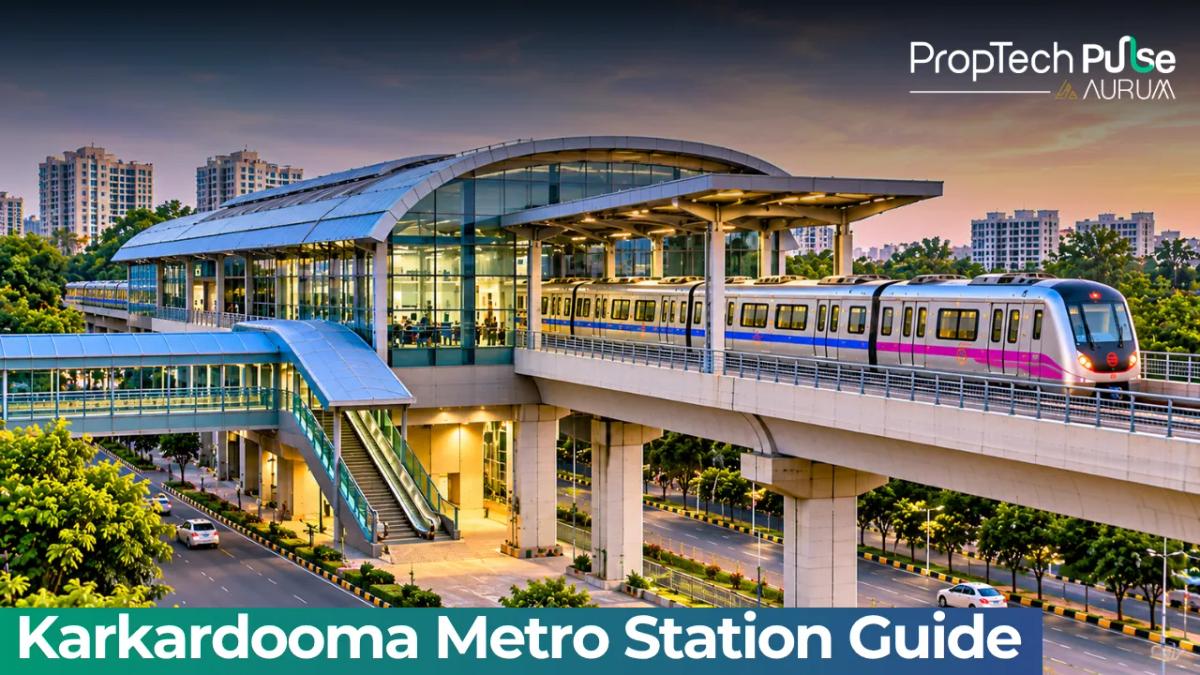
If you are stepping off the train at Karkardooma, the first question isn’t where to go. It is which exit cuts the walk short.
This station handles thousands of commuters daily. It sits at the intersection of two heavy corridors feeding traffic toward the courts, the bus terminal, and the IT clusters east of Delhi.
Below is a practical breakdown of every gate at the Karkardooma metro station. We also cover the lines stopping here, parking rules, and what a fifteen-minute walk actually costs in rent and resale value today.
Karkardooma metro station key details
Quick answer
Karkardooma metro station (code KKM) opened in September 2019 as an underground interchange on the Pink Line and Blue Branch Line. Four gates serve distinct destinations. Gate 1 faces Ring Road and the bus terminal. Gate 2 leads to Karkardooma Court and Surya Nagar. Gate 3 opens into Metro Walk near the government hospital. Gate 4 handles Pink Line transfers toward Shahdara. Regular DTC buses and auto stands cover ground transport, while covered parking operates on hourly tiers.
| Detail | Information |
|---|---|
| Station code | KKM |
| Serving lines | Pink Line (L7) and Blue Branch Line |
| Platform type | Underground interchange |
| Date opened | September 2019 |
| Location reference | Karkardooma Court, Shahdara, New Delhi |
The Karkardooma metro station handles mixed footfall from court staff, hospital visitors, and corridor commuters. Because it sits directly beneath a major judicial complex, security sweeps at entry gates tend to move faster than at standard suburban stops. Signage uses both Hindi and English, with colour-coded floor graphics matching the respective line routes.
Routes and connectivity on the Blue and Pink lines
Rail maps show the Blue Branch Line tracing a western corridor from Dwarka Sector 21 through central Delhi hubs, terminating at Vaishali. It extends toward Noida sectors beyond the city limit. The Pink Line arcs around the eastern and southern edges of Delhi, linking Majlis Park to Shiv Vihar.
Karkardooma acts as a pressure valve. Switching to the Blue Line here avoids the Rajiv Chowk chokepoint, saving fifteen to twenty minutes toward Dwarka. Pink Line users head toward Bhalswa, Janakpuri, and south-east Delhi without crossing the city grid.
This dual routing makes the station a natural transfer hub. During evening rush hours, the interchange concourse sees steady cross-platform movement.
Office commuters use it to avoid surface traffic on the Eastern Peripheral Expressway and Ring Road. Shifting passenger loads rarely exceeds five minutes. Lift bottlenecks can slow wheelchair users or travelers with heavy luggage during weekday peaks.
Station timings and train frequency
Service start times fall between 5:30 AM and 6:00 AM. Early arrivals at Karkardooma follow shortly after 6:15 AM. Evening services wrap up between 10:30 PM and 11:00 PM, barring late-night maintenance.
Weekday headways shorten to eight to ten minutes. Off-peak gaps widen to twelve to fourteen minutes. Watch the platform boards for late departures, since weekend extensions occasionally push the final trains back. Crowds pile up on Saturday afternoons when shoppers visit Metro Walk or locals catch buses.
Gate guide: which exit should you take
Karkardooma metro has four exits, each serving a different crowd. Gate 1 dumps you on Ring Road, steps from the District Courts and Bus Terminal. Gate 2 opens toward Surya Nagar, Ideal Home Sciences, and lanes feeding the judicial block.
Gate 3 drops you into Metro Walk and hits the government hospital entrance. Gate 4 mainly targets Pink Line travelers heading toward Shahdara or housing colonies on the eastern approach roads.
Gates 1 and 3 feature consistent elevators. Gates 2 and 4 depend on scheduled lifts that face short downtimes during servicing.
Commuter tip Plan your descent route based on your destination before reaching the stairs. Switching sides mid-platform adds three to four minutes during peak movement, and crowd density near Gate 1 tends to spike immediately after court dismissals around 3:30 PM.
Facilities and amenities inside the station
Covering fees operate on a graduated scale. Two-wheeler bays fill before 9:00 AM. Four-wheeler slots see moderate turnover until evening. The tariff jumps after the first hour, making this zone better for day-long parking than quick drop-offs.
Ticket vending machines near the Karkardooma metro station concourse cluster by the fare barriers. Waiting areas offer seating, drinking water, and clean restrooms.
Charging ports line the wall by the turnstiles. Wi-Fi covers the concourse but slows to a crawl once everyone connects.
Last-mile connectivity: buses and taxis
DTC bus fleets converge near the Ring Road junction. Several routes terminate at or pass through the Karkardooma Depot. Auto ranks line the northern curb, while prepaid taxi counters sit at Gate 1 in the afternoons.
Cycle tracks remain uneven on the approach roads, making midday walks uncomfortable beyond fifty metres. Authorities have not yet deployed a dedicated feeder loop for inner colony streets.
Ground transport relies on informal autos and minibuses, cutting travel time to distant habitations but lowering reliability during rains. Taxis queue longer after 6:00 PM, when court adjournments and hospital discharges clash.
Nearby residential areas and property context
Residential demand rests on two drivers. Court personnel require predictable commutes. Tech staff target nearby Shahdara and Patparganj jobs.
Apartments within a seven-minute walk command higher valuations.
They are mostly older builder floors with compact layouts. Properties claiming proximity sit further back along Phool Singh Market road. Rental yields stabilize in the single digits, while growth depends on future transit upgrades.
Measuring actual foot distance matters more than aerial radius here. Ring Road noise spikes instantly once you step behind the third parallel lane.
How proximity to metro stations affects apartment pricing walks through the valuation mechanics transit access introduces. For a granular look at street-level inventory and rental behaviour, refer to the Karkardooma and Anand Vihar localities guide. Investors comparing unit supply in adjacent employment hubs should also review flats in Patparganj to understand how parallel job centres shift tenant profiles over a thirty-month cycle.
Choose your exit before you commit
If your daily priority is court appearances or fast bus-terminal access, Gate 1 remains the dependable baseline.
Balancing work commutes with school pickups? Weigh elevator queuing and DTC crowding patterns before signing a lease.
Transit convenience rarely fixes poor building management or weak water supply anyway. Pair route checks with physical site visits during different daylight hours.
Frequently asked questions
Which gate at Karkardooma metro gives the shortest route to the district courts?
Gate 1 places you directly outside the Ring Road entrance leading to the Karkardooma judicial complex. Gate 2 feeds into the narrower approach lanes beside Surya Nagar, adding roughly one hundred and fifty metres of walking. If you carry heavy files or travel with elders, aim for Gate 1 and verify elevator status before descending.
Is Karkardooma interchange station wheelchair accessible?
Yes. Gates 1 and 3 feature permanent elevators and ramped pathways connecting the concourse to both platform levels. Gates 2 and 4 also provide lift access, though routine maintenance can temporarily pause availability. Station staff at the customer care counter can arrange assisted passage when the regular lifts undergo servicing.
How do I reach Karkardooma metro from Indira Gandhi International Airport?
Start with the Aqua Line to Delhi Airport Integrated Domestic-CISF Station. Switch to the Orange Line toward Shaheed Sthal, then transfer at New Delhi to the Yellow Line heading north to Karol Bagh. From Karol Bagh, board the Pink Line southbound and alight at Karkardooma. The entire corridor journey takes approximately sixty-five to seventy-five minutes depending on connections.
Are there parking charges at Karkardooma metro station?
Covered parking operates on a stepped hourly tariff. Two-wheeler rates rise after the first hour, and four-wheeler slots follow the same graduated structure. Overnight storage attracts higher daily caps compared to suburban termini. Keeping vehicles outside the paid zone works best for quick drop-offs or café stops.
What DTC bus routes stop near the metro concourse?
Multiple Delhi Transport Corporation fleets terminate or pass through the Karkardooma bus corridor, linking the station to outer residential pockets and commercial hubs. Routes change periodically based on traffic diversion directives and route rationalisation schemes. Check the current timetable on the DTC portal before planning morning commutes.
Sources
- Delhi Metro Rail Corporation: station codes, line routing, and platform layout references (accessed October 2026)
- Government of NCT of Delhi: district administrative location confirmation and civic boundary references (accessed October 2026)
Enjoyed this blog article? Visit PropTech Pulse for more interesting blogs.


Ask Pulse Ai anything about real estate

Unlock the Latest in Real Estate
News, Infographics, Blogs & More! Delivered to your inbox.

