New Launch - India Real Estate Report 2026.

Services
Knowledge Hub
Resources
Tools

Ask Pulse Ai
©PropTech Pulse 2025, All rights reserved.


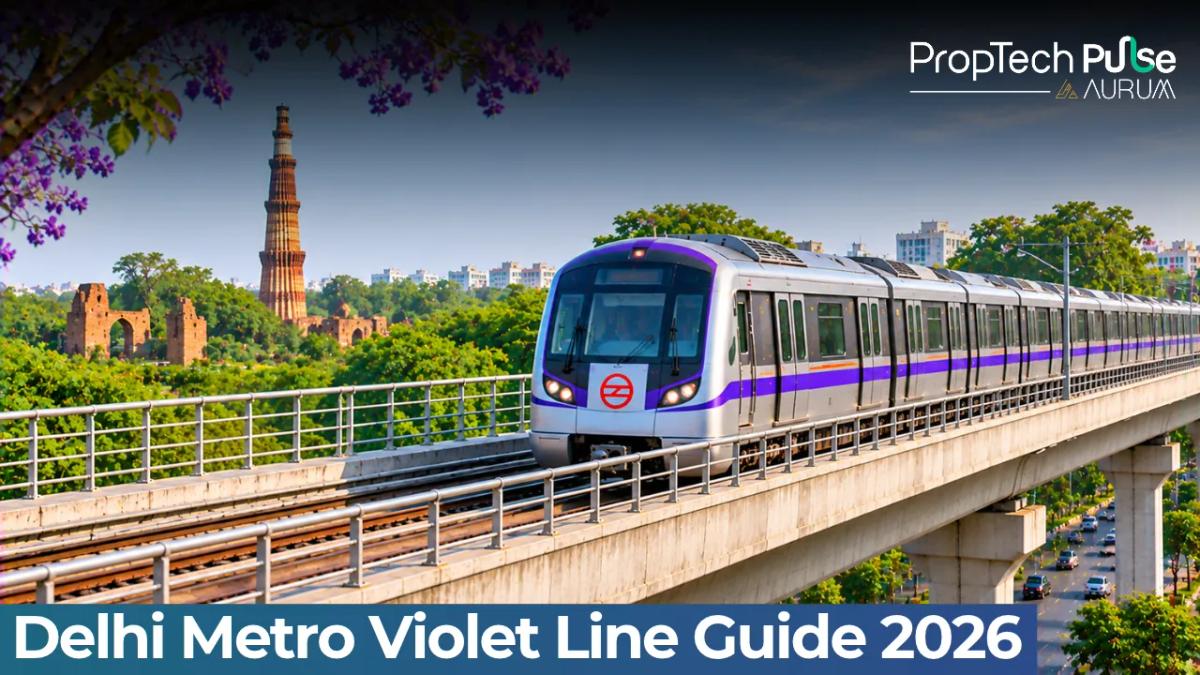
A daily commute from Faridabad to North Delhi traditionally eats two hours. The Delhi Metro Violet Line cuts that round trip down to about ninety minutes. That shift in travel time is what drives property prices along the corridor, turning former bedroom communities into high-demand investment zones. Whether you are mapping a daily journey or evaluating a purchase price, understanding the full route is the first step.
Delhi Metro Violet Line Route: Kashmere Gate to Raja Nahar Singh
Quick answer
The Delhi Metro Violet Line connects Kashmere Gate in North Delhi to Raja Nahar Singh in Faridabad, spanning 46.34 kilometres with 34 operational stations. The route crosses three major corridors, historical Old Delhi, central commercial hubs, and residential South Delhi before crossing the state border into Haryana. Peak fares run between ₹60 and ₹70, covering the entire stretch in roughly 75 minutes.
This north-south corridor diverges from the main line early in New Delhi. It then winds through dense commercial clusters before reaching residential areas in southern Delhi and eastern Faridabad.
Most riders use the line to bridge the gap between the National Capital Region's northern industrial belts and its southern IT corridors. The line also feeds directly into the city's oldest transport nodes, making it a critical artery for tourists and daily commuters alike.
Key Interchange Stations and Connections
Passengers can connect to four other heavy rail lines via interchange stations. These nodes act as pressure valves that either concentrate foot traffic or divert it toward peripheral areas.
- Kashmere Gate: Interchange with the Red Line and ISBT. Handles the highest passenger volume on the entire metro system.
- ITO: Direct link to the Blue Line and the old financial district. Ideal for professionals moving between government offices and private firms.
- Jhandewalan: Connects to the Blue Line near Ajmeri Gate and historic markets. Useful for merchants and wholesale traders.
- Pratap Nagar: Crosses the Pink Line. Provides access to western Delhis residential pockets without entering central Delhi.
- Khan Market: Interchange with the Magenta Line. Sits atop a premium retail and dining precinct used heavily by corporate staff.
- Jangpura: Second Magenta Line junction. Future integration with the Regional Rapid Transit System (RRTS) planned at this node will cut Gurugram-to-Jangpura travel to twenty minutes.
- Chandrayaan Colony: Junction with the Yellow Line heading toward Sadhrawa. Critical for cross-town transfers between Gurgaon and East Delhi.
- Nehru Place: Fourth interchange point, linking to the Yellow Line at one of Asias largest electronics market hubs.
Note for investors: Stations closer to interchange points command higher rental premiums. A one-bedroom apartment within 800 metres of Khan Market typically yields twelve to eighteen percent more rent than identical units further down the line.
Complete List of Metro Violet Line Stations with Facilities
The metro violet line stations span forty-six kilometres, starting at Kashmere Gate and ending at Raja Nahar Singh in Ballabhgarh. Each station varies in age, crowd density, and facility quality. Stations built in the early 2010s rarely have dedicated EV charging bays. Newer stops from the past five years, however, feature solar canopies and wheelchair lifts that meet strict accessibility rules.
Zone 1 to Zone 5 Breakdown
Dividing the route into five geographic zones helps clarify why property rates fluctuate so sharply over short distances. Travelers moving southward will notice the transition from heritage commerce zones to planned corporate grids and finally to affordable suburban towns.
| Zone | Coverage | Typical Apartment Price Range | Target Buyer Profile |
|---|---|---|---|
| Zone 1 | Kashmere Gate to Shakti Nagar (Old and North Delhi) | ₹8,500 – ₹11,000 per sq ft | Business owners, long-standing residents, commercial lessees |
| Zone 2 | Jhandewalan to Hauz Khas (Central Delhi) | ₹12,000 – ₹18,500 per sq ft | Middle-income families seeking heritage proximity |
| Zone 3 | Minto Road to Greater Kailash (South Delhi) | ₹15,000 – ₹22,000 per sq ft | Corporate tenants, young professionals, short-term investors |
| Zone 4 | Malviya Nagar to Saket and NHOC | ₹13,000 – ₹17,000 per sq ft | End-users prioritising lifestyle amenities over prime addresses |
| Zone 5 | Badkal Lake to Raja Nahar Singh (Faridabad) | ₹6,500 – ₹9,500 per sq ft | First-time buyers, budget investors, daily commuters to Gurugram |
When evaluating listings in Zone 1 and Zone 2, pay close attention to whether the brochure advertises super built-up area rather than carpet area. A quoted size that includes shared lobby space and stairwells can shrink the actual usable floor area by fifteen to twenty percent. Understanding the difference between built up area vs carpet area protects buyers from inflated valuations that do not reflect genuine living space.
Ticket Pricing, Peak Hours and Last Train Timings 2026
Fare structures on the Delhi Metro use a distance-based slab system. The minimum ticket cost starts at ten rupees, designed to make basic transit affordable. The maximum fare for riding the entire length from Kashmere Gate to Raja Nahar Singh generally falls between sixty and seventy rupees, depending on exact boarding and alighting gates.
| Route Segment | Distance | Travel Duration | Estimated Fare |
|---|---|---|---|
| Kashmere Gate to ITO | 3.8 km | 6 minutes | ₹10 |
| Khan Market to Nehru Place | 8.4 km | 14 minutes | ₹30 |
| Central Secretariat to Jangpura | 6.1 km | 10 minutes | ₹20 |
| Kashmere Gate to Raja Nahar Singh | 46.3 km | 74 minutes | ₹65 |
Peak hours run from eight o'clock to ten o'clock in the morning and again from six o'clock to nine thirty at night. Trains become extremely crowded between Nehru Place and Khan Market during these windows, especially on weekdays. Salaried workers prefer departing slightly earlier or later to avoid shoulder-to-shoulder conditions.
Last trains usually depart terminal stations around eleven-fifteen to eleven-thirty at night. During winter months and exam seasons, services sometimes extend past midnight near exam hubs like JNU and South Extension, but this remains an exception rather than the rule. Always allow an extra fifteen minutes for walk-back time if you plan to grab dinner in Saket before boarding the return train.
Real Estate Impact Along the Violet Line Corridor
Property values rarely move in isolation from transit improvements. When a rail corridor upgrades from surface buses to grade-separated rail transit, adjacent land prices adjust within six to eighteen months. The Violet Line accelerated that cycle across multiple tiers of the National Capital Region.
Old Delhi and Commercial Hub Connectivity
Zone 1 hosts some of the oldest commercial structures in India. Recent municipal redevelopment efforts alongside the metro stations have improved pedestrian safety and widened footpaths. Short-term lets targeting foreign tourists and business travellers remain profitable here, provided the building passes fire safety norms and offers reliable water storage. Investors buying heritage conversions should budget extra for structural reinforcement.
South Delhi Corporate Belts (Khan Market, Nehru Place)
South Delhi commands the highest rents on the line due to its concentration of multinational offices and luxury retail zones. Apartments near Khan Market and Hazrat Nizamuddin attract senior management and visiting clients willing to pay premium monthly fees. Landlords in this segment frequently offer fully furnished layouts equipped with modular kitchens and dedicated co-working desks. Rental agreements typically run for eleven months, with annual escalation clauses capped at five percent to maintain tenant stability.
If you are comparing mortgage terms for a purchase in this tier, running the numbers through a home loan emi calculator helps isolate the true monthly cash flow impact. Interest rates fluctuate with repo policy shifts, and locking a fixed-rate tenure during a buyer market can save substantial interest over a twenty-year payout schedule.
Faridabad and Ballabhgarh Affordable Housing Demand
Zone 5 serves as the primary affordable housing engine for the region. Properties here sell for roughly forty to fifty percent less than comparable units in South Delhi, yet rental demand stays strong thanks to IT professionals working in Sector 18 Gurugram and Cyber City. Daily commuters tolerate longer travel times in exchange for larger apartment sizes and fresh construction quality.
Before committing capital in Haryana, verify that the builder holds a valid registration certificate. Checking RERA registered projects in Delhi sets the benchmark for compliance standards, and Haryana follows a parallel regulatory framework that mandates escrow accounts for eighty-five percent of collected funds. You should also factor regional levies into your acquisition budget. Calculating stamp duty in Delhi gives you a baseline, but Haryana imposes distinct circle rates and documentation fees that change quarterly.
Final Verdict: Who Should Invest Near the Violet Line?
Match the station to your financial goal. Buyers chasing capital appreciation should target Zones 2 and 3, where corporate expansion restricts supply and keeps resale demand high. Investors focused on monthly rent rather than asset growth will find better yields in Zone 5, where entry prices are low and occupancy stays near ninety-two percent.
Avoid impulse bookings based solely on distance claims. You must verify road connectivity, check flood history for ground-floor units, and confirm power backup reliability before signing any agreement.
Frequently asked questions
How many stations are on the Delhi Metro Violet Line?
The Violet Line operates thirty-four stations stretching from Kashmere Gate in North Delhi to Raja Nahar Singh in Faridabad. Additional tracks extend toward Shaheed Sthal in parts of the Faridabad district, increasing the total track length beyond the core forty-six kilometre span listed by operators.
What is the maximum fare from Kashmere Gate to Raja Nahar Singh?
A single adult ticket covering the full route between the northern and southern terminals costs approximately sixty-five to seventy rupees as of late 2026. Children under three feet tall travel free, while senior citizens receive a twenty percent concession on regular fares using their special metro cards.
Does the Violet Line intersect with the RRTS?
Direct integration happens at Jangpura station, where the Violet Line crosses the Magenta Line platform level. Construction crews are currently coordinating track alignments for a dedicated RRTS corridor that will funnel passengers from Meerut directly into this intersection, expected to open in stages over the next twenty-four months.
What are the peak hour timings for the Violet Line?
Morning congestion begins around seven-thirty and peaks between eight and ten in the morning, driven largely by office commuters heading toward Khan Market and Nehru Place. Evening crowds surge again from six-thirty until nine-thirty when staff return toward residential districts in Saket and Faridabad.
Is parking available at Violet Line metro stations?
Most stations provide designated bicycle racks and limited two-wheeler slots that fill quickly before sunrise. Car parking exists only at select suburban terminals like NHOC and Raja Nahar Singh, where spaces are allocated on a first-come basis. EV charging points remain concentrated at newer builds outside central Delhi.
Enjoyed this blog article? Visit PropTech Pulse for more interesting blogs.



Ask Pulse Ai anything about real estate

Unlock the Latest in Real Estate
News, Infographics, Blogs & More! Delivered to your inbox.

