New Launch - India Real Estate Report 2026.

Services
Knowledge Hub
Resources
Tools

Ask Pulse Ai
©PropTech Pulse 2025, All rights reserved.


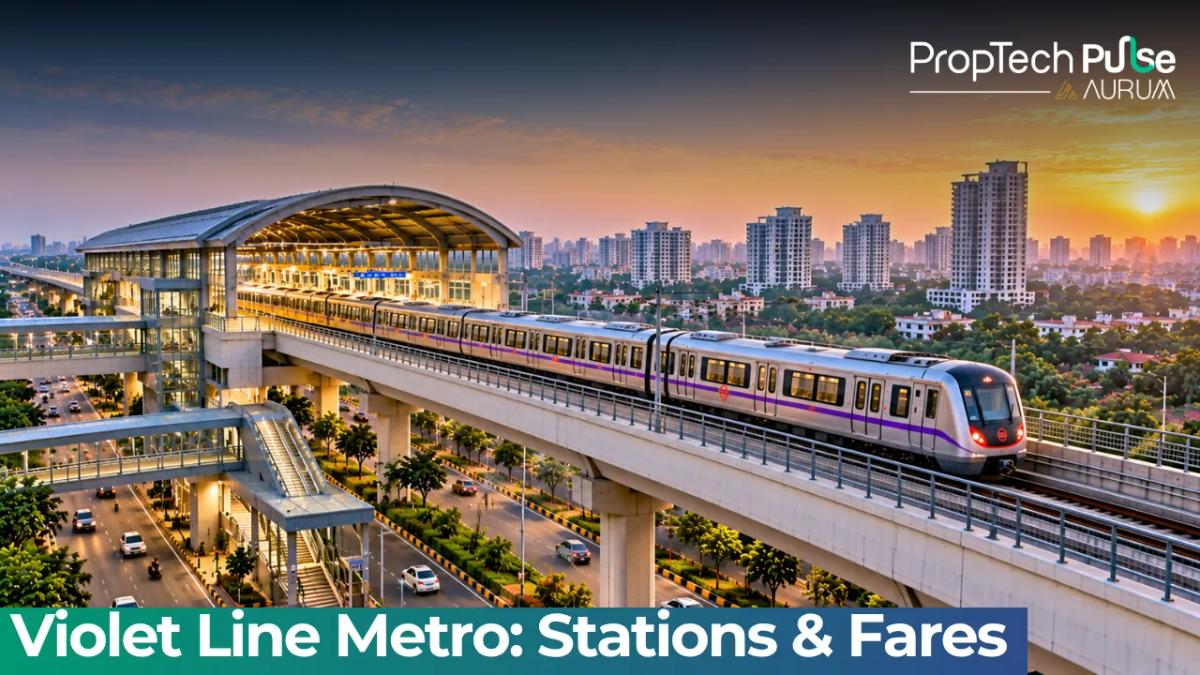
The violet line metro route stretches 46.3 kilometres from Kashmere Gate in central Delhi to Raja Nahar Singh in Faridabad.
It serves a massive daily ridership and bridges the capital directly with Haryana. The corridor also quietly dictates property valuations across South Faridabad.
Most transit guides stop at a static map, but the practical violet line metro route demands attention to schedule quirks and zone transitions.
Commuters need to know how often trains actually run after entering the Haryana zone. Buyers want to see where fares cap out. Investors watch which sectors get priced up next when the Jewar airport link finally breaks ground.
Violet Line Metro Stations
Quick answer
The Delhi metro violet line connects Kashmere Gate to Raja Nahar Singh in Faridabad. It covers 34 stations over 46.3 km, operates between 6 AM and 11:35 PM on weekdays, and charges a minimum fare of ₹10 rising to ₹60 for the full stretch. The line offers direct interchanges to the Red, Blue, Yellow, Magenta, and Pink networks.
Below is the complete sequential list of violet line metro stations from the northern terminus to the southern end in Haryana.
| Station | District / State | Interchange Lines |
|---|---|---|
| Kashmere Gate | Central Delhi, Delhi | Red Line |
| ISBT Kashmiri Gate | North Delhi, Delhi | None |
| Shastri Park | North Delhi, Delhi | None |
| Shaheed Nagar (H.No 48) | Dwarka, Delhi | None |
| Mansarovar Park | Dwarka, Delhi | None |
| Vivek Vihar | Ghaziabad, UP | None |
| Seelam Pur | Ghaziabad, UP | None |
| Mangat Puri | Ghaziabad, UP | None |
| Noida Chowk | Gautam Buddh Nagar, UP | None |
| Botanical Garden | Gautam Buddh Nagar, UP | Pink Line |
| Vaishali | Gautam Buddh Nagar, UP | None |
| Kaushambi | Gautam Buddh Nagar, UP | None |
| Anand Vihar | East Delhi, Delhi | None |
| Madangir | South West Delhi, Delhi | None |
| Sarai | South Delhi, Delhi | None |
| Nehru Place | South Delhi, Delhi | Pink Line |
| Govind Puri | South East Delhi, Delhi | None |
| Badarpur | South East Delhi, Delhi | Magenta Line |
| Saket | South Delhi, Delhi | None |
| Green Park | South Delhi, Delhi | Magenta Line |
| Hauz Khas | South Delhi, Delhi | Magenta Line |
| AIIMS | South Delhi, Delhi | None |
| Qutab | South East Delhi, Delhi | Blue Line |
| Chhatipur Malakhela | South East Delhi, Delhi | None |
| Arunachal Enclave | South East Delhi, Delhi | None |
| Lado Sarai | South East Delhi, Delhi | None |
| Chatta Lal Qila | Jhajjara, Haryana | None |
| Shiv Vihar | Jhajjara, Haryana | Yellow Line |
| Dharampura | Ballabhgarh, Haryana | None |
| Bhavbhuti Guru Marg | Ballabhgarh, Haryana | None |
| JLN Stadium | Ballabhgarh, Haryana | None |
| Haryana Vidhan Sabha | Ballabhgarh, Haryana | None |
| NHPC Chowk | Ballabhgarh, Haryana | None |
| Raja Nahar Singh | Ballabhgarh, Haryana | None |
Timings, Frequency & Peak Hour Strategy
Service hours shift depending on the day and the zone. Weekday operations run from 6:00 AM to 11:35 PM. On Sundays, the first train pushes back to 4:00 AM, making weekend market trips or site visits significantly easier.
The real friction happens underground and above ground. In the core Delhi section, particularly between Kashmere Gate and Nehru Place, headways are tight. Trains typically arrive every 3 to 5 minutes during morning rush.
Once the line crosses Badarpur and enters the Haryana stretch towards Raja Nahar Singh, the schedule thins out. Expect intervals to stretch to 7 or 10 minutes during mid-morning and late afternoon windows.
If you work at Nehru Place or Sarai, you face heavy transfer crowds regardless of the clock. The magenta and pink lines merge their foot traffic directly onto the violet line platforms here.
Arriving 15 minutes earlier than the absolute peak usually means finding a seat. Leaving 10 minutes past the hour gives you breathing room on the escalators.
Peak warning Between 8:15 AM and 9:00 AM, the platform congestion at Nehru Place and Govind Puri exceeds capacity. If you live beyond Ballabhgarh, consider boarding at the originating stations to guarantee a seat for your commute into the city.
This frequency rule applies strictly to commercial services. Night shifts often miss the last connections back into Ghaziabad or West Delhi. Always keep a backup ride-share app loaded if you finish work past 10:30 PM near Botanical Garden.
Weekend schedules also differ slightly on major public holidays. DMRC usually runs special trains for festivals or cricket matches. Check the official DMRC Twitter handle before planning a late return trip.
The last train might get pushed back by fifteen minutes, but the gap between services stays wide.
Working Out the Metro Fare for Common Routes
Fares follow a distance-based slab system administered by the Delhi Metro Rail Corporation along this entire violet line metro route. The floor ticket sits at ₹10 for the shortest hops, such as Kashmere Gate to Lal Qila.
The ceiling charge sits at ₹60 for traversing the entire corridor from the start to Raja Nahar Singh. There are no hidden charges for the Delhi-to-Haryana switch, unlike older railway services.
You can tap your card at the entry gate and walk straight through to any station within that distance bracket without paying again. Smart cards save roughly ten percent compared to paper tokens.
Corporate pass holders enjoy deeper discounts but need to register their passes monthly on the DMRC website.
Planning a relocation along the southern stretch? A ₹60 daily cap might look manageable, but factor it into your wider transport budget. Before you commit to a sector price, plug your expected monthly commute spend and current salary into a home loan EMI calculator to see how much borrowing power remains intact.
| Origin | Destination | Approximate Fare |
|---|---|---|
| Kashmere Gate | Lal Qila | ₹10 |
| Kashmere Gate | Anand Vihar | ₹30 |
| Kashmere Gate | Nehru Place | ₹40 |
| Kashmere Gate | JLN Stadium | ₹50 |
| Kashmere Gate | Raja Nahar Singh (Ballabhgarh) | ₹60 |
Students and senior citizens get concessional fares, but only for travel within Delhi limits. Crossing into Faridabad triggers full adult rates instantly. Carry valid ID proofs just in case field staff question the card swipe at Raja Nahar Singh exit gates.
Key Interchange Points
Understanding the wider network requires mapping how the violet line metro route intersects with the capital’s six operational corridors. Transfers on the violet line require zero extra payment.
All designated interchange stations share common concourses or direct walkway links. You tap your card once entering the network, and staying within the system until you reach your interchange gate does not trigger a fresh fare deduction.
For corporate commuters, the yellow line swap at Shiv Vihar is the fastest escape toward Gurgaon and Dwarka.
The magenta junctions at Badarpur, Green Park, and Hauz Khas dump hundreds of passengers onto violet line platforms simultaneously.
The pink line intersections at Botanical Garden and Nehru Place pull heavy residential footfall straight into commercial hubs.
Navigation signage generally works well, but the sprawling layout at Anand Vihar can confuse first-time users.
Follow the overhead blue arrows strictly if you need the bus terminal or the railway platform shortcut. Taking the wrong escalator adds twenty minutes to your transfer time.
The interchange at Qutab Enclave deserves specific mention. It links directly to the Blue Line's southern branch. This connection saves commuters from travelling all the way back to Rajouri Garden or Old Delhi Railway Station if they need to cross to west Delhi.
Jewar Airport Extension & Faridabad Real Estate
Speculation around the violet line rarely stays contained within existing boundaries. The latest phase planning targets a 24-kilometre extension reaching from the current terminus at Raja Nahar Singh to the Noida International Airport at Jewar.
Roughly 10 new stations dot this proposed alignment. The capital estimate hovers near ₹4,320 crore, pending final environmental clearances and land acquisition timelines.
Property markets move ahead of construction cranes. Sectors clustered around Neelam Chowk, Sector 28, and the old Delhi-Mathura highway frontage have already seen premium pricing on plots.
Ballabhgarh itself is absorbing spillover demand because buyers treat the existing metro proximity as a guaranteed liquidity floor for resale later.
Evaluate any pre-launch inventory against the broader infrastructure pipeline. A plot sounds cheap until you factor in local municipal levies. Run the transaction costs through a stamp duty calculator specific to Haryana before signing a token agreement. Simultaneously, cross-check every developer's permit using a builders in Faridabad tracker or the regional registration portal to confirm valid building approvals.
Delayed OCs sink returns faster than empty promises, so verify active project compliance with a Delhi RERA project verification report before handing over advance money. Focus your search on completed societies where rental yields beat bank fixed deposits, even before the airport extension officially opens.
Investment tip Avoid buying solely on the promise of a future station name change. Focus on locations sitting within a one-kilometre radius of the current Raja Nahar Singh node, where daily rental yields actually exist today while the airport line matures.
Smart Buying Rules for the Corridor
Buy the property closest to the existing terminal first, then scale outward as planners map the extended violet line metro route. Rental demand in Faridabad reacts immediately to metro proximity, whereas appreciation driven by airport connectivity takes four to six years to crystallise into rentable square footage.
Stick to RERA-approved societies with clear encumbrance certificates, and never skip the soil test report if you are purchasing land rather than a flat. Transit premiums are real, but they punish buyers who ignore basic due diligence.
Track the state government's official development plans alongside the DMRC updates. Political shifts occasionally pause or redirect large infrastructure projects.
Verify every zoning change through the local municipal corporation office before trusting builder brochures. Money tied up in unapproved plots drags down overall portfolio performance.
Frequently asked questions
What are all the violet line metro stations in Delhi?
The route contains thirty-four stations stretching from Kashmere Gate in central Delhi down to Raja Nahar Singh in Faridabad. Core stops include Noida Chowk, Botanical Garden, Anand Vihar, Nehru Place, Saket, Green Park, Hauz Khas, and Qutab Enclave before crossing into Haryana at Shiv Vihar and Ballabhgarh.
How much is the fare from Kashmere Gate to Raja Nahar Singh?
Travelling the full 46-kilometre span costs a flat sixty rupees. The system uses distance-based slabs starting at ten rupees for the shortest hop, climbing steadily until you reach the southern terminus. Transfer charges do not apply at interchange points.
When do the first and last trains run on the violet line?
Weekend service starts earlier, with the first departure hitting the track at four o'clock in the morning. Regular weekday operations begin at six AM and push the final outgoing train out at eleven-thirty PM. Check the official app for minor holiday shifts.
Which stations offer interchanges to the Blue, Yellow, and Magenta lines?
You can switch to the Blue Line directly at Qutab Enclave. The Yellow Line connection sits at Shiv Vihar in Haryana. Three separate hubs feed into the Magenta network, located at Badarpur, Green Park, and Hauz Khas. Pink Line swaps are available at Botanical Garden and Nehru Place.
Will the violet line metro connect to Jewar Airport?
Phase four plans outline a twenty-four kilometre extension reaching the Noida International Airport at Jewar. Ten additional stops are currently under feasibility review. Construction timelines depend on land acquisition completion, so direct service likely remains two to three years away.
Sources
- DMRC Official Portal: Operational timings, distance metrics, and terminal details (accessed October 2026)
- Central Board of Indirect Taxes and Customs: GST applicability on off-site amenities (accessed October 2026)
Enjoyed this blog article? Visit PropTech Pulse for more interesting blogs.





Ask Pulse Ai anything about real estate

Unlock the Latest in Real Estate
News, Infographics, Blogs & More! Delivered to your inbox.

