New Launch - India Real Estate Report 2026.

Services
Knowledge Hub
Resources
Tools

Ask Pulse Ai
©PropTech Pulse 2025, All rights reserved.


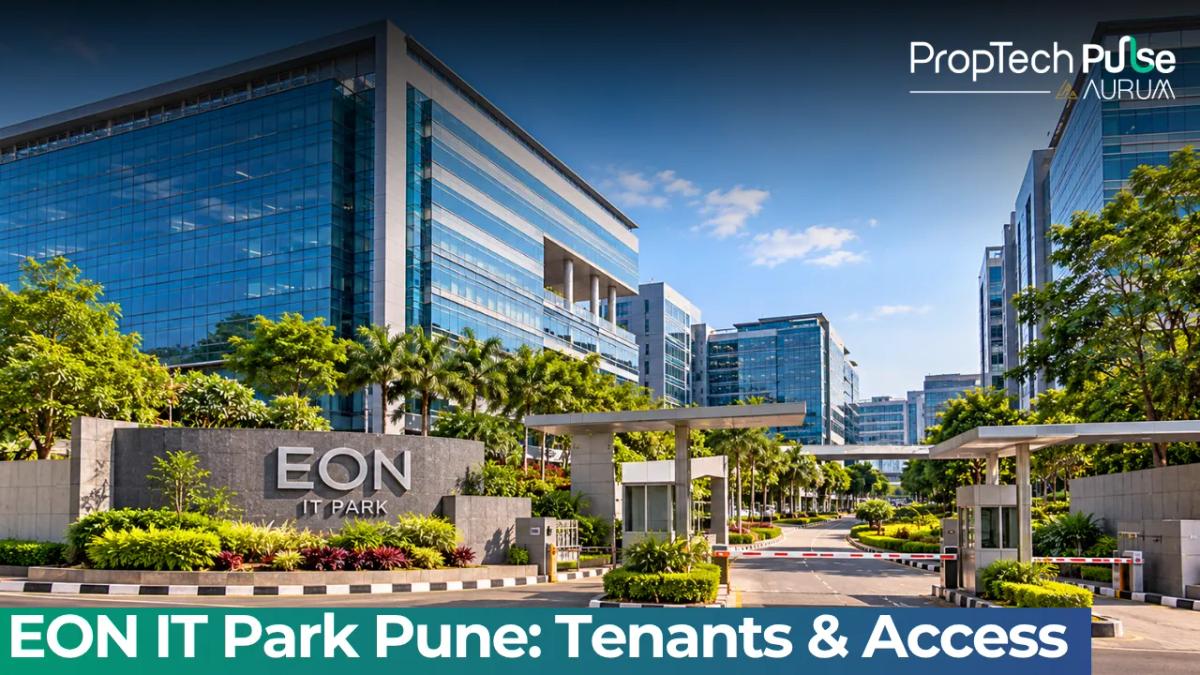
You want operational clarity around Eon IT Park Kharadi, not a sales brochure. Situated along the Wagholi-Kharadi stretch, Eon IT Park Pune stands out as one of the city's most functional tech campuses.
The site splits into two phases that operate differently. Structural age, parking layout, and amenity distribution vary sharply between them.
Facility managers scouting relocation options, HR leads scheduling candidate interviews, and brokers negotiating leases all benefit from understanding these logistics upfront.
Tens of thousands of staff traverse the grounds daily using private cars and public transit.
Knowing which phase fits your floor-plate needs helps you sidestep peak-hour bottlenecks at Kharadi Chowk. Visitor entry also follows strict security protocols that change depending on which gate you use.
EON Free Zone Location and Transport Links
Quick answer
The park sits off the Wagholi-Kharadi road near NH 48, reachable via private vehicles or public transit. The nearest metro stop is Ramwadi Station, served by the MS-20 feeder bus. Multiple PMPML routes connect the site from Kharadi Chowk and the Wagholi railway station.
It sits off the Wagholi-Kharadi road, tucked near the NH 48 corridor. That central position shapes how people move through the campus every day.
Travelers coming from Hinjewadi or Rajiv Gandhi Infotech Park usually funnel straight through Kharadi Chowk. Drop-off queues pile up predictably at 9 a.m. and thin out by 11 a.m.
Last-Mile Commute: Metro and Bus Routes
Transit access tightened up when the metro lines expanded. Ramwadi Station on the aqua line sits closest to the campus. MS-20 runs from the station exit right to the Phase II gate, skipping the walk along the busy ring road.
PMPML buses on routes 163, 234, and 235 also stop at nearby intersections. Taxis using those stops bypass the heavy traffic inside the parking complex.
Commercial flights add pressure to the morning rush. Travelers coming from Pune International Airport roll straight through the Kharadi toll plaza and head north toward Phase II. Rail passengers usually get off at Wagholi station instead.
They catch autos or buses along the ring road. Monsoons complicate the last mile. The Wagholi-Kharadi stretch collects standing water at several junctions in July and August, making pedestrian crossings slippery.
The MS-20 shuttle avoids those flooded stretches entirely, which explains why most staff prefer it over walking. Pull up the live schedule on mahametro.org before booking outstation cabs.
Campus Layout: Phase I vs Phase II Operations
You need to know the phase difference before touring the campus. Marketing materials treat it as one contiguous lot, but the buildings follow different blueprints.
Phase I dates back to the late nineteen-nineties. Those towers feature deep floor plates suited for large enterprises that need continuous open layouts. Their elevators track basic car-count logic rather than predictive algorithms.
Phase II arrived a decade later to handle overflow tenants. Those structures mix office floors with newer utility stacks.
Elevator groups run automated dispatch software, cutting wait times during the 8 a.m. and 5 p.m. peaks. The tradeoff shows up elsewhere; Phase II towers prioritize height over the wide-span interiors that Phase I provides.
| Feature | Phase I | Phase II |
|---|---|---|
| Structural Age | Built late 1990s to early 2000s | Constructed 2010 onwards |
| Floor Plate Layout | Large, contiguous open plans | Mix of large and modular segmented floors |
| Elevator Dispatch | Traditional panel-controlled banks | Automated group-control systems |
| Parking Configuration | Surface lots and older basement ramps | Multi-level structured parking decks |
| Dining Facilities | Scattered ground-floor vendors | Centralised food court complexes |
Cars dictate the daily flow almost as much as trains do. Phase II uses stacked concrete decks, which cuts down search time but floods completely during peak conference weeks.
Phase I leans on surface lots parked right next to the towers. Both fill fast. If your team needs guaranteed proximity to building entrances, negotiate for Phase II space before August.
Tenants and EON IT Park Companies
The tenant roster across Eon IT Park Pune reflects the site's long-standing reputation as a stable Grade-A asset.
Because the facilities offer consistent power backup, redundant internet fibre feeds, and rigorous security management, established corporations prefer renewing leases here over chasing speculative new developments in peripheral zones.
A comprehensive view of how corporate real estate behaves in this neighbourhood is useful; see our Pune Eon Free Zone Kharadi locality overview.
Breaking down the resident directory reveals a concentration of software services and business process outsourcing rather than hardware manufacturing. The dominant presence belongs to major IT services providers.
Large enterprises such as Infosys, Wipro Technologies, Tata Consultancy Services, Cognizant, and Zensar Technologies maintain substantial offices within the campus blocks. Their operations drive the steady flow of high-skilled professionals that defines the area's professional demographic.
The heavier concrete frames in Phase I suit a specific niche. Engineering consultancies often set up their calibration labs or server rooms here because the slabs handle dense equipment loads better than lighter Phase II steel frames.
Teams running heavy testing rigs report fewer structural vibrations across wider spans.
Financial services and telecom support form the second pillar.
Customer care operations require consistent power redundancy and heavy acoustic treatment, which the park has actively maintained. Vodafone Idea operates key digital processing centres here, alongside Maxxton Solutions and various other firms.
For commercial brokers managing B2B leads, noting that a majority of these occupiers operate on long-term lock-ins changes the supply-demand dynamic. Vacancy spikes are rare compared to newly launched markets. Understanding the prevailing rental market trends for Eon Free Zone prevents mispricing strategies during lease renegotiations.
Beyond the corporate towers, the surrounding micro-market has been heavily shaped by the same developer group driving the park. Residential assets like the Panchshil Realty Eon Waterfront and the MK Constructions Eon Bay sit just minutes away, creating a self-contained urban ecosystem where senior executives can reside within walking distance of their offices. This proximity reduces turnover friction for companies trying to retain talent who would otherwise relocate far from Pune.
Inside the EON Free Zone Business Park
Management of the premises falls under Eon Kharadi Infrastructure Private Limited. Despite frequent references to a "free zone" environment, the park does not carry a statutory Special Economic Zone classification enforced by the central government.
It operates entirely within regular municipal commercial zoning regulations, meaning businesses housed here pay standard GST and municipal taxes without seeking export-oriented concessions typically associated with SEZs.
Important distinction: Despite frequent colloquial use of "Free Zone," EON IT Park operates under standard commercial zoning. It is not a government-designated Special Economic Zone requiring export mandates or tax rebates typical of SEZs.
Sustainability features stand out as a genuine differentiator. Certain tower blocks achieved LEED Gold certification, indicating advanced water harvesting, energy-efficient HVAC cooling systems, and extensive use of natural daylighting. This aligns with broader shifts in commercial asset valuation, where sustainable commercial building standards in India increasingly influence tenant preferences and long-term property valuations.
Security protocol dictates everything from delivery timing to visitor movement. The primary gates enforce strict badge verification.
Delivery trucks carrying furniture or server racks are routed through dedicated cargo lanes to avoid passenger drop-off congestion. Visitor pass systems now rely largely on pre-registrations sent by host companies, streamlining the entry process.
Outside taxis and ride-sharing vehicles generally cannot penetrate past the initial security checkpoint. Passengers are directed to designated pick-up points outside the main perimeter.
Regular inspections of fire suppression systems and emergency stairwells occur monthly to comply with Pune Municipal Corporation fire safety mandates.
Before You Schedule a Visit or Lease Space
Your next move depends on whether you value immediate operational readiness or deep customization rights. Small to mid-sized teams benefit from Phase II because the modern lift networks, structured parking, and centralised food courts minimize friction for new employees settling in.
Larger enterprises deploying hundreds of staff simultaneously usually prefer Phase I, where the expansive floor plates allow bespoke interior architecture and branded lobbies that smaller units cannot accommodate.
When evaluating Eon IT Park Pune, always verify the exact utility load limits for your department before signing. Run a physical inspection of the specific tower block you target, rather than trusting marketing brochures alone.
Measure the load-bearing capacities for heavy equipment, check the generator room placement relative to your proposed floor, and stress-test the broadband connection during actual peak hours. Confirm current vacancy lists with certified local brokers instead of scrolling static directories.
Frequently asked questions
Which metro station is closest to EON IT Park?
Ramwadi Metro Station serves as the closest major transit hub for the campus. Located on the Pune Metro aqua line, it connects travelers efficiently from both east and west Pune. From the station exit, passengers board the dedicated MS-20 feeder bus, which runs regularly throughout the day and drops commuters directly at the Phase II entrance gate, minimizing the walking distance during extreme weather.
How much is the carpet area of EON IT Park?
The campus is composed of two separate phases spread across a vast tract of land, collectively encompassing millions of square feet of commercial office space. Phase I delivers expansive, uninterrupted floor plates ideal for massive deployments, while Phase II offers a flexible mix of large and modular segments tailored for diverse technology businesses and scaling firms.
What are the main companies located in EON Free Zone?
Several major technology leaders maintain a strong presence within the facility, particularly in IT services and backend operations. Prominent residents include Infosys, Wipro, Tata Consultancy Services, Cognizant, and Zensar Technologies. Additionally, the park hosts major financial services operations such as Vodafone Idea, engineering consultancies like Maxxton Solutions, and numerous supporting BPOs requiring heavy power and network redundancy.
Is EON Free Zone a SEZ in Pune?
No, it functions as a conventional commercial property situated within regular municipal zoning boundaries. The name often confuses potential lessees, but the park does not hold a government-designated Special Economic Zone license. Companies operating here do not face export obligation requirements and instead deal with standard commercial property laws, typical GST applications, and local municipal taxation structures.
Sources
- Maharashtra Metro Rail Corporation: Aqua Line schedule and feeder bus route information (accessed October 2026)
Enjoyed this blog article? Visit PropTech Pulse for more interesting blogs.

Ask Pulse Ai anything about real estate

Unlock the Latest in Real Estate
News, Infographics, Blogs & More! Delivered to your inbox.

