New Launch - India Real Estate Report 2026.

Services
Knowledge Hub
Resources
Tools

Ask Pulse Ai
©PropTech Pulse 2025, All rights reserved.


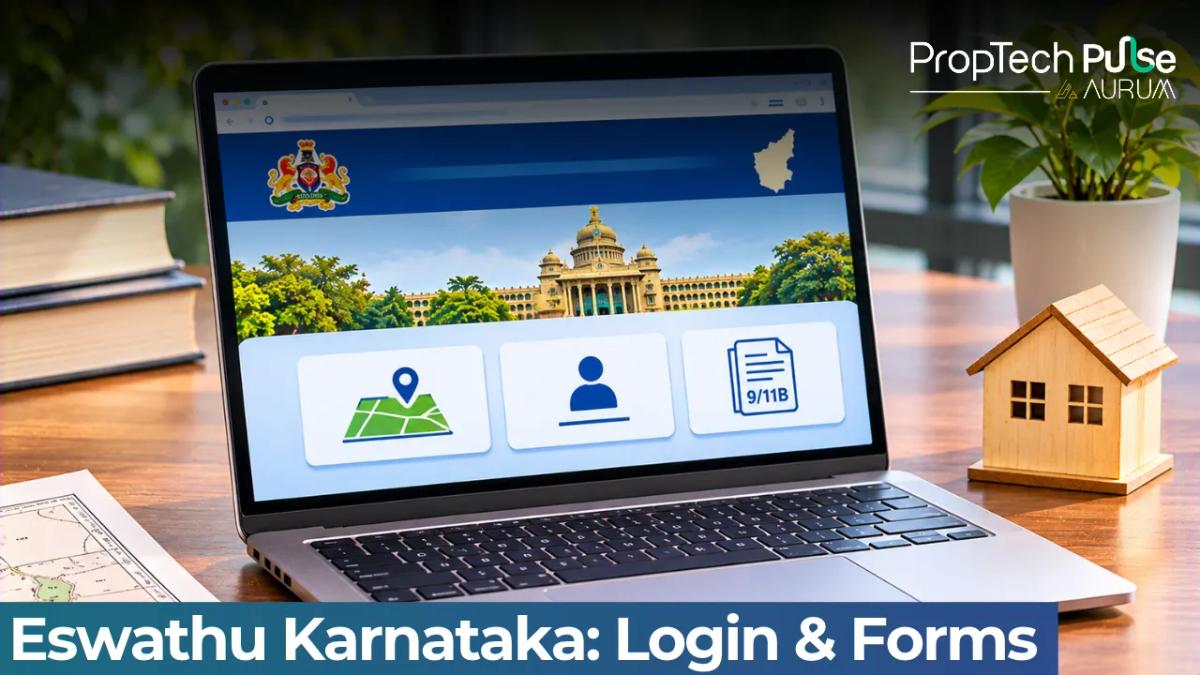
Many rural homeowners in Karnataka struggle to prove ownership. Their plots often sit outside municipal tax grids and lack proper digital records.
The state's answer is Eswathu, the centralized rural property digitization engine run by the Rural Development and Panch Rajya department.
Need a home loan on village land, or just want to confirm your standing? Learning how the portal works pays off here.
In late 2025, the government launched major technical upgrades to Eswathu. Those changes set the stage for a massive backlog clearance drive this year. The push moves historically unrecorded rural assets into the formal system.
What is Eswathu and Why Does It Matter for Rural Properties?
Quick answer
Eswathu is Karnataka's official rural property database managed by the RDPR department. It tracks land holdings within Grama Panchayat limits, issues digital Forms 9 and 11B, and allows applicants to perform eswathu login to track verification status.
Eswathu functions as a unified digital ledger designed to replace centuries-old physical registers kept by village accountants.
Before this system, rural property records sat scattered across handwritten lekhars and paper-based town planning extracts.
Banks routinely declined home loan applications when your land lacked a centralised digital footprint, regardless of how long you lived there.
The platform covers nearly 97 lakh rural properties across Karnataka's villages. Every gram panchayat gets instant access to updated ownership details under one roof. This verified source bridges the gap between informal village living and formal financial markets.
Verifying your rural records becomes simpler than verifying a city apartment. Learn how to check property Khata status in Karnataka.
Understanding E-Swathu 2.0 and GPS Geo-Tagging
The initial version of the portal worked mostly like a searchable spreadsheet. It listed plot numbers and owner names, but provided little geographic context.
Buyers frequently found that the boundaries drawn on paper did not match the actual terrain, leading to neighbour disputes and stalled transactions.
Government officials fixed this flaw by deploying Eswathu 2.0 in December 2025. The upgraded architecture mandates strict GPS geo-tagging for every new entry and pending mutation.
Trained surveyors visit plots or cross-reference satellite data to lock down exact positions. This spatial accuracy eliminates duplicate registrations and stops fraudsters from selling the same parcel twice.
On top of that, the new system connects directly with Panchatantra, Karnataka's core administrative dashboard for local self-government. Any building permit, property tax adjustment, or zoning change approved at the village level updates immediately in the master database.
Transparency from this overhaul won the platform a SKOCH Silver Award in 2026.
How to Do Eswathu Login and Check E swathu Status
Citizens access the platform through the official Karnataka citizen portal hosted on the state's government network. Visit the standard departmental address at https://e-swathu.kar.nic.in to reach the dashboard. Unlike commercial real estate apps, this interface relies on basic mobile authentication linked to your Aadhaar for reliable OTP checks.
Select 'Citizen Login' and enter the mobile number registered to your household. An automated SMS arrives within seconds containing your temporary password.
Type the code into the validation field to access your personal dashboard. Once authenticated, you will see three main navigation tabs: profile management, payment history, and submitted applications.
To monitor your ongoing case, head straight to the application tracker. Search using the unique Application Reference Number printed on your initial submission receipt.
If the system asks for an additional Property ID, use the code generated automatically when you entered the property earlier. The status progresses through four stages: Submitted, Verified by Secretary, Approved by Executive Officer, and Issued.
You can also check e swathu status directly on the homepage by entering your survey number and village name to pull up the existing public record.
How to Download Eswathu Forms 9, 11A, 11B and 3
The portal acts as both a tracking system and an official certificate repository. Each document type corresponds to a distinct administrative function. Mixing them up causes unnecessary delays when dealing with valuers or lawyers.
| Form | Purpose |
|---|---|
| Form 9 | Official Proof of Ownership. Required by lenders to release loans against rural land and by buyers to confirm valid title before exchange. |
| Form 11B | Taxation and Assessment Record. Captures the yearly tax liability and establishes whether the plot falls strictly under panchayat jurisdiction. |
| Form 11A | Mutation History. Displays previous ownership transfers and confirms there are zero pending legal objections attached to the holding. |
| Form 3 | Village Map Extract. A scaled outline identifying the specific plot boundary and adjacent households for rapid visual confirmation. |
Retrieve these files by navigating to the Public Repository menu on the main dashboard.
Choose the specific form you require, input your exact Survey Number and Hissa, then click Generate. The system generates a password-protected PDF showing your full name, plot size, and a digital signature from the Deputy Director of RDPR.
Financial institutions increasingly demand these direct downloads instead of scanned copies, since embedded encryption prevents manual tampering.
Before committing capital, calculate your overheads by learning how to calculate stamp duty and registration charges in Karnataka for rural conversions.
Eswathu Application Process and Required Documents
A critical workflow shift introduced alongside the 2.0 launch restricts raw land creation from independent public submission.
Individuals cannot simply populate the database themselves anymore.
Instead, every application must physically originate at the Grama Panchayat office to prevent systemic spam and guarantee that an authorised village official inspects the site before data enters the central cloud.
The procedure follows a strict sequence. First, compile your original ownership papers.
Walk to the village secretary's desk and request a fresh entry or mutation update form. The clerk inputs your demographic details and plot information into the E-Swathu 2.0 intake system while you wait.
A junior surveyor then visits your property to measure boundaries and lock the GPS coordinates.
The Executive Officer reviews these findings against historical archives. Once cleared, your chosen form appears on the citizen portal for instant download.
When heading to the panchayat, bring a neat folder with your Sale Deed or Inheritance Partition document. Add recent tax receipts, your Aadhaar and PAN cards, and ask a secondary witness to bring a government photo ID.
If the plot has been passed down through multiple hands, carry all previous sale deeds to trace the chain backwards. After securing the digital certificate, investors preparing for larger acquisitions often use an eligibility calculator to gauge how much credit the underlying rural asset can support.
RDPR's 2026 Backlog Drive and Alternative Document Routes
Decades of informal transfers, agrarian subdivisions, and unregistered farmhouses left thousands of rural homes floating outside official tax networks.
Long-time occupants faced a harsh reality. Their generational investments carried absolutely zero verifiable identity on paper.
Recognising that millions of working families were excluded simply because pristine paperwork vanished years ago, the Rural Development Minister ordered a comprehensive backlog clearance campaign in September 2026.
Starting November 1, dedicated verification squads began moving through districts conducting door-to-door surveys.
They are actively processing residential structures up to 4,000 square feet constructed over past decades without formal approvals.
The operational mandate demands a strict 15-day turnaround time for eligible Form 11B requests once the files clear the initial village screening and reach the taluk office.
This initiative introduces practical concessions regarding proof of ownership. Officials now accept alternative documentation parallel to standard sale deeds.
Electricity connection bills spanning multiple years, ration cards linked to the dwelling, updated voter registration slips, and notarized affidavits prove continuous possession.
If you inhabit an older homestead with deep roots but lost the original titles during a relocation or flood, those utility statements become your best way to bypass the usual bottlenecks.
Tracking these shifts helps you understand what is proptech real estate trends evolving rapidly in India's tier-2 housing markets.
Final Checklist Before You Act
Digitising your rural plot through Eswathu offers the strongest protection against future boundary fights and bureaucratic friction.
Treat the certification journey with the same discipline as any formal real estate deal. Never hand cash to strangers claiming representation over the land, and always run a full property due diligence india checklist before exchanging funds.
Confirm that the GPS marker displayed on your newly issued Form 9 aligns precisely with the ground terrain and surrounding landmarks.
If you are renovating an existing structure, upload your most recent electricity bill immediately to trigger priority processing during the active clearance window.
Frequently asked questions
Is having an Eswathu record mandatory for selling rural land in Karnataka?
The government now treats an active Eswathu entry as a prerequisite for completing rural sales. Most sub-registrar offices refuse to register sale deeds for plots that lack a verified digital footprint in the RDPR database. If you attempt to transfer ownership manually, the transaction will likely get flagged and sent back. Securing Form 9 beforehand speeds up the entire legal process and proves you hold valid title rights before handing over possession to a buyer.
Can I check my Eswathu application status using just my mobile number?
Yes, the official portal allows tracking primarily through registered mobile credentials tied to your Aadhaar. Once logged in, head to the 'submitted applications' tab to view progress. If the system asks for an additional Property ID, locate that code on the acknowledgment slip given to you by the village secretary. Relying solely on the phone number works best when the case is already in the verification phase.
What happens to rural properties located near municipal boundaries?
Municipal expansion constantly eats into surrounding gram panchayat zones. If your plot recently crossed into a city corporation limit, your Eswathu record may need migration to the local BBMP or city municipality authority. Until the formal handover completes, continue paying taxes through the panchayat portal. Keep your current GPS data handy so officials can seamlessly transfer ownership without starting the measurement process from scratch.
Are the downloaded PDF forms legally binding for bank loans?
Absolutely. The password-protected PDFs issued directly from the kar.nic.in domain carry encrypted digital signatures from the Deputy Director and RDPR controllers. Banks accept these files as legally binding proof of ownership equivalent to paper certificates. Ensure the document displays the most recent verification date, as older reports lacking current GPS coordinates sometimes get rejected by strict lending institutions.
Can a tenant or farmer apply for a record if they don't own the land?
Tenants cultivating the soil cannot claim permanent ownership rights through Eswathu, though they can register short-term agricultural lease agreements. The database specifically tracks freehold or inheritance-based ownership. Only individuals named on the original sale deed, gift deed, or partition deed qualify to initiate new entries. Agricultural workers sharing the harvest should instead look into separate tenancy registration portals run by the revenue department.
Enjoyed this blog article? Visit PropTech Pulse for more interesting blogs.




Ask Pulse Ai anything about real estate

Unlock the Latest in Real Estate
News, Infographics, Blogs & More! Delivered to your inbox.

