New Launch - India Real Estate Report 2026.

Services
Knowledge Hub
Resources
Tools

Ask Pulse Ai
©PropTech Pulse 2025, All rights reserved.


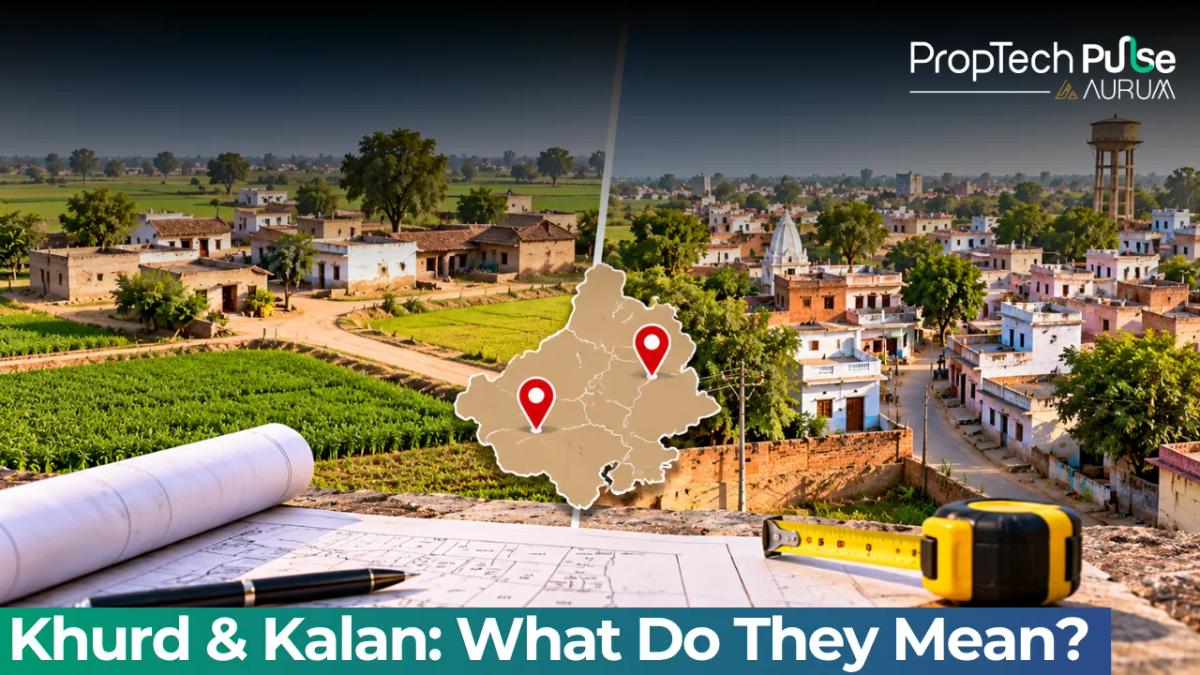
Verifying a sale deed or filing a mutation request across North and Central India requires checking village names. You will frequently encounter settlements ending in Khurd or Kalan. Type one character incorrectly into the registration portal, and the system rejects your application instantly.
These suffixes are active administrative markers. They dictate cadastral boundaries, stamp duty brackets, and municipal wards. Below is a straightforward guide to their meaning and a checklist for your title deeds.
What "Khurd" and "Kalan" Mean in Indian Village Names
Quick answer
In Persian, khurd translates to small or secondary, while kalan means large or main. Historically, a single agricultural settlement grew too big for one administrative unit, so revenue officers split it into two mauzas sharing the same root name. For property buyers, these suffixes are live identifiers across current Jamabandi records, mutation registers, and local pin code assignments. A spelling error on any document leads to rejection at the registrar office.
The classification traces back to medieval Persian administration. It expanded through the Mughal era and solidified under British rule when colonial surveyors needed a way to manage massive farming communities. Officials dropped the idea of creating new names for these sprawling plots. They simply added a suffix to separate the parent hamlet from the newer offshoots.
Kalan denotes the primary settlement. It usually sits on older, higher ground near historic trade routes, temples, or gurdwaras. Khurd marks the newer or smaller cluster. As families multiply and irrigation expands, housing spills beyond the original plot boundaries.
Eventually, satellite pockets become large enough to demand their own patwari and mutation ledger. The result is a twin settlement wearing identical names, separated by a few hundred metres or sometimes a dried riverbed.
This split rarely happens overnight. It takes generations of population pressure and agrarian expansion. In many cases, the Khurd location ends up closer to a newly built highway or railway siding, while the Kalan side retains traditional infrastructure. That physical divergence is exactly why municipalities treat them as separate tax zones today.
Where Khurd and Kalan Appear Across India
This naming convention dominates the Indo-Gangetic plains and western states. Properties in Rajasthan, Haryana, Delhi, Punjab, Uttar Pradesh, and Madhya Pradesh frequently use these terms. A quick map search reveals dozens of Khurd and Kalan pairs within a five kilometre radius.
| Settlement Suffix | Typical Characteristics & Modern Usage |
|---|---|
| Kalan | Larger population base; older revenue record (Jamabandi); historically central market hub. Often holds the primary postal address and sub-office. |
| Khurd | Newer expansion zone; frequently hosts recent residential developments or farmhouses. Falls under the same Tehsil but may carry a distinct municipal ward number. |
Maharashtra uses a different variant. Buyers spot Budruk instead of Khurd. Both words mean the same thing. Driving between Pune and Nashik shows Budruk villages across Raigad and Ahmednagar districts. The Malwa region of Madhya Pradesh sometimes uses Khera. Historical gathering spots eventually became permanent housing clusters.
Punjab follows a similar pattern. Local records list Nangley across Ludhiana, Sangrur, and Kapurthala districts. These names mark satellite clusters branching from a central village. The terminology changes based on the local language. The revenue logic stays the same.
Officials split one primary ledger into two geographic zones for simpler tax collection.
Khurd in Land Records: How It Shows Up Today
These suffixes usually feel like folklore until buyers check a government portal. That is when they realise how deeply the terms shape title verification. Every rural property sits inside a revenue parcel called a Mauza. District Collectors assign each Mauza a unique tracking code. This code feeds straight into the state Record of Rights database.
Your lawyer checks the Khewat or the Khatiyan next. Line three will explicitly state whether the land belongs to Mauza X-Kalan or Mauza X-Khurd. Submit the wrong name during application, and the system flags a mismatch against the seller's identity proofs. Searching for an Encumbrance Certificate requires the same precision. Government portals demand exact Mauza matches to display thirty years of transaction history.
Warning: Typing "Kalhan" instead of "Kalan" or dropping the "d" from "Khurd" is enough to return zero results on DILRMP-based state portals. Always copy the exact spelling from the latest Jamabandi extract or the seller's possession letter.
State governments automate much of this tracking now. Portals like the National Georeferencing Centre map every surveyed plot to GPS coordinates. These systems bind the village suffix to a strict visual boundary.
Open India's georeferenced land data to see the pattern. Khurd parcels typically form a crescent around the main Kalan grid. The boundary location dictates Circle Rates here. Shift a plot two hundred metres past that line, and the valuation bracket changes. Stamp duty liability moves accordingly.
Municipal corporations lean on this division too. Water pipelines, sewage contracts, and waste collection routes bid separately for Khurd versus Kalan clusters. Local body tax offices use the suffix to direct payments to the right Gram Panchayat.
An invoice for a Khurd property arrives from a different municipal desk than one for a Kalan address nearby. The billing departments stay completely separate.
Buyers Checklist: Verifying the Correct Settlement
Checking the suffix prevents rejection at the registrar's desk, saves months of legal chasing, and keeps your property tax routing accurate. Follow this sequence before you hand over any token amount.
Cross-referencing Survey Numbers & Postcodes
Check the broker listing or the resale offer sheet first. Find the Khasra number and the Mauza name on paper. Never approximate the figures. Visit the official state land records portal and pull the district map. Enter the Khasra exactly as written.
Match the loaded plot against surrounding Mauza labels. Watch how Survey 142 rests inside the Kalan boundary while Survey 143 crosses into Khurd territory. Align that boundary line with the Pin Code zone. Postal workers sort mail strictly by these invisible revenue walls. Your mailing address must match the land record word for word.
Cross-check the boundary findings against local market listings. Browse Gurugram price trends to compare adjacent zones. Developments near the main commercial strip in Khurd usually list at a discount. The established retail centre sits closer to the Kalan core.
Discount size depends entirely on utility access. Neighbourhood prestige plays no role in this gap.
Common documentation pitfalls & how to fix them
Three documentation mistakes delay ninety percent of mutations:
- Bank statement misspellings: Force a KYC flag if the permanent address lists Kalan but the deed reads Khurd. Secure a joint declaration from both parties to resolve the discrepancy.
- Default Tehsil selections: Break online forms. Twin villages often straddle state borders. Reset the dropdown menu manually before submitting the application.
- Shared utilities: Do not merge legal jurisdictions. A community tank in the Kalan sector cannot override a Khurd mutation entry.
Run the exact plot description past your lender early. Administrative delays stall disbursements and wreck calculated EMI projections. A mismatched suffix forces the lending officer to raise additional queries. Your lawyer must obtain a corrected revenue extraction to clear the hold. Calculating your monthly commitments using a reliable home loan EMI calculator assumes timely approval.
Before You Sign the Sale Deed
Signing the agreement turns the suffix into a legal coordinate. Copy the Mauza name from the ROR extract exactly into the sale deed recitals. Add the full Pin Code and Tehsil headquarters name right below it. This three-part label prevents title disputes later.
Remote investors must complete the digital mapping step. Digital land record platforms let you verify boundary overlaps from a desk. Skip the local scout if these tools work for you. Match the property polygon to the correct tax slab immediately.
Registering a wrong suffix later triggers heavy penalties. The Income Tax department scrutinises mismatched capital gains exemptions closely.
Store every Jamabandi PDF and encumbrance certificate in one labelled folder. Keep mutation approvals alongside them. Name the folder with the complete village designation. Future buyers or lenders will thank you. Perfect digital alignment saves weeks of paperwork scrambling during sales or refinancing.
Frequently asked questions
What does khurd and kalan mean in village names?
The terms originate from Persian. Khurd translates to small or secondary, denoting a newer or less populated settlement branch. Kalan means large or main, referring to the original, larger village centre that shares the same root geographical name. British surveyors formalised this split to manage revenue collection across sprawling agricultural lands.
Why do some villages have khurd while others have kalan?
As populations grew, single farming communities expanded beyond manageable boundaries for one local revenue officer. Administrators split the area into two mauzas to simplify land tax collection and dispute resolution. The older core retained Kalan, while the newly developed peripheral pockets became labelled Khurd.
Is khurd the same as budruk?
Yes. Budruk is the Marathi equivalent of Khurd. You will see Budruk scattered across Maharashtra and coastal Karnataka, serving the exact same administrative purpose. Both mark the secondary settlement that branched off from a primary village cluster centuries ago.
Do khurd and kalan villages have different stamp duty or property tax?
The suffix itself does not trigger a rate change, but the locations often fall under different municipal jurisdictions. Since stamp duty brackets and local body taxes depend on whether a plot sits inside a notified town limit or a Gram Panchayat zone, the geographical spread between Khurd and Kalan can shift your total transaction cost.
How do I verify my correct settlement on land records online?
Enter the exact Khasra number and Mauza name on your state's DILRMP-enabled portal, such as Bhulekh or e-Dharti. Ensure you select the correct Tehsil. Compare the displayed boundary map with your possession letter. If the plot falls in a Khurd parcel, type that exact spelling everywhere in your application to avoid auto-rejections.
Sources
- Press Information Bureau - Ministry of Rural Development: Notes on rural administration and revenue divisions (accessed October 2026)
Enjoyed this blog article? Visit PropTech Pulse for more interesting blogs.





Ask Pulse Ai anything about real estate

Unlock the Latest in Real Estate
News, Infographics, Blogs & More! Delivered to your inbox.

