New Launch - India Real Estate Report 2026.

Services
Knowledge Hub
Resources
Tools

Ask Pulse Ai
©PropTech Pulse 2025, All rights reserved.


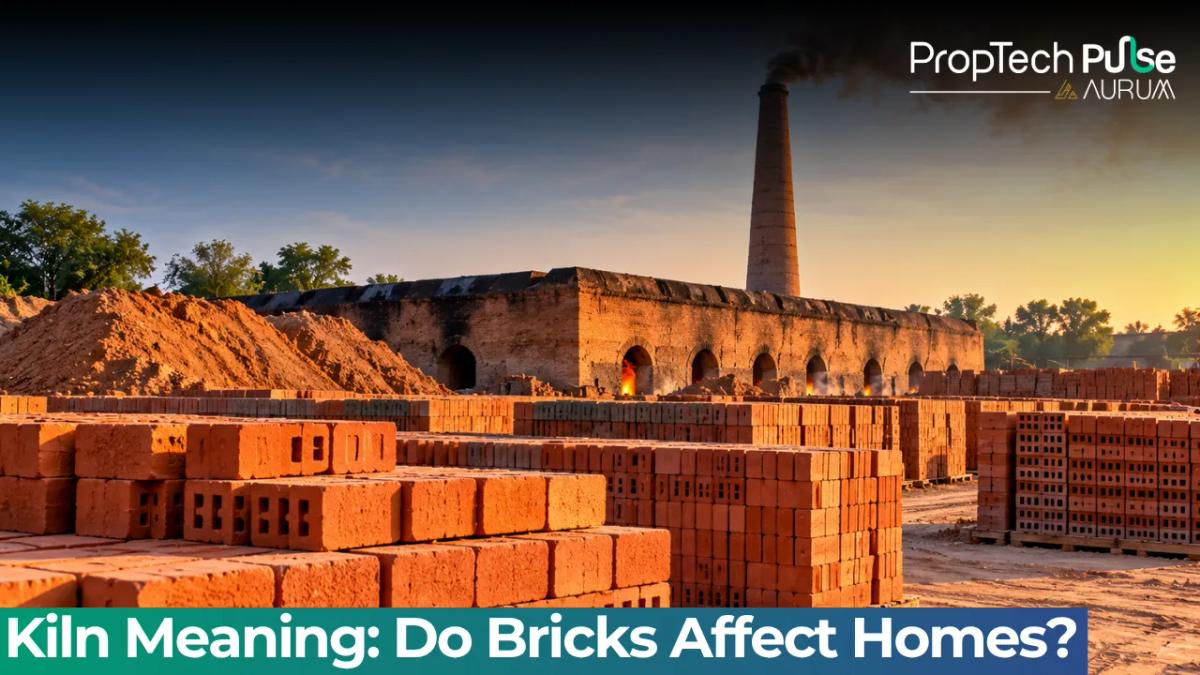
The kiln meaning goes well beyond a simple dictionary definition. Homebuyers often overlook this detail until damp patches appear months after monsoon season. A regulated continuous kiln produces uniform, high-strength masonry units.
An unmonitored clamp operation usually yields uneven bricks prone to moisture damage. When you ask what a kiln actually does, you are really asking how much maintenance liability sits inside the walls before you even move in.
This guide breaks down the mechanics, the environmental rules, and what brick origin tells you about a locality's long-term livability.
What is a kiln? Understanding the kiln meaning and core mechanics
Quick answer
A kiln is a refractory chamber designed to fire materials at high temperatures under controlled conditions. In Indian real estate, brick kilns dominate the construction sector, transforming raw clay into uniform, durable building blocks while adhering to strict environmental standards.
To grasp the actual kiln meaning, look at how heat moves through the chamber. Unlike industrial furnaces that keep metal molten around the clock, brick kilns run on thermal cycles.
Operators load raw clay blocks. They raise the temperature to roughly 1,000 degrees Celsius. They hold it there until the clay vitrifies, then let the structure cool gradually. That slow cooling phase prevents internal cracks and locks in compressive strength.
We usually picture towering chimneys on city outskirts when we hear the word. The same basic architecture serves ceramics, pottery, metallurgy, and agriculture.
Urban expansion keeps the focus almost entirely on masonry supply chains though. Builders need predictable strength ratings. Developers need consistent unit sizes to speed up site logistics. Buyers need walls that do not crack within three monsoon seasons.
Brick kiln operations in India: dominant types and regional mandates
India manufactures billions of clay bricks annually. The sector employs millions across rural districts. These units supply most load-bearing walls for independent houses and mid-rise societies.
Manufacturing processes have split into two clear camps. Intermittent batch systems still operate in pockets. Continuous chambers now dictate market standards.
Intermittent kilns and why they face pressure
Batch kilns follow a stop-start rhythm. Workers stack raw units inside an insulated shell. They fire coal or waste rubber. They maintain peak heat for thirty-six hours. They wait another forty-eight hours for the structure to cool completely.
Only then can operators unload the fired bricks and begin again. Modern Hoffman designs recover some exhaust heat. They still require full shutdowns between runs. Labour costs stay high. Fuel-to-output ratios lag behind newer models. State pollution boards in Punjab, Haryana, and Uttar Pradesh have repeatedly ordered these older units to either install emission controls or shut down permanently.
Continuous kilns: the mandatory shift to Zigzag technology
The Fixed Chimney Brick Kiln ruled northern plains for decades. Air moved straight up the stack. Hot gases escaped quickly. Raw clay blocks sitting near the chimney never reached optimal curing temperatures.
That wasted fuel and released thick black smoke. Regulators forced a design overhaul. The Zigzag modification routes flue gas horizontally across alternating brick rows before it exits the main shaft.
Exhaust air bounces off cold raw blocks multiple times. Residual heat transfers back into the pile. Coal consumption drops by nearly twenty-five percent. Black carbon emissions fall sharply. Battery tunnel kilns take this efficiency further. They run continuously for months without stopping. Gujarat, Maharashtra, and Karnataka mandate these sealed systems for new commercial licences.
Brick grading standards and how kiln meaning impacts quality ratings
Not all kiln output meets construction grade requirements. The Bureau of Indian Standards assigns a firing grade to every batch pulled from modern chambers. Grade F1 bricks require heavy cement mortar and plaster due to surface irregularities.
Builders avoid them for finish work. Grade F5 bricks possess tight pores and sharp edges. Architects specify these for exposed façades and heavy-load partitions. The kiln definition inherently ties directly to these grades.
Uniform heat distribution dictates porosity levels. Inconsistent firing leaves soft cores that crumble under weight. Verifying the firing grade protects buyers from invisible structural debt.
Independent homes built ten years ago often relied on Grade F2 or F3 stock from local batch yards. Those lower-grade materials absorb water rapidly.
They swell slightly during peak summer heat and shrink aggressively during rains. Repeated expansion fractures the lime-cement binder over time.
New apartments sourced exclusively from registered tunnel kilns lock into stable dimensions immediately. Maintenance crews rarely patch cracks on exterior cladding.
Kiln burning versus manual clamp firing: ground-level differences
Large swaths of older housing stock in Bihar, eastern Uttar Pradesh, and West Bengal used bricks pulled from open-air clamp piles.
That method predates modern combustion chambers. The mechanical gap between clamp firing and regulated kiln burning explains why maintenance expenses diverge so wildly between vintage independent homes and freshly handed-over apartments.
| Parameter | Continuous kiln firing | Clamp burning (traditional) |
|---|---|---|
| Heat management | Cycling temperature profile with insulated heat exchange | Open bonfire arrangement, minimal control over airflow |
| Operational cycle | Continuous or heavily optimized batches spanning forty-eight to seventy-two hours | Rapid firing and immediate cooling taking twenty-four to thirty-six hours |
| Fuel efficiency | High thermal recovery and reduced coal dependency per thousand units | Heavy coal usage with significant energy loss through atmospheric radiation |
| Scrap and rejection rate | Below ten percent due to uniform curing and automated stacking | Up to forty percent due to uneven baking, thermal shock, and cracking |
| Impact on wall strength | Consistent compressive strength meeting national masonry standards | Porous structure leading to higher cement demand during plastering |
Those structural gaps appear in daily maintenance. Under-fired clamp bricks act like sponges. Monsoon humidity soaks into the pores. Paint flakes off interior partitions within two years.
Mould spreads behind wardrobes placed against exterior walls. Properly cured kiln bricks hold their shape. Moisture passes through without degrading the mortar bed. Wall thickness stays stable. Plaster bonds firmly.
Why this affects your maintenance bill: Under-fired bricks absorb moisture quickly, leading to dampness and substantially higher cement replacement costs within five years of construction. Verifying the origin of existing walls during due diligence protects against hidden repair liabilities.
You can spot poorly fired bricks during a site visit without hiring a structural engineer. Tap the surface lightly with a steel rod. Sound bricks give a sharp ringing tone.
Dull thuds signal incomplete vitrification. Pour a few drops of water on a cut brick edge. Rapid darkening means high porosity. Slow absorption points to proper kiln curing.
Newer constructions listing Compressed Earth Block or Full Metal Mould fired units typically show stricter quality control. Before committing funds to any major purchase, verify material authenticity aligns with developer promises.
Environmental footprint of brick kilns on residential zones
Masonry production centres warp the air and soil around nearby villages. Black carbon settles on rooftops and coats vegetation. Sulphur dioxide mixes with winter inversion layers to trap particulate matter over low-lying districts.
Residential zones within two kilometres of active burn pits regularly breach permissible PM2.5 thresholds during December and January. Respiratory complaints spike. School closures become common. Lenders factor those seasonal air quality dips into loan pricing for adjacent plots.
Local governments now treat kiln migration as a planning priority rather than an afterthought. State environment departments publish updated maps showing where old clusters shut down and where newer Zigzag units open.
Property owners should cross-reference those maps before buying agricultural land zoned for conversion. Unregistered kilns often ignore groundwater extraction limits.
They strip aquifers dry during peak summer months. Municipalities have started levying heavy penalties on builders who receive bricks from unlicensed fields.
Regulatory frameworks keep tightening. The Central Pollution Control Board requires dust arrestors, closed-loop water recycling, and alternative fuels like biomass briquettes for all newly registered facilities.
Checking that a neighbourhood hosts only APC-certified brick works removes a major uncertainty from your location assessment. Architects counter residual visual clutter by spacing buildings away from industrial edges. They plant buffer species that catch airborne grit. Builders also add double-glazed windows and HEPA filtration to offset external noise and odour.
Before you commit to a property
Matching masonry quality with urban planning realities saves money long after possession. Request manufacturer certificates showing ISI marks and kiln type declarations.
Ask for the latest third-party compressive strength tests stamped on delivery challans. Pull up district-level pollution maps to see which brick fields operate legally today. Verify that the project file submitted to the state RERA authority includes valid environmental clearance documents. Proving the site respects ancient riverbed protections and groundwater withdrawal bans separates weak foundations from invisible regulatory debt.
Frequently asked questions
What is the difference between a kiln and a furnace?
A furnace operates continuously to maintain molten-state metal or glass, keeping temperatures steady throughout the day and night. A kiln functions intermittently or in cyclical batches. You heat the chamber, hold the material at peak temperature to cure it, and then allow it to cool slowly before extracting the finished product. This cycling ensures the material achieves uniform density, which is critical for construction bricks.
What is clamp burning versus kiln burning of bricks?
Clamp burning involves stacking raw bricks in an open-air formation and setting them ablaze with coal. It relies heavily on manual labour and usually takes less than two days, resulting in high rejection rates because parts of the stack burn unevenly. Kiln burning uses an engineered refractory chamber. The heat is channelled precisely, ensuring every brick undergoes the same thermal process, drastically reducing waste and improving structural longevity.
Why are certain kiln types banned or phased out in India?
Older intermittent designs and older continuous Fixed Chimney Brick Kilns release excessive particulate matter and greenhouse gases. State pollution control boards, guided by the Central Pollution Control Board, now mandate Green Kiln technologies like the Zigzag configuration. These designs force exhaust gases to circulate around raw bricks before exiting the chimney, capturing trapped heat and cutting carbon emissions significantly.
Does proximity to a brick kiln lower property value?
Yes, when kilns operate without mandated filtration or comply with outdated emission limits, they degrade local air quality. Properties located within a few kilometres of non-compliant kiln clusters face higher concentrations of harmful particulates and sulphur dioxide. This impacts resident health, increases medical expenses, and makes lenders more cautious regarding long-term valuation stability.
Sources
- Central Pollution Control Board (cpcb.nic.in): Technical guidelines for Best Available Technologies in brick manufacturing (accessed October 2026)
- Ministry of Environment, Forest and Climate Change (moef.gov.in): Ambient air quality monitoring framework and black carbon emission thresholds (accessed October 2026)
- National Housing Bank (nhb.org.in): Policy circulars on sustainable construction practices and green building incentives (accessed October 2026)
Enjoyed this blog article? Visit PropTech Pulse for more interesting blogs.





Ask Pulse Ai anything about real estate

Unlock the Latest in Real Estate
News, Infographics, Blogs & More! Delivered to your inbox.

