New Launch - India Real Estate Report 2026.

Services
Knowledge Hub
Resources
Tools

Ask Pulse Ai
©PropTech Pulse 2025, All rights reserved.


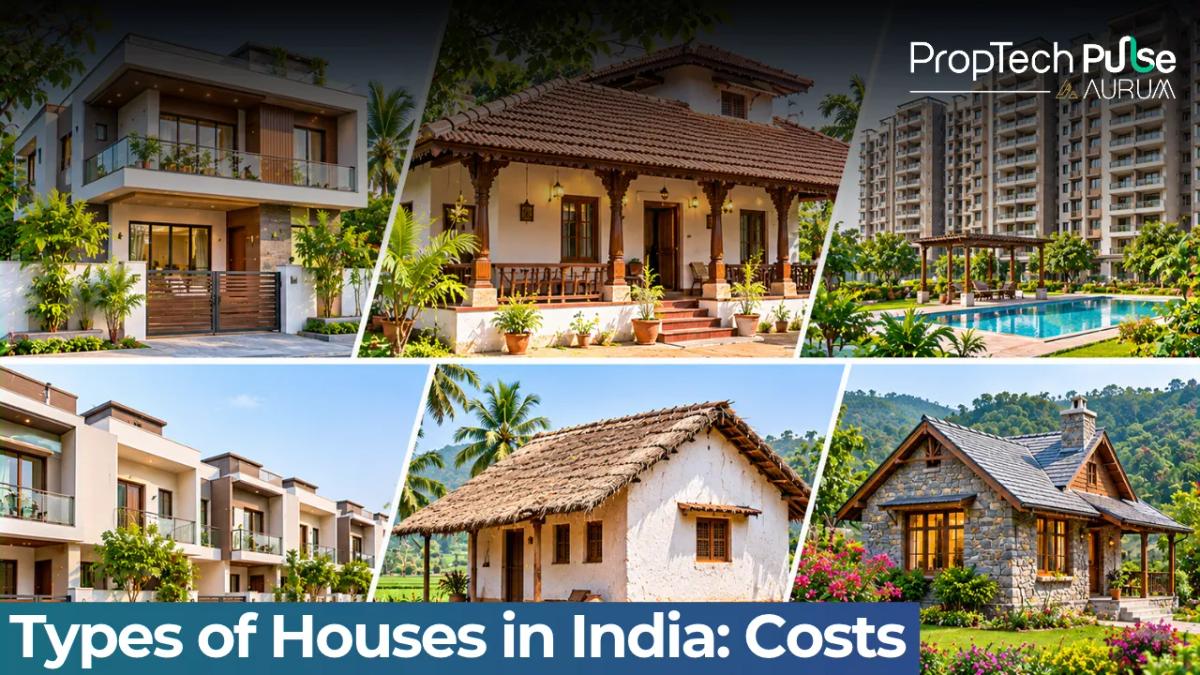
Buying a home involves more than square footage; you must pick a structure that suits your lifestyle and avoids draining savings on endless repairs. The different types of houses in India range from traditional courtyard homes to high-rise apartments.
Each style reflects regional architecture, climate, and urban demand. Before committing, review lifecycle costs, maintenance burdens, and legal restrictions.
Quick Answer: Top Different Types of Houses in India
Quick answer
The main different types of houses in India include traditional vernacular homes (courtyard-style and mud/bamboo structures), historic colonial buildings (British bungalows and heritage properties), and modern urban forms (apartments, independent floors, and villas in gated communities). Your choice depends on whether you prioritize heritage aesthetics and long-term capital appreciation, like a heritage house in Mysore, or low maintenance and security for city living.
Traditional and Vernacular Types of Houses
India's earliest housing designs were practical responses to harsh weather and locally available materials. Architects developed shapes that passively cooled interiors long before electricity reached rural districts.
Understanding the basics of kutcha vs pucca house meaning helps explain why certain earth-toned homes survive severe summers while others crumble within a decade.
Mud, Bamboo, and Thatched Dwellings
These structures dominate dry regions and tribal belts across Madhya Pradesh, Rajasthan, and parts of Northeast India. Builders use rammed earth, cob, and bamboo poles to create lightweight shells.
These materials resist seismic activity while requiring minimal construction energy. Monsoon moisture destroys exposed earthen walls faster than concrete without regular lime washing and drainage management.
Courtyard Homes: Wadas, Nalukettus, and Havelis
Central open courtyards act as thermal lungs for surrounding rooms. Kerala's nalukettu uses sloping tiled roofs for rainwater harvesting, while Maharashtra's wada relies on thick stone walls.
The North Indian haveli prioritizes enclosed family privacy behind ornate street-facing screens. These layouts maximize cross-ventilation, though their massive plot requirements no longer fit city limits.
Colonial and Historic Styles
Pre-independence architecture left a distinct mark on coastal towns and former administrative capitals. These buildings mix European planning with local craft techniques to handle tropical conditions.
Many have been converted into five-star hotels or corporate offices. Scattered private examples still trade hands occasionally.
Defining a British House
A classic British house in India distinguishes itself through high-pitched corrugated iron roofs that shed torrential rain efficiently. Tall wooden casement windows invite evening breezes while elevated stone plinths keep ground damp away from living spaces.
Interiors typically divide social life into separate drawing and dining rooms. Maintaining these features costs heavily over time and demands specialized tradesmen.
House in Mysore
Mysore's real estate portfolio holds a concentrated cluster of British-era bungalows alongside densely packed Old City homes. When people search for a house in Mysore, they usually encounter towering compound walls, polished teak flooring, and grand central staircases.
These designs accommodate the region's naturally cooler hill-station climate. Renovation remains the biggest friction point due to strict archival restoration requirements.
Regulatory Risks for Heritage Homes
Do not assume free rein over a century-old structure. Municipalities in cities like Bengaluru and Mysuru maintain designated conservation zones.
Changing the external facade, enlarging windows, or adding extra floors triggers mandatory Heritage Conservation Committee reviews. Ignoring these protocols results in stop-work notices and forced demolition orders.
Modern Residential Forms in Indian Cities
Vertical living has completely reshaped the Indian skyline, driven by soaring land prices and evolving family dynamics. Mid-segment buyers overwhelmingly prefer structured layouts with predictable monthly expenses over speculative ground-level builds.
Apartments and Independent Floors
High-rise apartment complexes offer standardized construction quality backed by RERA mandates and centralized security. Independent floors grant single-level living without full duplex overhead. Clarify spatial metrics by studying the duplex meaning in India, flat vs house, and area differences. Watch how builders calculate super built-up area versus usable carpet space.
Gated Communities and Villas
Low-density townships appeal to families prioritizing road width, underground utility lines, and dedicated children's play zones. Individual villa plots deliver total autonomy over landscaping, fence height, and exterior finishes. Buyers should review our detailed villa vs apartment comparison guide because lower liquidity slows exits during market dips. Township maintenance fees also scale up quickly as facilities age.
Real Cost of Ownership: A budget of ₹80 lakh for a flat might look straightforward on paper, but adding stamp duty and registration pushes the upfront cash requirement significantly higher. In Karnataka, stamp duty sits near 5%, while Maharashtra charges between 5% and 7% depending on the district and beneficiary status. Factor this additional 5% to 7% levy into your financing plan before booking.
Comparison Table: Construction Cost, Maintenance, and Climate Fit
| House Type | Approx Construction Cost (INR/sq ft) | Maintenance Burden | Ideal Climate | Key Risk |
|---|---|---|---|---|
| Vernacular (Mud/Bamboo) | ₹1,200 – ₹1,800 | High | Dry / Hot (requires seasonal waterproofing) | Termite damage, water seepage |
| Courtyard Homes (Wada/Haveli/Nalukettu) | ₹2,500 – ₹3,500 (restoration) | High | Hot / Semi-arid | Structural dampness, high labor costs |
| British Bungalow / Colonial Style | ₹3,000 – ₹4,500+ | High | All climates (thick walls insulate well) | Heritage regulation limits, pest decay |
| Apartments / Flats | ₹2,000 – ₹3,500 | Medium | All climates (centralized AC/fans avail) | Society disputes, parking shortages |
| Gated Community Villa | ₹2,500 – ₹4,000 | Medium | All climates | Lower liquidity compared to flats |
| Total Estimated Build Cost (Average 1,500 sq ft) | ₹30 Lakh to ₹67.5 Lakh depending on typology | |||
How to Choose the Right House Type
Start by mapping your non-negotiables onto each category. Family size dictates whether you need ground-floor accessibility versus vertical stairs. Your daily commute radius often restricts you to high-density zones where apartments dominate. Villas remain confined to expanding peripheral suburbs.
Decision Rule: Match Your Lifestyle, Beyond the Floor Plan
Your house type should fit how you actually live, not merely how you picture yourself living. Families with young children benefit from the safety and play areas of a gated community.
Salaried professionals juggling tight office hours should prioritize low-maintenance apartments over sprawling bungalows. Verify your borrowing power using a reliable eligibility calculator before locking in a choice.
Frequently asked questions
What are the different types of houses in India?
There are four broad categories of residential property in India: traditional vernacular homes built for local climates using mud, timber, or laterite; historic colonial structures characterized by high ceilings and verandas; modern urban apartments with shared amenities; and standalone villas or independent floors found in gated townships. Each category serves a distinct buyer segment based on budget, family size, and maintenance preference.
Which type of house is best for a hot climate?
Courtyard-style homes and thick-walled colonial bungalows perform exceptionally well in intense heat. The central open spaces in traditional layouts create cross-ventilation that pulls hot air upward, while massive stone or lime plaster walls absorb solar radiation during the day and release it slowly at night. Modern insulated concrete slabs with rooftop gardens also work effectively, though they require active cooling systems.
What is a house in Mysore called?
Most older residential buildings in Mysore are referred to as heritage bungalows, Old City homes, or colonial villas depending on their era and architectural style. These properties typically feature expansive compound walls, teak wood accents, and grand staircases designed to accommodate the city's cooler hill station temperatures. They represent a unique inventory where historical preservation mixes naturally with modern township development.
How much does a British bungalow cost in India?
Pricing varies drastically based on location and preservation status. A standard new-build colonial replica in a township will cost between ₹3,000 and ₹4,500 per square foot. Genuine heritage listings, particularly those in established neighborhoods of Bangalore, Mysuru, or Chennai, carry premium valuations that often exceed ₹10,000 per square foot due to land scarcity and architectural rarity. Financing these assets usually requires specialized loan products.
Difference between independent house and apartment.
An independent house gives you complete autonomy over the structure, boundary walls, and alterations, which appeals to buyers wanting maximum privacy and customization. An apartment places you within a multi-owner society where maintenance responsibilities, rule enforcement, and aesthetic choices are shared. While independent homes offer greater freedom, they demand higher daily management and generally incur larger municipal tax bills compared to flat owners.
Are old colonial houses safe to buy?
Historically sound structures built with lime mortar and thick masonry are generally safe, but you must commission a thorough structural audit before purchase. Builders who reused salvaged bricks sometimes cut corners on load-bearing capacity. Also, legacy wiring and plumbing inside these walls often fail inspection, meaning you will face significant hidden renovation costs immediately after possession. Check local heritage committee rules to avoid legal penalties for unauthorized remodeling.
Enjoyed this blog article? Visit PropTech Pulse for more interesting blogs.




Ask Pulse Ai anything about real estate

Unlock the Latest in Real Estate
News, Infographics, Blogs & More! Delivered to your inbox.

