New Launch - India Real Estate Report 2026.

Services
Knowledge Hub
Resources
Tools

Ask Pulse Ai
©PropTech Pulse 2025, All rights reserved.


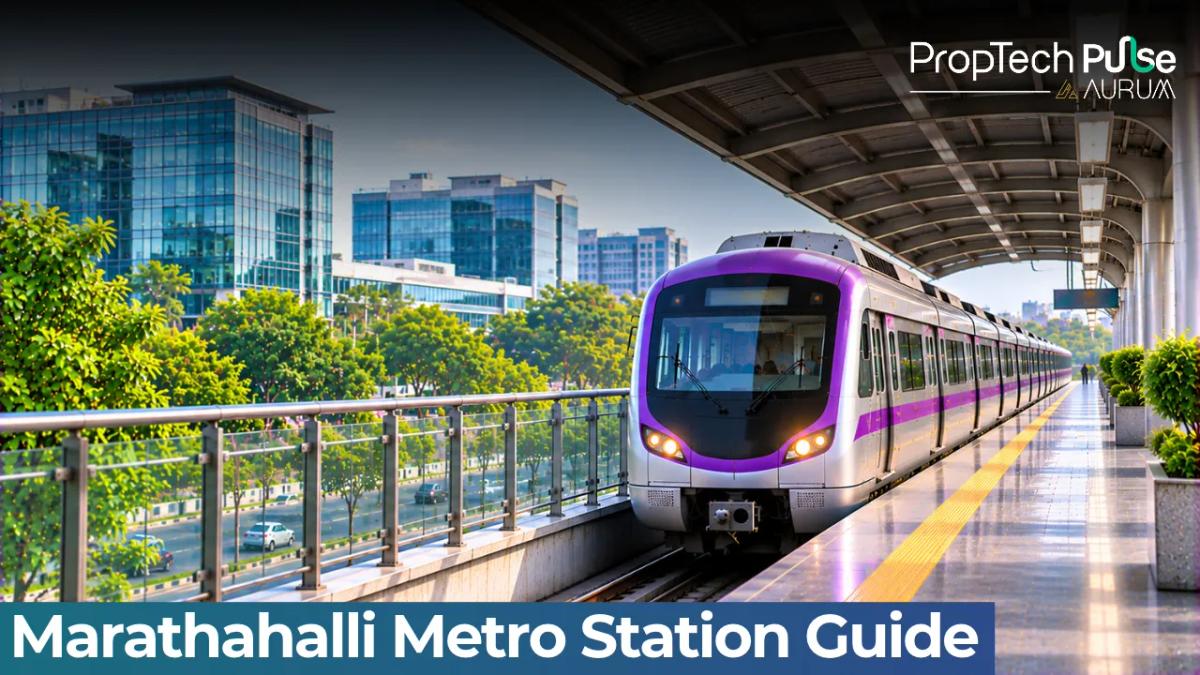
Marathahalli commuters know the feeling. You sit on the Outer Ring Road or at the old bridge, watching the hours bleed into rush hour while trying to reach Electronic City, Whitefield, or Central Silk Board.
For years, the only way out has been crawling forward in gridlock. That changes when the new Marathahalli metro station opens in December 2026.
The new Blue Line Phase 2A track will run on a raised viaduct parallel to the existing road. Station framing is already visible, but ground-level traffic remains gridlocked until the dedicated underpass opens next year.
We cover the layout, the route, and interim travel fixes below.
Marathahalli metro station location and layout
The new station sits squarely on the raised viaduct directly beside the existing Marathahalli Bridge flyover, just past the intersection where ORR meets Hosur Road.
Because the design uses a high-platform layout, passengers board from street level using ramps and elevators built into the approach roads on both sides of the junction.
Platform type: Double-track side platforms.
Accessibility: Standard lift access to the concourse, escalators to the upper levels, and foot-over-bridge integration connecting the eastern and western sides of the junction.
Construction status: Pile foundations and pier structures are largely visible across the junction, with the steel segments being lifted into place through late 2025 and 2026.
Quick answer
The Marathahalli metro station is an upline stop on the Blue Line Phase 2A, set to open in December 2026. It sits directly alongside the existing Marathahalli Bridge flyover on Outer Ring Road, designed to take heavy commuter load off the ground-level choke point heading toward Electronic City.
Phase 2A blue line route and key stops
The Marathahalli stretch belongs to BMRCL's Phase 2A Blue Line. It runs from Central Silk Board all the way north to KR Puram. Eventually, the line extends to the KIAL Terminals at the new airport.
This is the same corridor feeding IT hubs in Bellandur, Bommasandra, ISRO Layout, and Whitefield.
The route covers three major employment hubs. Key stops include Central Silk Board, Bannerghatta Road, Kadugodi, and Marathahalli itself.
Services continue through Bommanahalli, HSR Layout, EPIP Zone, Electronic City, and Bommasandra. Northern legs reach Peenya, KR Puram, Jalahalli, and the airport terminals.
This route matters because it stitches together those employment zones into one uninterrupted ride. Instead of changing buses halfway through a commute or sitting in a cab waiting at traffic signals, you stay on one train.
If you're buying or renting close to a station like this, the rental premium usually settles between 10 and 15 percent once the line becomes fully operational. The catch is timing.
Prices get bid up during construction, so the true yield benefit often arrives a full quarter after the trains start running.
Expected timetable and platform features
Namma Metro's urban corridors typically run first and last services mirroring the city-wide standard. Expect the first run around 5:00 AM and the last service wrapping up near 11:00 PM from the terminal stations.
Peak frequency on the busy Blue Line stretches lands at five to seven minutes per train during morning and evening rush hours. Midday and late night slots widen this gap to ten to fifteen minutes.
Upline parking is expected at most outer stations and select intermediate halts, though Marathahalli sits inside a densely packed urban zone.
Car-pooling and BMTC feeder routes will likely form the bulk of the last-mile connection here rather than massive multi-storey car parks.
Marathahalli nearest metro stations you can use today
The station isn't operational yet, but locals waiting for the December 2026 opening have found viable metro options close by. Your best alternative depends entirely on your daily destination.
Westbound commuters (Central Silk Board, Koramangala, Bannerghatta):
Kundalahalli sits roughly 2.7 km east of the junction on the Pink Line. From there, you hop on the metro and head west. Total door-to-door time adds thirty to forty minutes compared to a direct ride because of the surface transit required.
Northbound travelers (Whitefield, KR Puram, Airport):
If you've already made it past the Marathahalli traffic jam, KR Puram serves as the nearest active interchange. It connects you to the Purple Line heading toward Majestic and Yesvantpur. Most riders combine a bus or cab from the junction before boarding the train.
| Feature | Kundalahalli Metro (Pink Line) | KR Puram Metro (Purple/Blue Interchange) |
|---|---|---|
| Direcitonal fit | Westbound commuters heading to Central Silk Board or HSR Layout | Eastbound or Northbound commuters targeting Whitefield, JP Nagar, or Majestic |
| Approximate surface travel time | 2.7 km auto/bus via ORR; ~15 mins off-peak, up to 40 mins peak | Mixed surface travel (~30–40 mins); heavy dependency on traffic flow towards KR Puram |
| Last mile cost estimate | ₹60 to ₹90 auto fare | ₹150 to ₹250 cab/auto fare depending on distance and surge pricing |
| Frequency match | Pink Line operates every 5–8 mins during peak hours | Both Purple and Blue lines intersect; combined frequency reduces wait times |
Surviving the ORR bottleneck until the bridge underpass and metro open
Above these commuters, the metro framework continues its slow rise. Below that frame, the road remains heavily congested.
The old Marathahalli bridge got upgraded to a flyover a few years ago, but the real relief depends on the long-awaited Marathahalli bridge underpass. That tunnel aims to funnel traffic straight past the signal-heavy junction.
Road conditions stay noisy even after the underpass drops. Construction vehicles and shifting lanes dominate the morning window between 7:30 AM and 9:30 AM. Lanes shrink constantly during this period.
Traffic studies on the Outer Ring Road confirm that peak delays often stretch to ninety minutes just to cover ten kilometers heading toward Electronic City.
Alternative transit tip The BMTC 280G and 280J buses run frequent services linking Marathahalli directly to Rajajinagar Bus Terminal and Electronic City IT park, allowing you to bypass the worst of the central ORR merge points.
Follow these routing adjustments for the interim months:
- Avoid turning left onto Hosur Road between 8:15 AM and 9:30 AM if heading south. The merge point hits maximum saturation fast.
- Consider the alternate ORR ring routes. A quick diversion onto NICE Road Bangalore route toll charges bypasses much of the friction heading west, though you will still encounter typical ORR slowdowns.
- Track the Marathahalli bridge underpass construction updates closely. Once that tunnel fully channels traffic straight through without hitting junction lights, road capacity improves dramatically. Don't bank on zero congestion until the metro takes over.
How a future metro drop changes rental yields nearby
Rail infrastructure announcements move property markets quickly. In areas surrounding a major station like Marathahalli, developers price in the expected completion date well ahead of handover.
Buyers who lock in a flat or rented office space six months before the December 2026 opening usually pay the pre-opening premium. They then watch capital appreciation compound once daily commuters arrive en masse.
Office leases near the station behave differently. Corporate tenants looking at spaces along the ORR-Bellandur stretch factor the Blue Line heavily into their location decisions.
Spaces within walking distance of a station built above ground consistently command higher occupancy and lower vacancy cycles.
Investors eyeing residential plots further out near the property rates near the upcoming Kumbalgodu metro stop often see slower initial traction. Those sites are still filling in residential density. Marathahalli moves faster due to existing commercial gravity. Meanwhile, checking the Bangalore Namma Metro Green Line route map helps you understand how the city's overlapping transit arteries create distinct zones of rapid growth.
Before you switch to the Blue Line
The metro won't magically erase every trip problem overnight. Platform layouts, BMTC integration, and parking logistics take a quarter or two to stabilize.
Your immediate strategy should focus on surviving the bridge underpass build-out using alternate bus routes and avoiding peak turn-off times. Mark December 2026 as your hard target for re-evaluating commutes, leasing renewals, or property purchases.
By then, the difference between driving past the old flyover and stepping onto an air-conditioned Blue Line platform will be stark.
Frequently asked questions
When will Marathahalli metro station open?
The Marathahalli metro station is scheduled to become operational in December 2026 as part of the Blue Line Phase 2A rollout. While pilot trials and commissioning activities usually begin a few months prior to the official launch, this is the confirmed completion window BMRCL is targeting for full passenger entry. Until the trains start moving, commuters must rely on surface transport options.
Which metro line connects to Marathahalli?
The station sits on the Namma Metro Blue Line Phase 2A, covering the stretch between Central Silk Board and KR Puram before eventually extending to the KIAL Terminals at the new Kempegowda International Airport. This specific segment connects several critical IT corridors, including Bellandur, Bommasandra, ISRO Layout, and Whitefield, making it a vital north-south artery for Bengaluru.
What is the nearest metro station to Marathahalli?
Right now, the nearest operational metro stop is Kundalahalli Station on the Pink Line, located roughly 2.7 kilometers east of the Marathahalli junction. Commuters currently traveling towards Central Silk Board or Koramangala often take an auto-rickshaw from Marathahalli back to Kundalahalli to hop on the train. This extra transfer adds twenty to thirty minutes to your daily travel time.
Will there be parking at Marathahalli metro station?
Parking availability at Marathahalli remains limited due to the dense urban surroundings of the junction. While Namma Metro provides extensive multi-storey parking facilities at most of its outer terminals and interchange hubs, central stations like Marathahalli tend to prioritize pedestrian and feeder bus access. Drivers are advised to plan for shared mobility or public transit to avoid parking searches.
How long does it take to reach Electronic City from Marathahalli metro?
Once the Blue Line runs regularly, the journey from Marathahalli to Electronic City is projected to take approximately twelve to fifteen minutes by train. This removes the typical sixty-minute-plus surface traffic delay experienced on the ORR flyovers during peak business hours. Trains operate at high frequencies of five to eight minutes apart throughout the day.
Enjoyed this blog article? Visit PropTech Pulse for more interesting blogs.





Ask Pulse Ai anything about real estate

Unlock the Latest in Real Estate
News, Infographics, Blogs & More! Delivered to your inbox.

