New Launch - India Real Estate Report 2026.

Services
Knowledge Hub
Resources
Tools

Ask Pulse Ai
©PropTech Pulse 2025, All rights reserved.


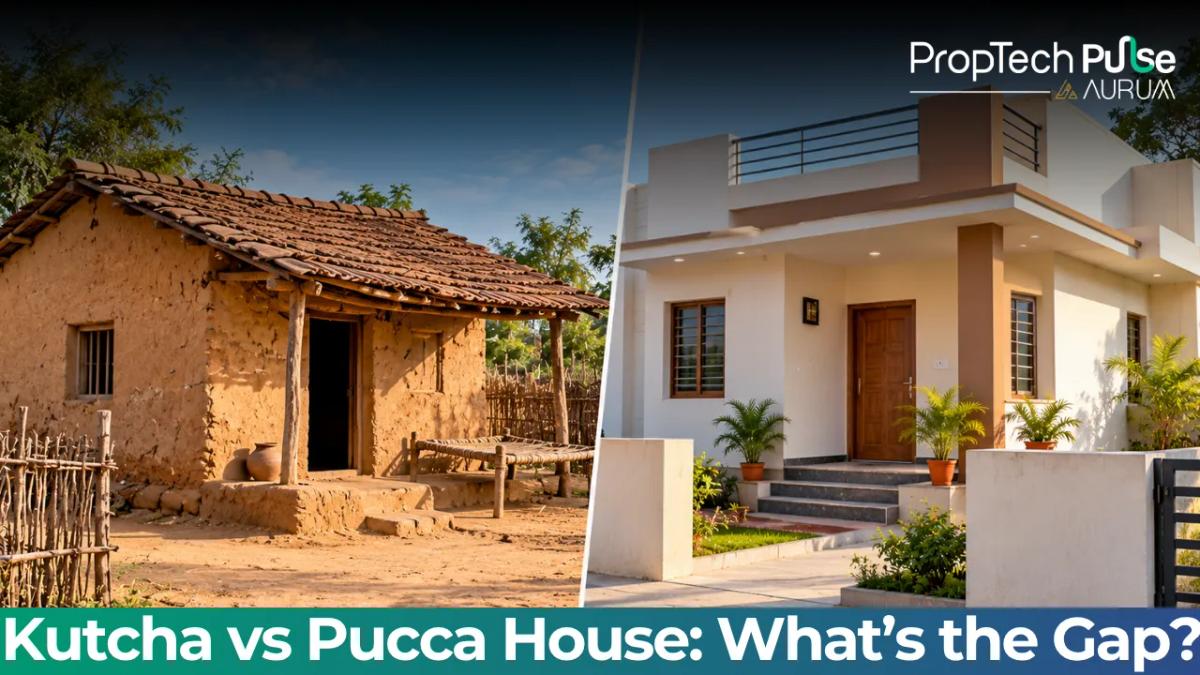
What is a Kutcha House?
Quick answer
A kutcha house is a temporary structure where walls and roofs are built from perishable materials like mud, bamboo, grass, or unburnt bricks. Because the structure degrades quickly, banks do not accept it as loan security, and it falls outside formal property insurance coverage.
Kachcha Houses: Common Materials and Variants
The spelling variation "kachcha" appears frequently in colonial-era records and older municipal documents, but it describes the same structure type. Most katchcha houses found across northern plains use a woven bamboo framework stuffed with dried river reeds or locally pulled mud. Coastal belts favour casuarina poles and coir. Roofing usually consists of thatched palm leaves or a thin layer of clay tiles mixed with cow dung. This technique keeps interiors cool in summer but requires complete replacement every two to three heavy rainfall cycles. Flooring remains compacted earth, sometimes mixed with lime, but rarely treated with cement or concrete slabs. These variants survive well in drought-prone regions because they allow moisture evaporation, yet they collapse rapidly during severe flooding. They also lack fire resistance unless builders apply thick mud coats over the bamboo skeleton.Semi Pucca House Explained
Over thirty percent of Indian households live in what statisticians call semi pucca houses. These sit comfortably between mud huts and permanent homes, but they carry confusing labels depending on who counts them. A family might replace a fragile grass roof with corrugated galvanized iron or aluminium sheets while leaving the underlying walls untouched. Some add a single layer of burnt bricks to support the load, skipping the concrete columns entirely. Lenders struggle with semi pucca structures because insurance premiums jump sharply. Insurers classify these buildings as moderate to high hazard zones, since the metal roof conducts heat and amplifies internal temperatures, making living conditions uncomfortable even if the shell stands firm. Local masons often patch the frame with single-wythe brick walls lacking cross-wall connections. In earthquake-prone zones, those isolated walls act like dominoes, transferring lateral force straight onto fragile earth floors. Municipal inspectors frequently reject final occupancy certificates for such hybrids because they cannot guarantee basic fire resistance or wind shear stability during monsoon gusts. Microfinance institutions typically refuse to treat these walls as primary collateral, forcing borrowers toward high-interest personal loans instead.Kutcha House vs Pucca House vs Semi Pucca House
The classification system helps planners track infrastructure gaps, but buyers use it to gauge long-term risk. The table below breaks down the structural and legal differences that actually affect a transaction.| Feature | Kutcha House | Semi Pucca House | Pucca House |
|---|---|---|---|
| Main Wall Material | Mud, bamboo, grass, unburnt brick | Mixed: Mud base with partial brick or stone reinforcement | Burnt brick, stone, reinforced concrete, timber |
| Roofing | Thatch, leaf, tile with mud mortar | Corrugated metal sheets, asbestos tiles | RCC slab, concrete, permanent metal or tile roofing |
| Flooring | Unreinforced earth or mud | Mixed dirt, laterite, or basic ceramic tiles | Cement, marble, granite, vitrified tiles |
| Bank Loan Eligibility | Ineligible as primary security | Limited approval; low Loan-to-Value ratio | Full residential loan access up to standard LTV limits |
| Typical Lifespan | Less than 5 years with minimal upkeep | 5 to 10 years | 30+ years with regular maintenance |
How Surveys Define "Pucca": NSS vs NFHS
National statistics often look contradictory when comparing housing reports. The Ministry of Statistics and Programme Implementation relies on the NSS survey, which focuses heavily on walls and roofs. The National Family Health Survey (NFHS) takes a stricter approach, adding floors and habitability checks like electricity connection, functional toilets, and drainage systems into its count of true pucca shelters. This mismatch explains why one annual release might show a rise in pucca houses while another indicates stagnation. For a buyer tracking micro-market development, treat government aggregate percentages as directional indicators, not absolute measures of living standards.Housing Conditions Across India
Recent data from the NSS round covering 2020-21 puts the national pucca share at roughly 85%, but the urban-rural divide tells a sharper story. Nearly 97% of urban dwellings fall into the pucca category, leaving just over three percent still reliant on temporary structures. In rural belts, the pucca share sits closer to 79.5%. Only a fraction of these homes meet full amenity thresholds. About 28.4% of all surveyed houses had separate kitchens, proper toilets, bathrooms, and functional waste disposal systems combined. Rural areas lag significantly, with just 13.3% achieving that baseline. Social group disparities remain steep. Scheduled Tribe households account for roughly 38% of the country's kutcha housing stock, followed by SC populations at 18.4%. Government interventions have shifted thousands of structures toward permanent status. Over 22 million houses registered under the PMAY-Gramin programme were completed against targets, though state-wise execution varies wildly. Nagaland, Sikkim, and Meghalaya reported completion rates hovering around twelve to nineteen percent as of mid-2023, highlighting terrain and supply chain bottlenecks that delay upgrades. Demand for permanent housing clusters drives rapid price correction in fringe areas. When the government announces PMAY-G sanctioned plots near a hamlet, informal transit roads appear within weeks. Traders set up kirana stores along dirt paths, forcing local authorities to finally survey waste lands for commercial zoning. Buyers watching these transitions often mistake early speculation for stable appreciation. Track actual service delivery milestones like water tanker routes and electricity transformers before pricing your entry point against theoretical future values.Market Reality Check Properties located near ongoing government housing clusters appreciate faster once roads and electrification arrive. Use the 3 easy methods to calculate the market value of a property to see how infrastructure spillovers impact pricing tiers before committing capital.
Financial and Legal Implications
Mainstream lending institutions treat kutcha construction as high collateral risk. Because the underlying asset erodes yearly, banks refuse to accept these structures as primary security for mortgages. Your Loan-to-Value ratio effectively hits zero until the building achieves permanent status. Insurance companies handle these assets similarly. Standard homeowner policies exclude kutcha and semi pucca buildings from damage cover unless bundled into specialized micro-insurance products designed specifically for rural disaster recovery. Municipal bodies treat structural upgrades as a tax event. As a plot shifts from temporary shelter to permanent dwelling, property tax slabs often move from nominal rural levies to higher municipal tiers. Owners must notify their local revenue office before starting major masonry work, otherwise the structure gets tagged illegal and faces demolition threats during routine audits. Legal compliance also plays a role in rural land transactions. Municipal bodies require pucca or semi pucca verification before issuing occupancy certificates or connecting commercial-grade power meters. State RERA portals govern project-based approvals, but individual rural plots skip that funnel entirely until a developer enters the space. If you plan to secure future financing, reviewing types of mortgage in india clarifies exactly which lenders entertain partial-construction collateral and what documentation triggers their approval gates. Liquidity improves drastically once a buyer secures a pucca classification, allowing them to access secondary market pricing rather than struggling through informal peer-to-peer deals.Health, Safety and Climate Resilience
Dampness remains the primary health threat for kutcha structures. Earth floors absorb groundwater during heavy rains, raising indoor humidity levels and promoting fungal growth that aggravates respiratory conditions. Stagnant moisture also attracts rodents and insects seeking nesting sites. Climate resilience exposes these buildings to regional vulnerabilities. Cyclonic winds in Odisha and coastal Andhra routinely demolish thatched roofs and bend bamboo frames. Floodwaters in Bihar and Assam wash away foundation bases because cut mud lacks cohesion once submerged. Builders in earthquake-prone hill states like Uttarakhand and Himachal Pradesh face additional scrutiny. Permissible loads for unbraced mud walls drop drastically in seismic zones, making retrofitting expensive compared to new construction. Structural engineers recommend steel mesh binding or wooden bracing even for temporary shelters in these regions. Tropical ventilation strategies fail when walls wick moisture upward, trapping sweat and creating breeding grounds for vector-borne illnesses during late monsoons. Installing simple plinth drains cuts indoor dampness by half, a cost-saving measure many rural contractors skip to win initial bids.Upgrading a Kutcha House: Steps to Pucca Status
Transitioning from kutcha to pucca follows a logical sequence rather than sudden reconstruction. Most families start by replacing the roof. Switching from thatch to concrete slab or RCC roofing stops leakage immediately and increases usable attic storage. The second phase addresses walls, often beginning with lime surkhi plaster over existing mud layers to bind cracks before adding brick cladding. Flooring upgrades demand soil testing first. Expansive black cotton soils shrink and swell dramatically, cracking rigid cement floors. Using stabilizers or installing floating timber screeds prevents subsidence fractures in those zones. Builders in earthquake-prone hill states like Uttarakhand and Himachal Pradesh face additional scrutiny. Permissible loads for unbraced mud walls drop drastically in seismic zones, making retrofitting expensive compared to new construction. Structural engineers recommend steel mesh binding or wooden bracing even for temporary shelters in these regions. Material logistics often dictate project timelines in tier-3 towns and villages. Sand and gravel shipments face seasonal road bans during monsoons, stalling foundation work precisely when weather conditions demand rapid enclosure. Sourcing certified Portland cement from district centres adds fifteen to twenty percent to baseline costs once transport margins stack up. Rural masons frequently substitute branded products with bulk industrial-grade mixes, trading compressive strength for speed. Verify mix ratios visually before approving plaster layers; cheap lime substitutes wash away in heavy rainfall, exposing underlying brick joints to moisture ingress. The quickest financial bridge for eligible households involves applying for central assistance through the affordable housing schemes in india pmay 2 0 guide. State governments supplement these grants, though disbursement delays remain common in remote districts where supply chains fracture during lean seasons. Builders typically charge premium rates for structural conversion work because demolition risks expose hidden defects inside aged walls.Before You Pay the Token
Evaluate whether upgrading costs more than purchasing a semi-finished pucca unit nearby. Conversion expenses often surpass buying residual inventory from local developers clearing unsold margins. Verify land titles properly before investing in foundations, since disputes surface later when builders return to claim payment increments. When dealing with incomplete listings or ambiguous site conditions, step back and consult a structured checklist so you don't miss critical red flags early. Follow how to buy a house india to map your decision timeline and budget boundaries before negotiating further.Frequently asked questions
What is the exact difference between a kutcha house and a pucca house?
A kutcha house uses natural, non-permanent materials like mud, bamboo, or grass for its walls and roof. These materials degrade within a few years and offer little protection against weather extremes. A pucca house relies on engineered materials such as burnt bricks, concrete, and stone. The structural difference determines loan eligibility, insurance availability, and long-term durability.
Can I get a home loan for a kutcha house in India?
Almost never through standard banking channels. Banks classify kutcha structures as high-risk collateral because the asset value declines annually. The loan-to-value ratio typically drops to zero until you complete the upgrade process. Some niche rural finance providers may offer small personal loans, but these carry high interest rates and strict repayment terms that exceed standard mortgage affordability benchmarks.
What percentage of Indians live in kutcha houses today?
Recent national survey data shows roughly fifteen percent of total households occupy kutcha or semi-pucca structures, though rural areas remain disproportionately affected. Urban pockets have largely transitioned to permanent housing, leaving kutcha dwellings concentrated in isolated tribal regions and flood-prone eastern districts. The exact percentage shifts quarterly as state-level PMAY construction pipelines deliver new units.
Is a semi pucca house safe for families to live in?
Semi pucca houses provide better wind protection than full kutcha huts but introduce new thermal discomfort. Corrugated metal roofs trap intense daytime heat and conduct rain noise heavily. While structurally stable enough for basic occupancy, they fail to meet modern insulation standards. Families often prioritize upgrading the roof before addressing walls to improve livability during peak summer months.
Does stamp duty change if a property is registered as kutcha versus pucca?
Stamp duty hinges on the circle rate and land value, not the building's condition. Local bodies sometimes revise ad-valorem charges down the line, but they usually trigger that revision only after you submit fresh construction permits. Buyers paying transfer taxes on plots with standing kutcha structures should expect standard state-duty application unless they apply for exemption clauses meant for affordable housing conversions.
Sources
- Open Government Data Platform India: Distribution of households by pucca and kutcha house (accessed October 2026)
- Ministry of Health and Family Welfare: National Family Health Survey methodology and demographic breakdowns (accessed October 2026)
- Reserve Bank of India: Banking guidelines on construction norms and property valuation metrics (accessed October 2026)
Enjoyed this blog article? Visit PropTech Pulse for more interesting blogs.





Ask Pulse Ai anything about real estate

Unlock the Latest in Real Estate
News, Infographics, Blogs & More! Delivered to your inbox.

