New Launch - India Real Estate Report 2026.

Services
Knowledge Hub
Resources
Tools

Ask Pulse Ai
©PropTech Pulse 2025, All rights reserved.


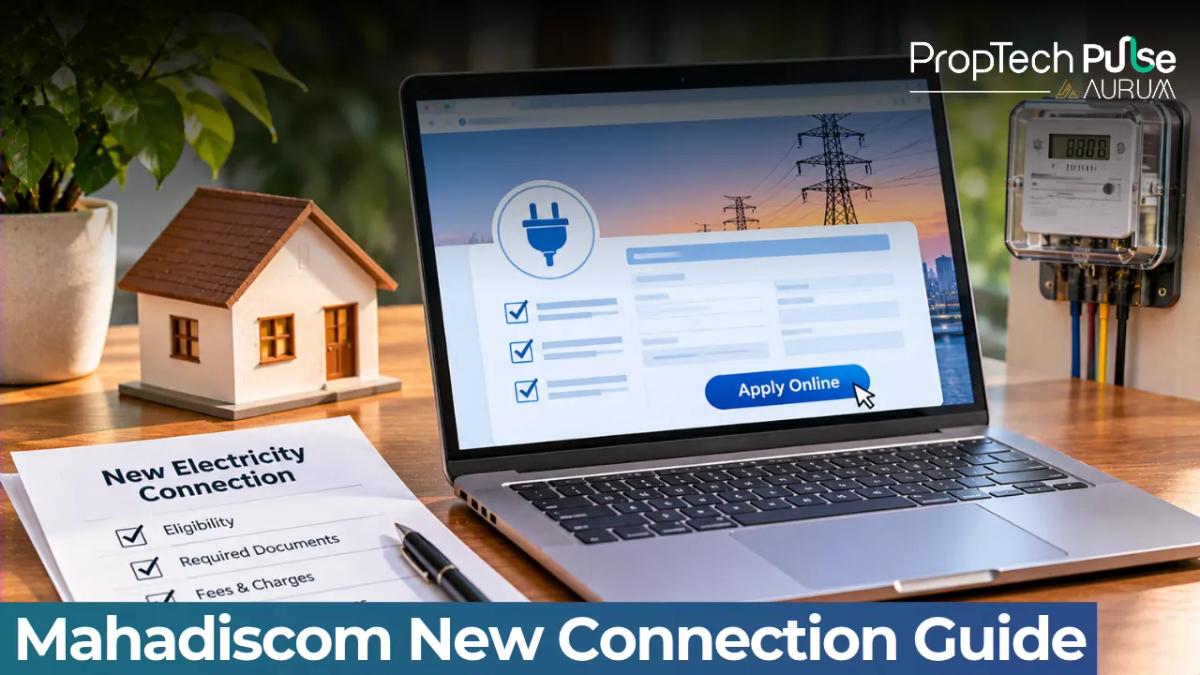
Securing a fresh electric supply tops the priority list after legal paperwork. Applying for a Mahadiscom new connection now runs entirely through the official MSEB digital portal. But sorting out security deposit multipliers, service line allowances, and document stamps still trips up many applicants. This guide breaks down exactly which forms to submit and how the upfront fees calculate.
Who is MAHADISCOM, MSEDCL and Mahavitaran?
Quick answer
The state discom responsible for power distribution in Maharashtra goes by three names depending on the document: MAHADISCOM (regulatory entity), MSEDCL (distribution company), and Mahavitaran (consumer brand and mobile app). The application process, tariffs, and customer care channels remain identical across all three designations.
MSEB splits distribution work between a few operating arms. MSEDCL handles daily infrastructure and supply. MAHADISCOM functions as the regulatory fund society for innovation financing.
Consumers see the Mahavitaran brand when logging into apps or walking into regional offices. Search for a Mahavitaran new connection or open the web portal; you are dealing with the same grid operator.
Types of Connections You Can Apply For
MSEB categorises connections by voltage level, sanctioned load, and end-use purpose.
When applying for a Mahadiscom new connection, matching your category to the correct form speeds up approval and prevents back-and-forth queries at the zonal office.
Domestic (LT-I to LT-XV)
Low tension residential supply covers flats, independent houses, and rental units. Slants run from LT-I (single-phase, up to 3kW) to LT-XV (three-phase, typically 5kW to 10kW for larger homes or home offices).
Most newly handed-over apartments default to three-phase LT because modern units require simultaneous compressor, inverter, and lighting loads.
Commercial & Industrial (HT & LT)
Shops, showrooms, restaurants, warehouses, and light manufacturing fall here. High tension (HT) connections kick in above 33kV feeders for large facilities, while low tension commercial covers standard retail and office fits.
These attract higher fixed demands and peak-shift penalties compared to households.
Agricultural Connections
Farm pumps, irrigation networks, and agri-processing sheds receive separate agricultural feeders. These connections carry heavily subsidised energy rates and longer service line allowances, but require land revenue proof and dedicated transformer zoning.
Step-by-Step: How to Apply for a MSEDCL New Connection Online
The entire workflow lives on the official MSEB customer portal and the Mahavitaran mobile application. Paper submissions have been largely phased out unless you fall under special rural outreach schemes.
- Navigate to the customer services dashboard on the official MSEB website and select the new connection module. Download the appropriate application form: Form D1 for domestic and commercial users, or Form D2 for agricultural lines.
- Create a user account using your registered mobile number and email. Verify both endpoints via OTP. The RMS system ties your MAHADISCOM new connection request to your Aadhaar-linked contact, which accelerates SMS updates.
- Fill in the sanctioned load, consumer category, and feeder details. If you are unsure of your local substation zone, visit the district map page linked from the header or call your zonal helpline for the nearest node.
- Upload scanned copies of identity proof, property documents, and the latest occupancy certificate. Residential applicants also need a no-objection certificate from the society secretary or layout developer, especially in gated communities.
- Preview the demand draft or trigger net banking payment for the provisional deposit. The portal calculates the exact amount before you lock it in. Retain the transaction ID and receipt PDF.
- Submit the form. You will receive an acknowledgment number immediately. Save it alongside your payment proof. Field engineers pull these numbers for site surveys.
Complete Document Checklist by Category
Missing one paper causes more delays than pricing errors. Gatekeepers at the zonal desk return files within 48 hours if the packet lacks stamps, signatures, or mismatched addresses. Keep everything aligned to your PAN or Aadhaar spelling.
| Document Type | Domestic | Commercial | Agricultural |
|---|---|---|---|
| Identity Proof (Owner/Absolute Lessee) | Aadhaar / Voter ID | GST Certificate / Proprietorship Proof | Ration Card / Land Title |
| Property Proof | 7/12 Extract / Sale Deed / Lease Agreement | Shop Establishment License / Municipality Tax Receipt | Draft 7/12 / Bhu Naksha Printout |
| Society / Developer NOC | Yes, if part of a flat development | No, unless shared infrastructure applies | No |
| Construction Completion Proof | OC or CC Copy | Building Plan Sanction + OC | Farm Utility Letter |
| Additional Concession Forms | Women Ownership Declaration / SC-ST Certificate | MSME Registration Copy | State Agriculture Subsidy Allocation |
Address alignment matters. If your sale deed shows a different locality code than the municipal ward, attach a property due diligence summary or a cantonment board extract explaining the shift. Zonal clerks reject files on geography mismatches faster than billing disputes. Always verify your MAHADISCOM new connection application details before final upload.
Understanding MAHADISCOM Tariffs & New Connection Costs
Tariff Headings Explained
When your approved MAHADISCOM new connection activates, your monthly invoice breaks down into distinct components.
Domestic consumers mainly see energy charges per kilowatt-hour, a fixed monthly levy tied to sanctioned load, and peak-off-peak variations if you qualify for differential pricing.
Commercial accounts face additional demand charges, power factor penalties, and fuel adjustment clauses. Agricultural lines draw flat seasonal tariffs or heavily discounted pump-set rates under the state irrigation budget.
Real Calculation Example
Predicting upfront costs requires matching your sanctioned kilowatts to the standard MSEB multiplier matrix. Below is a transparent model for a typical three-phase household setup in Pune or Nashik.
| Charge Head | Base Rate Applied | Amount (₹) |
|---|---|---|
| Security Deposit | ₹1,100 per kW × 5kW | ₹5,500 |
| Meter Installation & Testing | Flat slab for 3-phase smart meter | ₹2,200 |
| Standard Service Line (up to 100m pole-to-house) | Included in base allocation | ₹0 |
| Processing / FAC Surcharge | Fixed administrative levy | ₹1,100 |
| Total Estimated Outlay | Before GST & distance extras | ₹8,800 |
The security deposit scales linearly with your applied kW. If your house draws 8kW because you plan dual inverters, central AC, or EV charging points early, bump the multiplier accordingly.
Service lines beyond 100 metres incur per-kilometre construction levies billed at actuals.
Women-owned properties and scheduled caste households often qualify for slab migration or deposit rebates under MERC concession orders.
Verify current discount percentages on the regulatory commission portal before payment. Once activated, regular bills merge the deposit amortisation quietly over the first twelve months.
Common rejection trigger: Applying for HT classification when your load sits below 10kW. The system auto-rejects misclassification and forces you to restart. Stick to LT-III or LT-VII for standard residential draws.
After activation, reading your meter cycles aligns with the district’s monthly collection window. You can manage payments, download statements, and raise fault tickets through the same dashboard.
Review our detailed walkthrough for checking older dues or splitting multiple unit bills before switching to the new unified ledger.
Site Inspection, Approval & Activation
Submission triggers a 5-day field survey window. A junior engineer visits your location, confirms feeder capacity, checks earthling standards, and photographs the proposed meter post.
The file moves to the deputy executive officer desk for sign-off. Once the sanction letter hits your registered email, you book the physical connection date. Technicians install the sealable meter, attach the phase protection switch, and energise the line.
Timeline averages 14 to 21 days from upload to live supply, assuming zero document corrections.
How to Track Your MSEDCL New Connection Status
The RMS dashboard reflects stage-by-stage movement. Log in with your consumer reference number to see whether the file sits at data entry, zonal review, field survey, or dispatch.
SMS alerts push status shifts to your phone at each gate. The Mahavitaran app mirrors these updates and adds a direct chat escalation button for stuck files.
If your status freezes past the 10-day mark without a comment, note the reference number and walk to the zonal counter with a printed copy.
Front-desk executives clear backlog queues faster than remote nudges. Keep a written log of dates and staff names during in-person visits.
Before You Submit Your Payment
Match your sanctioned load to genuine usage, not aspirational future upgrades. Overpaying for security deposits locks capital until portability or closure.
Underdrawing leads to penalties and forced upgrades that halt operations mid-project. Gather documents early, align spelling across certificates, and cross-check concession eligibility.
A clean first submission beats three corrected resubmissions every time.
Frequently asked questions
What documents are required for a MSEDCL new connection?
Provide identity proof, like an Aadhaar card. Add ownership records such as a 7/12 extract or sale deed, along with completion certificates. Flat buyers need a society no-objection letter. Commercial applicants add GST registration and shop licences, while farmers need land revenue drafts. Scan everything clearly and match the address spelling exactly across files to avoid instant returns at the zonal desk.
How much is the security deposit for a domestic connection?
Deposits scale linearly with your requested kilowatts. Standard residential setups currently charge approximately eleven hundred rupees per sanctioned kilowatt, meaning a 5kW three-phase line runs around five thousand five hundred rupees. The exact rate shifts slightly each fiscal year as the regulator updates the schedule. Women owners, BPL households, and certain scheduled category applicants may access reduced multipliers under the state concession circular.
How to track MAHADISCOM new connection status online?
Log into the MSEB customer dashboard using your application reference number or registered mobile credentials. The progress tracker displays four stages: data validation, zonal engineering review, field survey assignment, and meter dispatch. The companion Mahavitaran app replicates these feeds and pushes automatic SMS notifications whenever the file crosses a checkpoint. Frozen timelines usually resolve once you escalate with a printed reference sheet at the regional counter.
What is the difference between MAHADISCOM and MSEDCL?
They represent the same entity operating under different administrative labels. MSEDCL functions as the corporate distribution company managing infrastructure and daily supply. MAHADISCOM operates as the regulatory fund society handling innovation financing and long-term planning. Mahavitaran serves as the consumer-facing brand for apps, customer care, and public communications. All three share identical helplines, payment portals, and technical teams.
Can I change my sanctioned load after the meter is installed?
Upgrades are permitted but trigger a secondary approval cycle. You must file a fresh application citing increased appliance requirements, pay the revised security deposit differential, and potentially fund feeder extension work if your local transformer approaches capacity. Downgrades rarely save money since fixed monthly levies dominate domestic invoices. Engineers assess transformer headroom before granting permission, so timing your request around monsoon maintenance windows reduces queue delays.
Sources
- Department of Energy, Government of Maharashtra: Agricultural subsidy linkages and rural electrification frameworks (accessed November 2026)
Enjoyed this blog article? Visit PropTech Pulse for more interesting blogs.




Ask Pulse Ai anything about real estate

Unlock the Latest in Real Estate
News, Infographics, Blogs & More! Delivered to your inbox.

