New Launch - India Real Estate Report 2026.

Services
Knowledge Hub
Resources
Tools

Ask Pulse Ai
©PropTech Pulse 2025, All rights reserved.


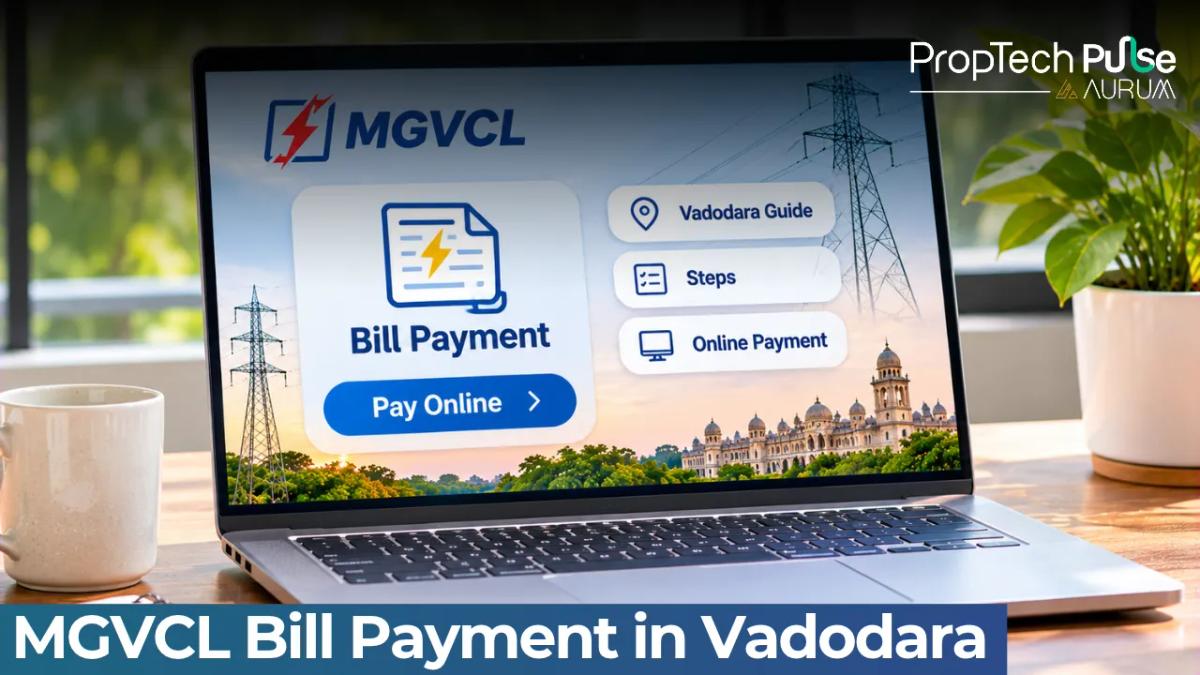
If you own a home or run a business in central Gujarat, settling your MGVCL bill payment quickly matters more than ever. Delayed payments attract steep penalties within thirty days.
MGVCL handles distribution across Vadodara and surrounding districts, and their digital infrastructure means you rarely need to visit an office to clear dues.
This guide shows exactly how to complete mastering the property management essential skills to learn as a property manager starts with utility coordination, especially when you take ownership of a new flat or hand one over to a tenant. We cover locating your consumer number, calculating late fees, and printing your payment receipt without stepping outside.
What is MGVCL and Where Does It Operate?
Quick answer
Madhya Gujarat Vij Company Limited supplies power to Vadodara, Anand, Nadiad, Godhra, Bharuch, and Kheda districts. You can track your account and process your payment digitally through their official web portal or any Unified Business Payment System app linked to your banking credentials.
Madhya Gujarat Vij Company Limited operates as the primary electricity distribution utility for central Gujarat. The company manages generation, transmission, and distribution assets for millions of consumers across urban centres and rural clusters alike.
New purchases in the region carry hidden electrical risks. Always verify your top builders in vadodara 2026 project connections first. Check that the meter is active and legally transferred before occupying the premises. The utility operates under regulatory oversight from the Gujarat Electricity Regulatory Commission, which sets base tariffs and authorizes periodic fuel cost adjustments.
Tip: When moving into a resale property, never pay the full market value until you have physically verified that the electricity meter carries an active, non-dues status under the seller's name. Request a recent bill printout from the previous owner as proof before finalizing the deal.
How to Do MGVCL Bill Payment Online
The modern approach to proptech solutions redefining property management relies on automation. Completing monthly dues now takes minutes instead of hours. MGVCL runs directly on the Bharat Bill Payment System. You can route transactions through mobile wallets, UPI apps, or direct net banking interfaces.
- Open your preferred banking app, such as SBI Yono, HDFC PayZapp, PhonePe, or Google Pay.
- Navigate to the Utilities or Bills section and select Electricity.
- Choose MGVCL from the dropdown list of distributors for Gujarat.
- Enter your 11-digit consumer number and confirm the displayed consumer name matches your records.
- Review the outstanding amount displayed on screen and tap Pay Now.
- Complete the authentication via UPI PIN or OTP from your registered mobile device.
Standard interbank settlement timelines govern the workflow. Deductions reflect almost instantly. The MGVCL system updates your ledger the moment the BBPS sends a success message.
| Payment Channel | Processing Fee | Settlement Speed |
|---|---|---|
| MGVCL Web Portal (Cards/UPI) | No fee (or nominal gateway charge) | Instant |
| PhonePe / GPay / Paytm (BBPS) | ₹1 to ₹4 per transaction | Instant to 2 hours |
| Direct Net Banking | No fee | Within 30 minutes |
How to Locate Your 11-Digit Consumer Number
Every valid request for a bill status update or transaction requires the unique consumer identifier. MGVCL uses a strictly eleven-character alphanumeric format to differentiate between high-tension commercial feeders and low-tension domestic households.
You can find this number by searching for vadodara bill pin code alongside your flat or house address on the MGVCL public dashboard if you lack physical documents. Alternatively, look at any past paper bill, an SMS alert sent by the utility regarding scheduled maintenance, or a printed demand notice stuck to your main electrical distribution box.
Once you enter the code on the login page, the system cross-references the geographic sector and sub-division.
Verify the locality manually if the attached name matches yours but the address differs slightly. Using an incorrect identifier often routes the money to a dormant account, delaying your credit posting.
Tenant Note: Landlords frequently transfer the account holder name to the new occupant. Until that formal name transfer happens at the sub-divisional office, any payment made under your name appears as a deposit held against the landlord's original account. Always clarify who holds the official connection before settling large amounts.
Understanding MGVCL Tariff Bands & Monthly Costs
Average monthly energy costs in Vadodara shift noticeably depending on household size and appliance load. Domestic consumers fall into consumption bands that dictate rate progression.
Light users drawing less than seventy-five units usually see charges ranging from ₹400 to ₹650 inclusive of basic service charges. Medium households averaging one hundred to two hundred fifty units typically pay between ₹900 and ₹2,100.
Heavy users consuming above three hundred units face higher marginal rates plus fixed monthly infrastructure levies.
Tracking your consumption trend helps catch billing anomalies early. A sudden fifty percent spike usually signals either a faulty smart meter register or a newly installed high-load appliance left running continuously.
Cross-check your reading against the state-wide daily average reported in municipal reports before disputing a cycle. Most discrepancies resolve within fifteen working days once the sub-divisional engineer reviews the meter calibration certificate.
Calculating Late Payment Charges
Both domestic and commercial accounts face uniform late payment charges, though commercial lines trigger isolation notices faster. The regulation stipulates an annual interest rate of fifteen percent applied to the total outstanding balance.
Many readers wrongly assume compound interest inflates overdue bills overnight. MGVCL applies simple interest calculated on a monthly pro-rata basis. A ten-day delay generates significantly less friction than missing the cycle entirely.
| Outstanding Amount | Days Overdue | Interest Accrued | Total Payable |
|---|---|---|---|
| ₹5,000 | 15 Days | ₹31.25 | ₹5,031.25 |
| ₹5,000 | 30 Days | ₹62.50 | ₹5,062.50 |
| ₹12,000 | 45 Days | ₹225.00 | ₹12,225.00 |
Clearing partial balances early remains financially sensible. Settling the principal amount stops future interest calculations from stacking on top of previous months' unpaid dues.
Some older circulars mention waiver provisions during extreme weather events or widespread grid failures, but routine delays do not qualify.
Offline Options for Making MGVCL Bill Payment
Routine digital usage masks several offline scenarios requiring physical presence.
Consumers lacking stable internet connectivity, those whose biometric verification fails during automated KYC checks, or elderly residents managing cash-based households still rely on traditional counters.
Authorized collection centres spread across administrative zones handle these queues.
Residents near major corridors can utilize bank branches where teller screens accept direct BBPS commands. Municipal corporation offices also host dedicated MGVCL kiosks during peak billing seasons.
When visiting a centre, carry two forms of identification alongside the physical bill paper.
The staff will match your consumer number against the central database before dispensing the stamped receipt. Keep this physical copy safely until the next monthly cycle confirms zero outstanding status.
Downloading and Printing Your Payment Receipt
Digital payments generate instant electronic acknowledgments, but maintaining a centralized archive prevents disputes during sudden meter replacements or annual inspections.
Keeping proof of your MGVCL bill payment becomes mandatory when claiming tax deductions under Section 80C or proving utility expenses for rental income calculations.
Home loan audits typically demand three months of settled utility bills. Banks pair these documents with salary slips to evaluate your ongoing affordability ratios.
The MGVCL consumer portal allows logged-in users to pull historical transaction logs spanning several years.
- Visit the official MGVCL consumer dashboard on a laptop or desktop browser.
- Log in using your registered mobile number or email ID paired with the OTP.
- Select the Payment History or Transaction Report tab from the main menu.
- Pick the specific financial month or quarter you wish to verify.
- Click the PDF icon beside the desired transaction row to save the receipt locally.
Which Payment Method Should You Choose?
Your choice depends largely on how rapidly you need the ledger updated and whether you require a formal PDF stamp for tax filings.
For immediate confirmation without paperwork, UPI applications connected to the BBPS network provide the smoothest experience and cost nearly nothing.
Banks charging zero gateway fees offer identical speed with added transaction security logs accessible via statement downloads.
Reserve visits to physical offices exclusively for name transfers, meter complaints, or resolving stubborn system glitches that stall automatic credits. Regular settlements belong behind a screen, not in a queue.
Frequently asked questions
How can I find my MGVCL consumer number?
Locate the eleven-character code printed prominently near the top right corner of any past printed bill. You can also view it by logging into the MGVCL citizen dashboard using your registered mobile OTP, or by checking SMS alerts sent about localized power cuts in your specific street.
What is the latest MGVCL electricity tariff rate per unit?
Domestic rates generally scale from approximately two rupees for basic consumption tiers up to ten rupees per unit once cross-threshold usage begins. Verify exact bracket figures on the Gujarat Electricity Regulatory Commission website, as fuel adjustment charges modify base rates quarterly.
How to check MGVCL bill payment history online?
Access the secure MGVCL consumer portal via a web browser and sign in with your designated mobile number. Navigate to the transaction report section to view downloadable PDFs covering completed monthly cycles and pending ledgers spanning multiple years.
What happens if I miss the MGVCL bill due date?
Missed deadlines trigger a straightforward fifteen percent annual simple interest charge calculated pro-rata against your total unpaid balance. After extended delays exceeding several billing cycles, the utility reserves the right to issue physical disconnection notices requiring manual intervention.
Is it safe to make MGVCL bill payment online using third-party apps?
Yes, provided you select legitimate UPI platforms like Google Pay or PhonePe that explicitly display the BBPS badge. These apps route funds securely through NPCI gateways without storing sensitive banking passwords directly on merchant servers.
Enjoyed this blog article? Visit PropTech Pulse for more interesting blogs.



Ask Pulse Ai anything about real estate

Unlock the Latest in Real Estate
News, Infographics, Blogs & More! Delivered to your inbox.

