New Launch - India Real Estate Report 2026.

Services
Knowledge Hub
Resources
Tools

Ask Pulse Ai
©PropTech Pulse 2025, All rights reserved.


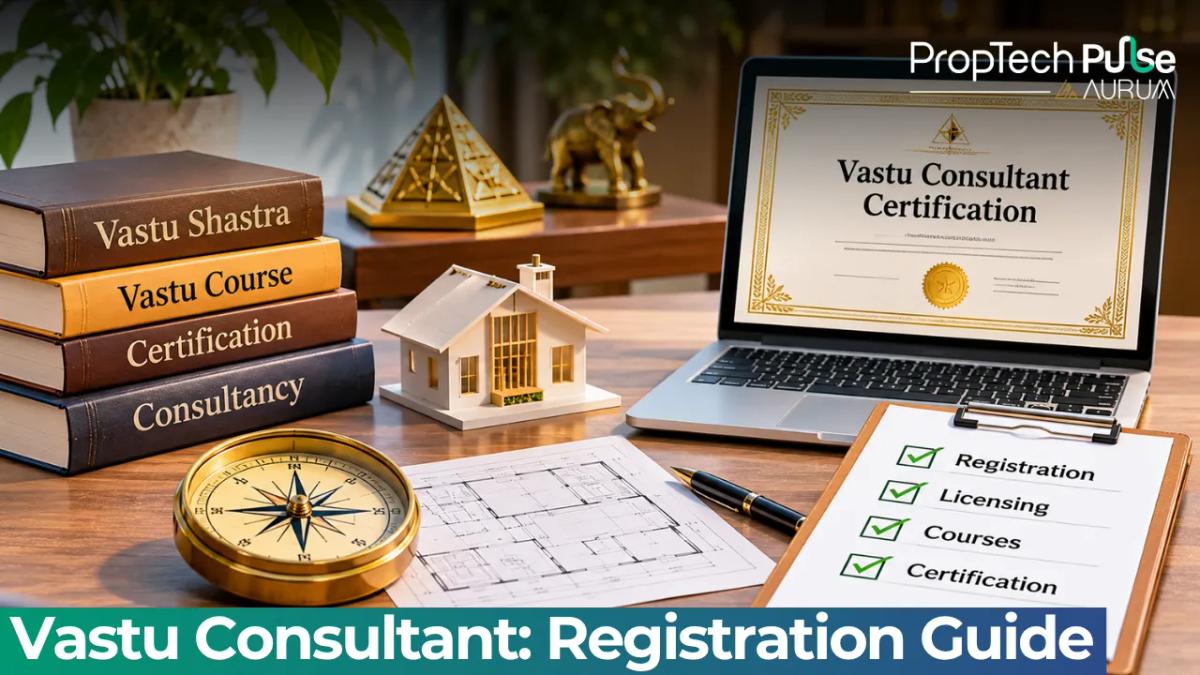
Searching for vastu consultant registration in india usually leads to private directories and paid certificates before you find a single government rule.
The situation is straightforward. There is no mandatory licence. No central board exists. Statutory agencies do not issue cards for this practice. Your work falls under professional consultancy.
Trust comes from verifiable education, clean tax compliance and transparent client history.
Is a Vastu Consultant License Mandatory in India?
Quick answer
No. There is no government licence or mandatory registration for Vastu consultants in India. The sector operates as an unregulated professional service, meaning credibility comes from verifiable education, clean business compliance and transparent client work rather than a statutory card.
Is a Vastu Consultant Licensed?
You won't see a government number printed on a visiting card. Vastu sits outside central statutes like the Advocates Act. Aspiring practitioners often confuse professional depth with legal licensure. Clients rightly expect architectural rigour when discussing their homes.
Both fields handle space and structure. A licensed architect signs structural plans and bears statutory responsibility.
A Vastu consultant adjusts layouts within those existing walls. Interior tweaks carry no permit requirements. You can advise safely without a state mandate.
The catch lies in how you present your qualifications. Claiming false statutory recognition carries legal risks. Understanding the actual landscape helps set clear boundaries.
Vastu Consultant Regulation and Business Compliance
Vastu consulting may lack direct oversight, but running the business follows strict financial rules. Operating without basic paperwork invites penalties under the Income Tax Act and GST laws. Clear terms protect both sides.
Money changes hands, which means every engagement needs an invoice. Most solo operators start as sole proprietors. Open a current account. Grab a PAN.
Register under Udyam MSME. This costs nothing and takes minutes. Scaling up later usually pushes you toward a private limited structure.
GST thresholds depend on your aggregate annual turnover across states. Cross ₹20 lakh and registration becomes mandatory. Consultation services sit squarely in taxable categories.
E-invoicing triggers once higher ceilings are met. Standard consumer protection rules govern your daily interactions. Fabricated remedies or misleading cost estimates invite formal complaints under the Consumer Protection Act, 2019.
Ethical conduct acts as your strongest shield. Seeing how real estate agents, brokers and consultants handle fiduciary duty clarifies why documentation matters even outside regulated trades.
Recognised Vastu Courses and University Degrees
Accredited academic programmes carry weight. Public universities have rolled out dedicated degrees in Vastu Shastra recently. Students digest ancient texts alongside modern spatial planning. Some syllabi even touch upon basic construction mechanics.
The University Grants Commission recorded nine universities offering these degrees. Banaras Hindu University runs postgraduate and doctoral tracks. Rajasthan University focuses master's programmes on traditional town planning.
Pt. Ravishankar Shukla University ties spatial harmony to local heritage. Open universities like Dr. Bhimrao Ambedkar Bihar University and IGNOU weave Vastu modules into urban history and sustainable living courses.
Degrees provide historical depth. They signal to future clients that you cleared written examinations. Classroom learning rarely teaches site visits though.
Negotiating with homeowners requires separate soft skills. Confidence comes from walking multiple sites.
Training tip Pair academic study with hands-on internships. Walking a live construction site teaches load-bearing walls and plumbing logic far better than a textbook does. Avoiding structural damage while suggesting remedies forms the bedrock of safe Vastu work.
Vastu Certification Authority India and Professional Councils
New consultants frequently type “Vastu Certification Authority India” into search bars. Those titles belong to private councils. Independent institutes fill the void left by the government.
Syllabi vary widely between providers. Exams happen online. Membership letters often feature post-nominals like FCVS. Three body types typically drive this space.
National councils demand portfolios alongside theoretical papers. Regional networks prefer apprenticeships.
Directory platforms allow self-registration after a flat fee. These turn profiles into searchable assets for potential clients.
Private certificates hold zero legal force. They cannot stop illegal constructions or approve blueprints. Their value signals commitment instead. Structured portfolios build immediate trust. Treat certification as a toolkit item. Client testimonials drive referrals. For deeper insights on selecting qualified professionals in property development, checking Aurum PropTech’s approach to simplifying real estate journeys highlights how standardised metrics eventually dominate advisory markets.
Practical Checklist to Start Practising
Launching requires discipline. Skipping bureaucracy guarantees friction later. Build credibility slowly. Define your scope first. Focus purely on residential interiors or commercial fit-outs.
Narrow niches speed up learning. Kitchen placements interact differently with factory loading bays. Secure foundational training next. Enrol in a degree programme or join a recognised institute.
Push for hard assessments. Memorising directional rules proves easy. Applying them to cramped metro apartments demands real judgment. Pursue registration through accredited bodies if it fits your roadmap.
Check renewal fees before handing over money. Register your business immediately after. GST numbers enable proper invoicing.
Document every assignment thoroughly. Photograph layout adjustments. Track occupant comfort improvements. Portfolios replace government badges.
| Business Setup | Professional Credentials |
|---|---|
| Sole proprietorship registration | Academic degree or diploma in Vastu |
| Current bank account opening | Institute certification letter |
| GST application (above threshold) | Portfolio of documented site visits |
| Basic invoicing software | Code of ethics signed by client |
How Homeowners Can Verify a Consultant
Homebuyers face heavy financial pressure during renovations. Scammers exploit anxiety by promising guaranteed wealth or instant marriages if walls shift colour. Steer clear of absolute outcome claims.
Vastu targets harmonious spacing and natural airflow. Ask for education proof upfront. Request university names and completion years. Ask for digital folders containing three complete case studies. Genuine experts explain remedial logic.
They document how suggestions fit existing constraints. Flats feature fixed columns and ventilation shafts. These often contradict ideal directions. Competent consultants adapt strategies.
They suggest movable partitions. They refuse to demand wall demolition. Walk away from anyone embedding expensive metal pyramids before understanding safety limits.
For deeper insights on selecting qualified professionals in property development, reviewing a detailed look at builder consultant strategies reinforces why due diligence remains essential regardless of the expert's specialty.
Before You Engage or Launch
Step into consultancy with clean business practices and honest portfolio building. Legitimacy accumulates slowly then pays dividends. Homeowners should vet candidates rigorously.
Ignore miracle promises. Prioritise practitioners who respect flat dimensions. Both paths lead to safer spaces.
Should you prefer a curated search for ethical experts, consider checking the Pulse Vastu Vetting page to compare registered practitioners side by side.
Frequently asked questions
Is a government license required to practice Vastu?
No. There is currently no mandatory government license or statutory registration board for Vastu consultants in India. The profession operates independently without direct state control. Consultants build credibility through verifiable academic qualifications, private institute certifications and consistent, transparent client portfolios instead of official permits.
Which universities offer recognized degrees in Vastu?
Several central and state universities provide dedicated degrees and diplomas. Banaras Hindu University runs extensive postgraduate and doctoral tracks. Rajasthan University offers master's programs focusing on traditional spatial planning. Dr. Bhimrao Ambedkar Bihar University and IGNOU also include core Vastu modules that blend ancient texts with modern housing requirements.
How does GST apply to Vastu consultation services?
Consultation services fall under taxable categories just like other professional advisory sectors. Once your aggregate annual turnover crosses twenty lakh rupees across all states, registering for GST becomes mandatory. You must issue compliant electronic invoices to maintain full legal standing and avoid unexpected penalties from tax authorities.
What red flags should homeowners watch out for?
Be wary of consultants guaranteeing specific life outcomes like sudden wealth, career jumps or disease cures. Anyone demanding massive upfront payments for heavy metal fixtures embedded directly into load-bearing walls ignores basic safety norms. Genuine experts always prioritize structural integrity and offer practical adjustments like color therapy or furniture repositioning first.
Are private Vastu certificates legally binding?
Private certifications issued by commercial councils hold zero legal force under Indian law. They do not grant powers to approve blueprints, halt illegal constructions or regulate other advisory trades. Their real value lies in signaling commitment to rigorous study and providing structured networking opportunities for newcomers entering the field.
Enjoyed this blog article? Visit PropTech Pulse for more interesting blogs.




Ask Pulse Ai anything about real estate

Unlock the Latest in Real Estate
News, Infographics, Blogs & More! Delivered to your inbox.

