New Launch - India Real Estate Report 2026.

Services
Knowledge Hub
Resources
Tools

Ask Pulse Ai
Services
FOR BUYERS & RENTERS
FOR REAL ESTATE DEVELOPERS








Refer other Connectors &
Multiply IncomeRefer other Connectors
& Multiply Income
Refer KuberX & earn
commission on every
loan they get
disbursed.


Scan & Download
©PropTech Pulse 2025, All rights reserved.


Course description
This beginner-friendly certification course is designed to help learners understand the fundamentals of real estate taxation simply and practically. Through structured modules, you will learn key tax concepts, property-related compliance basics, important documentation, and how taxation impacts real estate transactions in India. By the end of the course, you will have a clearer understanding of how taxation works in the real estate sector and how to apply this knowledge in professional discussions and client interactions.
What you'll learn
Real Estate Tax Basics: Understand the key taxation concepts involved in buying, selling, renting, and investing in real estate.
Property Transaction Taxes: Learn about important taxes and charges linked to property deals, including stamp duty, GST basics, TDS, and capital gains.
Documentation & Compliance: Get clarity on the essential documents, tax records, and compliance steps required in real estate transactions.
GST in Real Estate: Understand how GST applies to under-construction properties, developers, and real estate services.
Capital Gains & TDS: Learn how capital gains tax and TDS work in property sales, and why they matter for buyers and sellers.
Practical Client Advisory: Build confidence to explain taxation basics to clients, investors, and property buyers in a simple, professional way.
Course structure
Foundation
· 0h 48min
The Zero-Tax Blueprint
· 0h 36min
Diversification
· 0h 14min
Inflation
· 0h 18min
Compliance
· 0h 29min
Instructors

Mayur Motwani
Head of Education Initiatives
Similar Courses

Uncategorized
MahaRERA Fundamentals Course – Real Estate Regulation
Most agents learn MahaRERA the hard way, from a buyer's sharp question they couldn't answer or a registration mistake that surfaced too late. This course teaches you the rules before the field does. Built for agents, brokers, and sales teams, it covers everything you need for practical MahaRERA fluency, not legal theory. Learn to navigate the MahaRERA portal and verify project registrations before recommending anything. Complete your agent registration and understand the compliance duties that follow. Read a cost sheet correctly, agreement value, GST, carpet area, and total cost, without missing a number. Spot the documentation gaps and due diligence red flags that separate a clean deal from a future dispute. Every module ends with a real scenario, so you finish able to operate as a compliant agent and catch problems before they become disputes. Includes a verified, shareable certificate

PropTech Pulse Editorial
18th September 2026


Uncategorized
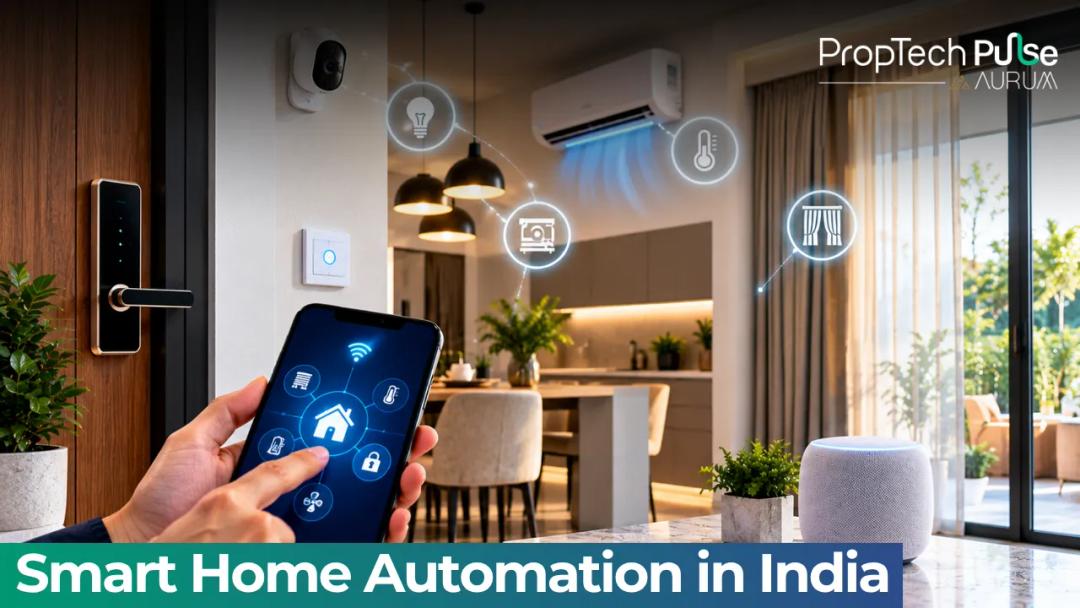
Smart Home Automation in India: Cost, Benefits & Guide
Most people who buy smart bulbs end up with a phone full of apps and a home that still needs them to press buttons. Smart home automation is what closes that gap: your devices act on rules, so you stop tapping. This guide covers what is worth automating in an Indian flat and the three ways to build it. It also gives costs and the wiring to settle before the walls are painted. Prices and rules that move fast are marked to check. In this guide What smart home automation means Routines worth automating Three ways to build it, and what they cost Does it save electricity? Planning automation in a new flat Keeping it reliable How to decide Frequently asked questions What smart home automation means Quick answer Smart home automation means connected devices that act on triggers such as time, motion, a door opening or your phone's location, instead of waiting for you to control them. It needs three parts: sensors or schedules, a controller that holds the rules, and devices that carry out the action. Remote control and automation are different things. Switching the AC off from the office is remote control. The AC turning itself off when the balcony door opens is automation. The rules usually live in an app, a hub or a wired controller. The trigger might be a clock, a motion sensor, a door sensor or your phone leaving the house. The action is whatever the connected device can do. If you're still choosing hardware, the Pulse explainers on IoT in real estate and PropTech trends give the wider context. Routines worth automating Start from your day, not from a shopping list. These routines earn their keep in most Indian homes. Routines that pay off, with the trigger, the action and what you need RoutineTriggerActionWhat you need Geyser on before you wakeClockSwitch on 20 minutes before your alarm, off afterSmart plug or geyser controller rated for the loadBathroom or corridor lightMotionLight on when someone enters, off after a few minutesMotion sensor and a smart bulb or switchAC off when a door opensDoor sensorSwitch the AC off after the balcony door has been open a whileDoor sensor and an IR controllerWater tank pumpLevel sensorPump starts and stops on water level, with dry-run protectionLevel sensor, a proper pump controller and an electricianLeak alertWater sensorPhone alert when water reaches the sensor near the washing machineBattery leak sensorAway modePhone locationLights off, AC off, camera on when everyone has leftHub or app that supports location rules Source: author's list of common routines; device ratings and safety limits vary by product [VERIFY: check each product's rated load with an electrician]. Pick two of these, not six. A routine you never notice is a good one. A routine that misfires at 2 a.m. is why people turn the whole system off. Three ways to build it, and what they cost There are three practical routes, and the right one depends on whether you own the flat and how far along the interiors are. Three routes to smart home automation and rough cost bands RouteHow it worksRough cost for a 2BHKBest for DIY, app-basedWi-Fi plugs, bulbs, IR controllers and sensors, with rules set in one app₹15,000 to ₹40,000Renters and first-timersHub-basedA hub links Zigbee or similar devices, with local rules and more sensors₹40,000 to ₹1.5 lakhOwners who want steadier performanceProfessionally wiredA wired controller runs lights, fans, curtains and scenes from switch panels₹3 lakh and aboveNew flats before interiors are finished Source: author's estimate of typical planning bands, not quotes [VERIFY: obtain two or three installer quotes for your city]. The wired route looks attractive because everything feels built in. It is also the hardest to change. If the installer disappears, you may be stuck with panels nobody can service. Ask about spares, support and open standards before you sign. Does it save electricity? Only if you were wasting some. Here is an illustration with round numbers. A 1.5-ton split AC draws roughly 1.5 kW when running [VERIFY: check your unit's rating]. If it stays on two extra hours a day after you leave the room, that is 3 units a day, or 90 units a month. At an assumed ₹8 a unit [VERIFY: your state's slab rate], that is ₹720 a month. An IR controller costing about ₹2,000 that stops the habit would pay for itself in under three months, but only if the habit happens every day. If you already switch the AC off, the saving is close to nothing. Automating lights is similar. LED bulbs use little power, so the gain from timers is small. Automate for comfort and security, and count any saving as a bonus. For buildings designed to use less energy in the first place, the note on green buildings in Indian cities is worth a read. Planning automation in a new flat This is where it pays to think early. Retrofitting wiring after the paint and false ceiling are done is expensive and messy. Neutral wire at every switch box. Many smart switches need it, and older Indian wiring often leaves it out. [VERIFY: with your electrician] Spare conduits. Run a couple of empty pipes to the main door, the living room ceiling and the balcony. A wired network point. Cabling to the router location and to any camera position is steadier than Wi-Fi alone. A socket near the front door. A lock controller, doorbell chime or hub needs power there. Router and UPS position. Keep it central, ventilated and on a small UPS. Access panels. Leave controllers reachable. Do not bury them behind a fixed cabinet. Share this list with your interior designer at the start. The Pulse interior design guide and false ceiling cost guide help you plan where sensors and lights will sit, and the interior design service page shows what Pulse offers. If a builder promises automation, get it written into the specifications of your agreement. The property buying guide explains what to check before you commit. Money check: a ₹3 lakh wired package financed at 8.5% over 20 years adds about ₹2,603 to your monthly EMI (₹3 × ₹867.8), and about ₹6.25 lakh in total repayment. Test your own numbers on the EMI calculator. [VERIFY: illustrative rate] Keeping it reliable Automation fails in dull ways. The Wi-Fi drops, an app updates, a battery dies. Design for those days. Keep every light and fan usable from a normal switch. Prefer rules that run locally on a hub over rules that need the cloud. Do not automate anything where a failure is dangerous, such as a main door that locks with no key backup, or a pump with no dry-run protection. Use unique passwords and two-step login on every account. Remove guest access when a tenant or helper leaves. Update firmware when the app asks. If you're renting, first-time renting tips cover what to check with the landlord before changing anything fixed. How to decide Automate a routine only if you can say what it saves you: money, time or worry. Otherwise it is a hobby, which is fine, but budget it as one. If you rent or have just moved in, go DIY with two routines and see what sticks. If you're renovating a flat you own, fix the wiring points now even if you buy devices later. If a builder or installer proposes a wired system, ask for the support terms in writing and compare the cost with the DIY route. For the bigger picture of where the city itself is heading, read the note on smart city technology. Frequently asked questions What is the difference between smart home devices and smart home automation? Devices are the hardware, such as bulbs, plugs and locks. Automation is the set of rules that makes them act without you: a light that comes on when you enter, a geyser that starts before you wake. You can own devices and never automate anything. How much does smart home automation cost for a 2BHK in India? A DIY app-based setup can start around ₹15,000 to ₹40,000. A hub-based one costs more, and a professionally wired system runs to several lakh [VERIFY: get two or three installer quotes]. The gap comes from wiring, controllers and labour, not from the gadgets. Can I automate an existing flat without rewiring? Largely, yes. Plug-in controllers, IR blasters for the AC, battery sensors and clip-on doorbells need no new wiring. Fixed lights and fans are the exception, since switch modules usually need an electrician and sometimes a neutral wire. Does home automation really reduce the electricity bill? It can, but only where you were wasting power. Cutting an AC or geyser that stays on by mistake shows up on the bill. Automating lights that were already switched off on time barely does. Check where your own waste is before buying. Will automation add to my flat's resale value? Rarely by much. Buyers like a home that works well, but few pay extra for a system they must learn and maintain. Treat it as a comfort purchase, and keep wiring changes neat so a later owner can undo them. Enjoyed this blog article? Visit PropTech Pulse for more interesting blogs.
PropTech Pulse Editorial
30th September 2026



Ask Pulse Ai anything about real estate

Unlock the Latest in Real Estate
News, Infographics, Blogs & More! Delivered to your inbox.