

©PropTech Pulse 2025, All rights reserved.

How can survey and demarcation report for land purchase benefit property owners and investors?
A survey and demarcation report for land purchase can benefit property owners and investors by providing precise, professionally verified boundary documentation, reducing risk of future disputes and ensuring buyers understand exactly what property they are acquiring.
Benefits of Survey and Demarcation Reports for Land Buyers
- Precise boundary verification helps buyers understand exactly what land area and dimensions they are actually purchasing.
- Reduced future dispute risk results from professionally documented, verified boundaries supporting clear ownership understanding.
- Identification of potential encroachment or boundary issues before purchase completion supports more informed transaction decisions.
How Survey and Demarcation Reports Function for Land Purchase
- Licensed surveyors physically measure and document precise property boundaries using professional equipment and methodology.
- Reports typically include detailed maps and documentation confirming exact boundary locations and any identified discrepancies.
Considerations for Commissioning Survey and Demarcation Services
- Understanding specific surveyor qualifications and report scope helps buyers ensure comprehensive, reliable boundary verification.
- Ongoing industry evolution continues to shape best practices and expectations in this area.
- Understanding local market context remains important when applying these general principles.
survey and demarcation reports benefit land buyers through precise, professionally verified boundary documentation reducing future dispute risk. This assessment significantly supports informed purchase decisions by confirming exactly what property area buyers are acquiring.
Recent Glossary
What is the yield gap between offices and warehouses?
What is the YEIDA Sector 22D plot scheme?
What is Yamuna Expressway industrial city?
What is the yield spread over G-Secs for REITs?
What is the year-over-year vacancy trend in coworking?
View More...
Recent FAQs
What are the red flags to watch for in a new project brochure?
What are the processing fees and other charges on a home loan?
Can I earn while learning through Pulse University and how is it tracked?
How does age affect the eligibility result in a home loan calculator?
How does the learn and earn model at Pulse University work?
View More...
Insight Pulse
Uncategorized
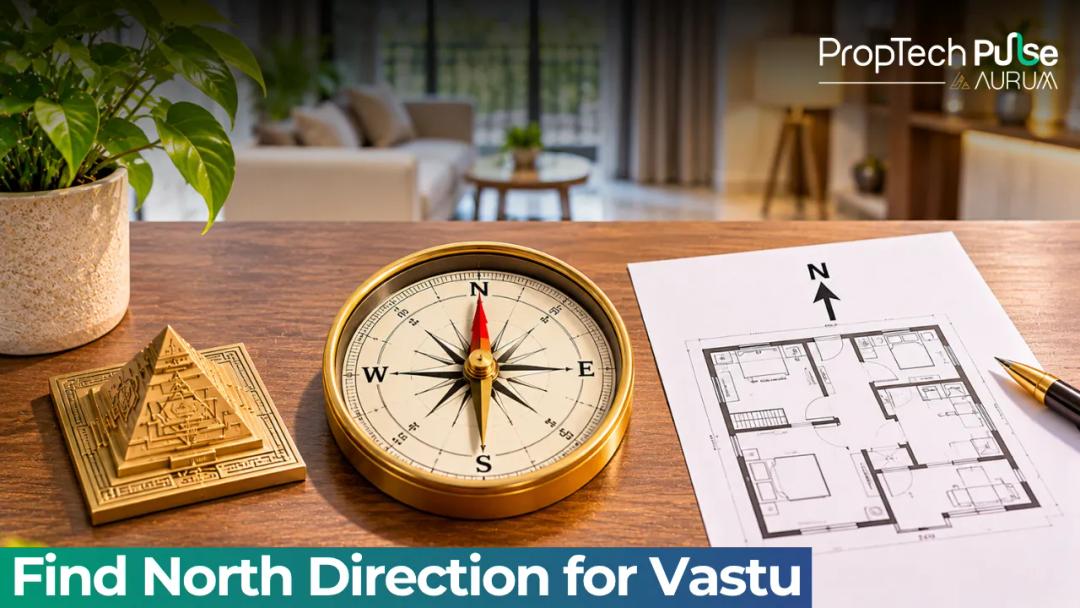
How to Find North Direction in House for Vastu: Guide
Buying a home involves more than square footage and location. When a property carries Vastu intentions, the first step is always the same: pinning down exactly which way the house faces. Modern Indian homes complicate this. Concrete walls hide steel reinforcement. Lobby layouts push main doors underground. Phone apps promise instant answers. The result is a lot of guesswork and conflicting readings. This guide shows you how to find north direction in house for vastu reliably. You will get results whether you live in a high-rise flat or a plotted house. You will learn where to stand and which tools actually work indoors. You will also learn how to convert phone readings to true north. Finally, you will see how to lay the foundation grid over your floor plan. These methods strip away confusion. They give you a repeatable workflow you can trust before moving furniture or making renovations. In this guide How to find north direction in house for vastu simply explained How to use a smartphone or vastu direction app effectively Alternative ways to find the direction of flat safely Mapping your findings to the Vastu Purusha Mandala Preparing your layout for a balanced flow Frequently asked questions How to find north direction in house for vastu simply explained Quick answer Stand at your main doorway facing outward. Hold a reliable analog compass level against your chest and wait for the needle to settle. That reading is your facing direction. Adjust the angle later using a current magnetic declination calculator so your final grid aligns with true north. The core rule in Vastu is straightforward. Facing is determined by the primary exit route from the house. If there is one clear main door, stand just inside the threshold, face outwards, and take the reading. If the layout uses multiple equal exits without a dominant entry, tradition points to the side with the most natural light, ventilation, or daily foot traffic. Pick the most active side and measure from there. Where exactly should you stand to take the reading? Location matters more than most readers expect. Do not stand next to a lift shaft, metal gate, electrical panel, or reinforced stairwell. These structures create localized magnetic pockets that pull smartphone sensors off course. Step out to the street edge or walkway boundary where you have at least two metres of clear space around you. Keep mobile phones, keys, and watches in your pocket. Even a slim wallet with a metal clasp can shift a reading by several degrees. Plot, house, and entrance zone: clarifying the difference Beginners often mix up three separate concepts. The plot orientation describes the boundary line and municipal setback. It rarely changes when you renovate. Your house facing describes the main door you actually walk through daily. This dictates the directional grid inside the structure. This entrance zone covers additional gates, compound entries, or lobby lifts that serve the same building. These belong to a different functional layer. For interior layouts, always lock onto the house facing first. The plot orientation helps with site planning. The entrance zone matters only if the main door itself is shifted significantly from the original approved position. How to use a smartphone or vastu direction app effectively Digital tools have made direction-finding accessible, but they come with hidden friction points in modern construction. Why indoor readings fail (steel, lifts, and electronics) Phone magnetometers detect extremely weak fields. These typically range between twenty-five and sixty-five microteslas. TMT rods inside concrete slabs easily swamp those sensors. Metallic elevator cages and ceiling-mounted ducts do the same. Household appliances add to the noise. Reading from a balcony, corridor, or kitchen window gives inconsistent data. Structural steel runs continuously across floors. If your app shows wildly different angles depending on where you hold it, interference dominates the signal. You are measuring building clutter rather than the earth’s field. Calibrating your device and fixing magnetic north vastu alignment If you must use a phone, start with calibration. Draw a figure-eight slowly outdoors. Stop once the app confirms baseline accuracy. Take three consecutive readings along the main threshold line. Keep the phone level and centred between shoulder heights. Discard any outlier caused by a passing vehicle or nearby metal fixture. Average the remaining two consistent numbers. Here comes the critical adjustment. Your raw reading points to magnetic north, not geographic north. Search for the current magnetic declination for your city coordinates. Subtract or add that angle to your averaged reading. Do this depending on whether your region reports east or west declination. This corrected bearing becomes the north arrow for your Vastu grid. When exploring Vastu Shastra and real estate standards, remember a key detail. Traditional grids assume true north alignment, not magnetic drift. Alternative ways to find the direction of flat safely When digital noise overwhelms indoor spaces, fall back on methods that do not rely on sensitive electronic sensors. Overlaying your building plan on a satellite map Print your approved architectural floor plan at full scale. Open a high-resolution satellite view on your device and locate your building footprint. Rotate the printed plan until its outer walls align perfectly with the visible roof outline in the satellite image. The top edge of that rotated plan now points to true north. Trace the main door line across the paper and mark the angle. This technique bypasses structural interference entirely and works exceptionally well when you are trying to understanding why Vastu compliance in residential design matters for long-term property utility. The string-and-needle method for interference-heavy areas A balanced needle floats evenly on still water. Fill a shallow bowl, let the water sit undisturbed, and gently float a sewing needle tied to a thin thread. Place the bowl away from laptops, Wi-Fi routers, and heavy wooden furniture that hides moisture gradients. Give it two minutes to settle. The needle naturally aligns with the local magnetic field. Repeat three times and average the result. It takes longer than opening an app, but it ignores steel reinforcement and delivers a stable baseline for hand-drawing your grid. Comparison of direction-finding methods for flats and houses Method Best Used For Main Limitation Analog compass Independent houses, ground-floor entrances Sensitive to nearby vehicles and metal fixtures Smartphone compass app Quick outdoor checks, preliminary plots Fails indoors due to rebar, lifts, and wiring Satellite map overlay High-rise flats, irregular corners, shared lobbies Requires accurate scaled print or digital tracing tool String-and-needle float Steel-heavy basements, underground parking thresholds Needs calm water, patience, and steady hands Each method compensates for the others. Using two techniques side by side reduces error margins noticeably. Whether you are verifying a new purchase or reviewing an existing layout for resale considerations related to property layout, consistency beats speed. Mapping your findings to the Vastu Purusha Mandala Once you have a verified true north bearing, drawing the grid is mechanical. Place a protractor or right-angle ruler on your floor plan. Align the zero-degree line with your verified north arrow. Draw a horizontal line across the entire width of the shape. From the four corners and the midpoint edges, draw perpendicular lines inward. Continue until you achieve sixteen equal sectors. Mark the corners clearly. Ishanya (north-east) sits at the top left if north points upward on your page. Bhagya (south-west) occupies bottom right. Assign functions to each sector based on established tradition. Avoid wishful thinking. Accuracy in the north arrow determines whether every subsequent room falls into the correct quadrant. Drawing the sixteen-zone grid over your verified north arrow Start with the largest exterior rectangle. Divide it horizontally and vertically to create four large quadrants. Split each quadrant further by drawing diagonal lines from corner to corner. Measure carefully. Small angular errors compound quickly across a wide floor plan. If your layout contains bay windows, sloped roofs, or cut-out terrace decks, treat the usable plinth area as your primary division boundary. Irregular extensions stay outside the grid. They do not distort the core sixteen sectors. Preparing your layout for a balanced flow Matching room functions to sectors reduces last-minute demolition work. Keep the master bedroom in the south-west for stability. Place the pooja or meditation corner in the north-east. Position kitchens in the south-east. Bathrooms and storage ideally sit in the south-west or north-west. Never place them above living or sleeping zones. When structural shifts are unavoidable, focus on reversible adjustments first. Reorient wardrobes. Relocate study desks toward the north or east. Use breathable dividers instead of solid masonry changes. If you prefer a professional review of your verified layout, explore our Live Vustu Check service. You will get a detailed assessment tailored to your floor dimensions. Remember Small angular differences happen when buildings sit on uneven contours. Trust your averaged readings, adjust cleanly for declination, and let the grid guide your choices rather than chasing impossible geometric perfection. Frequently asked questions How do you find the correct north in a house without a compass? You can use a free satellite mapping application to overlay your property plan onto an aerial image. Align the building walls with the roof outline visible from above, then rotate the paper or digital canvas until the streets match their real-world orientation. The upward edge now points to true north. This workaround bypasses magnetic interference completely and works reliably for both plotted homes and tower apartments where indoor signals get distorted by shared infrastructure. What is the exact location to take Vastu readings in a flat? Stand immediately inside the main living entrance, facing outward toward the street or common landing. Keep at least two metres of clearance on both sides to avoid wall reflections. Do not measure from a bedroom window, balcony door, or internal corridor junction. Those openings do not dictate the primary facing axis. If your society lobby pushes the actual access point underground, walk to the nearest surface-level gate that serves your unit. Treat that gate as your reference line and measure from there facing away from the building core. Difference between true north and magnetic north for Vastu? Magnetic north follows the Earth’s shifting geomagnetic poles and moves annually by fractions of a degree. True north marks the precise geographic axis running through the rotational poles. Traditional Vastu grids are calibrated to true north because regional climate patterns, wind directions, and solar exposure depend on that fixed axis. Smartphone apps display magnetic north by default. You must subtract or add your city’s current declination value to convert the reading. Most metropolitan regions report between two and five degrees of variance, enough to misalign a sixteen-zone grid if ignored. Can you trust your mobile phone compass for Vastu Shastra? Indoors, smartphone compasses are unreliable in steel-reinforced constructions because structural TMT rods and lift cages create localized magnetic pockets that dwarf the sensors’ detection range. Outdoors, on open plots or upper-level terraces, they perform adequately after calibration. Always draw a slow figure-eight pattern to refresh the magnetometer baseline, hold the device flat against your sternum, and record three consistent readings before averaging. Treat phone outputs as preliminary references rather than final survey-grade measurements. Which app is best for finding Vastu directions? No single application overrides the physics of building materials. Choose a compass tool that lets you toggle declination settings manually and displays raw bearing numbers rather than forcing automatic corrections. Look for apps that show sensor calibration status, support manual figure-eight validation, and allow background map overlays for plan alignment. The software category matters less than proper outdoor testing, repeated sampling, and cross-checking your results against a printed satellite reference or an analog backup method. Sources Survey of India: satellite orientation reference (accessed October 2024) Enjoyed this blog article? Visit PropTech Pulse for more interesting blogs.

PropTech Pulse Editorial
7th November 2026

Uncategorized
What Is Vastu Shastra? Meaning, Principles & Flat Tips
When people ask, "what is vastu shastra?", they are usually looking for a straightforward way to harmonize their living spaces with natural elements. This ancient framework predates modern interior design by millennia. It focuses on spatial geometry, directional orientation, and elemental balance to enhance comfort and psychological wellbeing. Many homeowners treat these vastu principles as a practical guide rather than religious dogma. The practice isn't about rigid superstitions or fear-based house rules. Instead, it provides a practical checklist for optimizing light, air, and movement within your home. By separating timeless architectural wisdom from modern marketing hype, you can make informed adjustments whether you hold a key to a new apartment or own a standalone bungalow. Let us explore the foundational ideas behind this tradition and how you can apply them today. In this guide What is Vastu Shastra? Meaning & Origins The Five Elements and Principles of Vastu Shastra Vastu Shastra Basics: Room-by-Room Guide Vastu Shastra for Home: Flats vs. Plots Common Myths vs. Reality Getting Started with Your Home Design Frequently asked questions What is Vastu Shastra? Meaning & Origins Quick answer Vastu Shastra is a traditional Indian system of architecture dating back over five thousand years. Its name literally means "science of the dwelling place," and it focuses on arranging spaces so they feel balanced, well-lit, and comfortable rather than rigidly following superstitions. To understand the vastu shastra meaning, we break the term into two Sanskrit words. "Vastu" refers to the building site, land, or dwelling itself. "Shastra" translates to a treatise, code, or systematic rules. Combined, the phrase describes an ancient framework for designing homes and temples. This framework works with natural light, wind patterns, and the earth's magnetic field. The earliest texts date back to the Vedas, roughly five thousand years ago. Classical works like the Vastu Purusha Mandala map a cosmic being onto a square plot, dividing it into nine distinct zones. Over centuries, practitioners adapted these guidelines for everything from grand palaces to modest farmhouses. Today, it remains a cultural reference point for millions of Indian homeowners seeking a sense of alignment in their living spaces. Many view the practice as a blueprint for intuitive home design rather than dogma. The Five Elements and Principles of Vastu Shastra At the core of principles of vastu shastra lie the five fundamental elements, known as Panchabhoota. Every direction in a home is associated with one of these elements. Balancing them across your layout creates a foundation for stability and ease. Directional associations in traditional Vastu Shastra Direction Element Key Principle North-East (Ishanya) Water Keep open, light, and clutter-free. Favors water storage or prayer areas. South-East (Agneya) Fire Ideal for heat-generating spaces like the kitchen. South-West (Nairutya) Earth Represents stability. Best for master bedrooms and heavy walls. North-West (Vayavya) Air Governs movement. Suitable for guest rooms, bathrooms, and ventilation. Center (Brahmasthan) Space The neutral zone. Should remain unobstructed and airy. The guiding principle is equilibrium. If one element dominates a space, the house can feel stagnant or restless. Take the kitchen. Placing it in the north-east disrupts the calm energy associated with water. Conversely, locating the master bedroom in the south-west grounds the inhabitants in earth energy. This placement traditionally supports deeper rest. You simply match room activity to the corresponding direction. They aren't arbitrary taboos. Think of them as spatial zoning strategies refined over generations. Put heavy furniture in stable zones. Reserve light activities for airy corners. Practical Tip Before moving heavy furniture, simply sit in different corners of your empty flat. Note where the cross-breeze hits and where sunlight pools until mid-afternoon. Traditional recommendations almost always coincide with these physical observations. Vastu Shastra Basics: Room-by-Room Guide Once you grasp the elemental mapping, applying vastu shastra basics becomes a straightforward exercise in room placement. You do not need to demolish walls to make progress. The focus is on assigning activities to the correct directional zones. Applying vastu principles to modern spaces requires separating tradition from superstition. Kitchen: Place it in the south-east corner. The cook should ideally face east while preparing food to capture morning light. Avoid locating the stove in the centre of the home. This keeps the fire element contained. Heat stops here from spreading to the entire living area. Master Bedroom: Assign this to the south-west quadrant. The headboard should ideally point south or east. This zone's heaviness promotes uninterrupted sleep and financial stability. Keep electronic devices away from the bedside table to preserve the grounding atmosphere. Pooja or Meditation Room: Reserve the north-east area for prayer. Facing east while praying aligns with sunrise traditions. This keeps a sacred, quiet zone away from heavy foot traffic. Maintain a clean shelf and store idols securely to honor the water element in that sector. Living Room: The north or north-west sector works well. These directions govern social interaction and airflow. They naturally encourage conversation and visibility. Keeping the center of the living room light allows energy to circulate freely. Study or Home Office: Position your desk facing east or north. This orientation supports concentration and mental clarity. Place heavier files or cabinets along the south wall to anchor your workspace. A clear path to the door helps maintain focus during long work sessions. Bathrooms & Guest Rooms: North-west is acceptable here. As air represents movement, transient uses fit comfortably without disrupting the home's grounding energy. Ensure doors stay closed when not in use to prevent stale odors from affecting adjacent living areas. Notice how these rules operate independently of your front door. Room zoning follows a fixed grid. Door placement deals with how energy enters that grid. Confusing the two is why many buyers panic unnecessarily. Treat each room according to its function first. Vastu Shastra for Home: Flats vs. Plots The biggest friction point for modern buyers happens when vastu shastra for home guidelines clash with high-rise realities. Ancient texts were drawn for standalone plots with free-flowing wind on all sides. Apartments introduce shared walls, concrete cores, and fixed plumbing stacks. You must distinguish between what you cannot change and what you fully control. Structural limitations usually stem from the builder's approved floor plan. Trying to shift a bathroom three metres left because of a classical chart is neither feasible nor safe. Adjustable items versus structural constraints in apartments Item Can You Control It? Notes Main Door Pada (Segment) No Fixed by the developer's sanctioned blueprint and stairwell design. Sleeping Head Direction Yes Rely on freestanding bed frames rather than built-in cabinetry. Cooking Direction Yes Simply reorient your modular kitchen or gas hob position. Plumbing Stack Position No Governed by the building's wet zone vertical shaft. North-East Clutter Yes Remove storage boxes and dead plants from the NE corner. Total Adjustable Items Four out of six major considerations respond to interior design choices. This breakdown alone removes most anxiety. If you can orient your bed, adjust your cooking station, and keep the north-east tidy, you are already satisfying the functional intent of the system. The remaining structural quirks require zero intervention. You also need to understand load-bearing columns versus partition walls. Only the former restrict your layout. Modern apartments allow flexible flooring plans once you know where the structural skeleton stands. Consult your builder's drawings before starting any renovation work. Integrating these spatial habits with contemporary requirements is exactly what shapes the intersection of property and ancient design. Common Myths vs. Reality The internet is flooded with fear-based headlines. One persistent myth claims that a west-facing home guarantees losses or bad health. Traditional texts never support this blanket statement. In fact, the west is governed by Varuna, the deity of water and abundance. What actually changes with a west-facing entrance is the specific Pada or segment your door occupies. You must manage sun glare and afternoon heat during construction. Install proper shading and keep curtains breathable. That is basic building physics. Not a curse. Similarly, arguing over lucky or unlucky house numbers ignores a simpler truth. A chaotic, poorly ventilated home with a lucky number performs worse than a bright, well-maintained flat with an odd one. Maintenance and cleanliness matter far more than digit strings. Another widespread claim suggests you need expensive remedies, brass coins, or specialized crystals to fix an unbalanced home. Authentic practices rely on simplicity instead. Clean floors, sharp mirrors, functional locks, and decluttered pathways serve as the original solutions. If a consultant pushes complex products before explaining the basics, treat it as a sales pitch. Real adjustments involve rearranging furniture, changing paint tones for warmth or coolness, and improving cross-ventilation. These steps cost little time. They improve livability immediately. Reality Check Vastu is a comfort metric, not a legal code or a guarantee of stock market returns. Buy the home that fits your budget, meets your commute needs, and passes structural inspections first. Adjust the interior later for peace of mind. Getting Started with Your Home Design If you are buying, use these principles as a screening tool alongside your standard due diligence checklist. Ask the developer which quadrant the living room falls into. Check that the north-east corner won't be buried under a lift shaft or external AC unit. Once you move in, prioritize three immediate adjustments. Park your bed with the head against the south or west wall. Face east while cooking whenever possible. Clear out the northeast zone completely to welcome morning air and daylight. Start with flow and decluttering. Treat the system as a flexible map rather than a rigid test. Walk through each room and notice where you feel cramped or chilled. Move seating away from drafts. Add heavier rugs in the southwest to anchor the space physically. Remember that consistency beats perfection. Small tweaks compound over months to create a calmer environment. Apply the rules gradually as your inventory grows. For those who prefer a professional walkthrough of their layout against these principles, Pulse Vastu offers a Live Vastu Check service to guide you through the specifics. Frequently asked questions What does Vastu Shastra mean? The term comes from two Sanskrit words. Vastu means dwelling, land, or site. Shastra means a systematic treatise or rules. Together, they translate to the science or traditional framework of dwelling places. It guides how to arrange buildings so they align with natural forces, aiming for better comfort and balance in everyday life. Is Vastu effective for apartments or flats? Absolutely, though you apply it differently than a standalone plot. High-rise buildings restrict structural changes, so you focus on adjustable elements like sleeping direction, kitchen orientation, and clearing clutter from specific zones. Keeping the north-east open and positioning heavy furniture towards the south-west works regardless of whether you own a bungalow or a third-floor unit. Which direction is best for a main door? Traditionally, north, east, and north-east entrances are considered highly auspicious because they welcome morning light and positive breezes. However, a west or south-facing door is not forbidden. When the entrance points elsewhere, Vastu simply directs you to choose a specificPada or segment within that wall and adjust your interior layout accordingly to maintain energy flow. How does Vastu differ from Feng Shui? Both systems share the goal of harmonizing human habitats with nature. Feng Shui originates from China and relies heavily on the Bagua map, compass directions, and specific life aspects like career or relationships. Vastu originates in India, centers on the Panchabhoota elements, uses a rigid nine-zone Mandala grid, and ties directions to ancient Indian mythology and planetary influences. Enjoyed this blog article? Visit PropTech Pulse for more interesting blogs.
PropTech Pulse Editorial
7th November 2026

Uncategorized
Vastu Consultant in Navi Mumbai: How to Choose for Your Flat
Buying a flat in Navi Mumbai often means signing agreements in CBD Belapur or Kharghar without seeing the final elevation. After you get the keys, many owners bring in a specialist to align the new space. This guide walks you through vetting a vastu consultant in Navi Mumbai. It explains what paperwork actually matters for a high-rise flat and when a digital floor-plan review makes more sense than a physical site visit. High-rise towers in Navi Mumbai present unique challenges. Shared walls, common corridors, and fixed structural cores mean traditional plot-based rules rarely apply directly. A skilled practitioner adapts these ancient principles to modern vertical living. They focus on improving spatial flow, managing sunlight entry, and placing furniture to support daily comfort. You do not need to knock down load-bearing walls to achieve a balanced home. In this guide What a Vastu Consultant Actually Does in Navi Mumbai Today How to Verify a Vastu Expert Navi Mumbai What to Prepare Before a Home Vastu Visit Navi Mumbai Online Review vs On-Site Visit: Which Works for Apartment Buyers? Spotting Unrealistic Promises Before You Commit Booking Your First Vastu Consultation Navi Mumbai Frequently asked questions What a Vastu Consultant Actually Does in Navi Mumbai Today Quick answer A Vastu consultant evaluates your flat’s layout against traditional directional principles and suggests non-structural adjustments, like furniture placement, colour balancing, or opening a window, to improve spatial flow. For high-rise apartments in Navi Mumbai, most practitioners rely on your floor plan and photographs rather than major construction. Vastu follows traditional architectural principles, not statutory building codes. NMMC bye-laws do not mandate compliance here, and structural alterations must follow the National Building Code of India 2016. A competent vastu expert in Navi Mumbai knows this boundary immediately. They focus on optimizing sunlight entry, checking bedroom placement against the southwest corner, and ensuring kitchen layout supports smooth daily movement. Verifying practical experience saves time compared to chasing framed certificates. Most buyers overlook track records within local housing societies. Instead, ask how many mid-rise flats the consultant has reviewed across Mumbai and Thane recently. Adapting traditional ground-floor guidelines to vertical towers demands specific knowledge of shared walls and service shafts. When evaluating a proposed fix for a kitchen or bedroom, start with a solid understanding of carpet area vs built-up area. Developers frequently skew layout visibility by labeling balconies as part of the super built-up area. Knowing your actual usable square footage stops the practitioner from prescribing remedies for spaces you do not legally own. How to Verify a Vastu Expert Navi Mumbai Digital portfolios simplify initial screening, but you must look beyond generic website banners. Request a clear breakdown of their classical training alongside detailed residential project lists. A professional comfortable with modern high-rises will gladly provide direct contact details for two past clients in Navi Mumbai with matching three-BHK units. Securing a capable vastu consultant in Navi Mumbai means confirming these verifiable references early on. Competence also relies on understanding local infrastructure and natural airflow. Navi Mumbai draws distinct sea breezes from the western coast and southern creeks. Qualified practitioners factor these ventilation patterns directly into their directional advice while distinguishing corridor-facing entrances in older complexes from fresh CBDD developments. Spotting this micro-location awareness confirms genuine field experience. What to Prepare Before a Home Vastu Visit Navi Mumbai A productive session starts long before the consultant arrives. Bring concrete data rather than vague memories of how the space feels. Gather the approved blueprints from your builder, take clear photographs of every wall and window, and map the exact cardinal direction of your front door. Layout or blueprint: Print the final floor plan you received during possession. Highlight the main entrance, balcony position, and internal staircase if applicable. Facing direction: Note the precise direction the front door faces. Use a reliable compass app to verify the magnetic angle before the appointment. Occupancy details: Share ages and birth months of the primary residents. Some vastu consultation Navi Mumbai providers blend personal timing with spatial layout, which requires accurate dates. Existing complaints: List any persistent issues the household faces, such as poor morning light, dampness, or lack of privacy, so the practitioner knows what problem to solve first. Utility zones: Mark the location of the main electrical panel, Wi-Fi router, and water tank access points. Modern energy distribution plays a quiet role in contemporary spatial planning. When reviewing the scope of work, make sure the consultant asks for your current property due diligence checklist outcomes. If there are unresolved builder defects or structural issues documented during possession, those usually outweigh any directional concern. Fixing water seepage or ventilation gaps always takes priority over rearranging furniture. Online Review vs On-Site Visit: Which Works for Apartment Buyers? Homeowners debating between a physical visit and a remote review should match the format to their actual living situation. An on-site audit gives the consultant sightlines into neighbouring buildings, sunlight angles at different times of day, and cross-ventilation flow. A digital review relies entirely on what you upload and show on camera. For renters or investors who do not stay in the flat daily, a digital floor-plan review is often faster and cheaper. Hiring a qualified vastu consultant in Navi Mumbai via this remote method still delivers comparable directional insights. It covers roughly ninety percent of standard spatial corrections without the extra commute overhead. Vastu service formats for Navi Mumbai apartment owners Feature On-site Visit Digital Floor-Plan Review Best for Independent houses, row houses, duplexes Rented flats, investment properties, rental shared flats Consultant sees Actual sunlight, cross ventilation, neighbours' walls Only the uploaded blueprint and basic photos Time required 60 to 90 minutes physically on location 45 to 60 minutes via video call Cost impact Takes travel time into billing for locations outside central nodes Usually fixed pricing with no travel overhead Recommendation Use an on-site visit only if you plan to move in within three months. Spotting Unrealistic Promises Before You Commit Real estate already carries enough risk without unverified spiritual guarantees. Watch closely for three specific warning signs during your screening calls. The first warning is demanding wall removal to correct a minor directional fault, which violates safety and legal codes in Navi Mumbai high-rises. Responsible practitioners rarely suggest structural demolition as a primary solution, offering instead lighter adjustments. Another major red flag involves guaranteeing specific financial returns or health improvements based solely on changing one room. Vastu fundamentally aims to stabilize spatial balance and enhance environmental comfort rather than replacing medical or financial planning. The third warning sign utilizes fear tactics, such as claiming a misplaced bedroom permanently ruins a child's education. Trustworthy professionals provide calm solutions, not manufactured panic. Practical tip: Focus on remedies that are reversible and budget-friendly. Moving the stove, shifting a bed, or adding a healthy plant are far more common than installing heavy brass items or altering door frames in an existing Navi Mumbai flat. Booking Your First Vastu Consultation Navi Mumbai Once you have filtered your shortlist down to two or three viable candidates, book a preliminary call rather than rushing into a paid site visit. Discuss your budget clearly upfront before finalizing arrangements with your vastu expert in Navi Mumbai. Confirm the exact deliverable, whether they will provide a written report or a verbal walkthrough, and agree on the expected timeframe for completion. Many consultants bundle astrology services at a steep premium, even if you mapped out the local market using our guide on Vastu Shastra real estate. Stick to pure spatial alignment unless you specifically want horoscope integration. Keeping the engagement focused on optimizing your living space ensures efficiency and clarity. Ready to move forward? Simply search for Pulse Vastu's Booking / Packages section to find the next available slot. The platform handles scheduling directly, removing the back-and-forth emails that typically delay appointments. Frequently asked questions What documents do I need to share with a vastu expert in Navi Mumbai before the consultation? You will need the approved floor plan from your builder, clear photographs of every wall and window, and the exact facing direction of your main entrance. If your chosen practitioner incorporates personal timing, also prepare the birth dates of primary residents. Having the possession letter and any builder defect records ready ensures the expert addresses actual structural concerns alongside directional advice. Can I get a vastu consultation online for my flat in areas like Vashi or Kharghar? Yes, online reviews are widely used by apartment owners who do not live in the property full-time. You simply upload your final layout blueprint and show your windows over a video call. While an in-person auditor notes cross-ventilation and neighbour shadows, a digital review still covers roughly ninety percent of standard spatial corrections without the extra travel cost. Is it mandatory to remove a load-bearing wall if a consultant spots a southeast deficit? Never allow a consultant to suggest touching a load-bearing wall. NMMC regulations and standard engineering safety codes forbid random structural demolition in multi-storey towers. Any legitimate vastu expert in Navi Mumbai will offer reversible adjustments, such as shifting appliance placement, changing paint shades, or relocating furniture, while leaving the building frame untouched. How much does a standard consultation typically cost for a two-bedroom apartment? Pricing varies by practitioner expertise and property size, but expect a baseline range anywhere between ₹3,000 and ₹15,000 for a typical two-bedroom flat. Digital floor-plan reviews generally sit on the lower end because there is no commute charge, whereas detailed on-site audits that include travel time across Mumbai suburbs command higher fees. Should I bring a vastu consultant before moving into a resale flat? It is highly advisable to check the layout early, ideally while you still hold the sale agreement or right after registration. Catching directional imbalances before you move your belongings saves money on reversing furniture later. Early validation also gives you time to negotiate minor builder amendments, such as adjusting gate positions, before the transaction closes permanently. Enjoyed this blog article? Visit PropTech Pulse for more interesting blogs.
PropTech Pulse Editorial
7th November 2026
Uncategorized
How to Find North Direction in House for Vastu: Guide
Buying a home involves more than square footage and location. When a property carries Vastu intentions, the first step is always the same: pinning down exactly which way the house faces. Modern Indian homes complicate this. Concrete walls hide steel reinforcement. Lobby layouts push main doors underground. Phone apps promise instant answers. The result is a lot of guesswork and conflicting readings. This guide shows you how to find north direction in house for vastu reliably. You will get results whether you live in a high-rise flat or a plotted house. You will learn where to stand and which tools actually work indoors. You will also learn how to convert phone readings to true north. Finally, you will see how to lay the foundation grid over your floor plan. These methods strip away confusion. They give you a repeatable workflow you can trust before moving furniture or making renovations. In this guide How to find north direction in house for vastu simply explained How to use a smartphone or vastu direction app effectively Alternative ways to find the direction of flat safely Mapping your findings to the Vastu Purusha Mandala Preparing your layout for a balanced flow Frequently asked questions How to find north direction in house for vastu simply explained Quick answer Stand at your main doorway facing outward. Hold a reliable analog compass level against your chest and wait for the needle to settle. That reading is your facing direction. Adjust the angle later using a current magnetic declination calculator so your final grid aligns with true north. The core rule in Vastu is straightforward. Facing is determined by the primary exit route from the house. If there is one clear main door, stand just inside the threshold, face outwards, and take the reading. If the layout uses multiple equal exits without a dominant entry, tradition points to the side with the most natural light, ventilation, or daily foot traffic. Pick the most active side and measure from there. Where exactly should you stand to take the reading? Location matters more than most readers expect. Do not stand next to a lift shaft, metal gate, electrical panel, or reinforced stairwell. These structures create localized magnetic pockets that pull smartphone sensors off course. Step out to the street edge or walkway boundary where you have at least two metres of clear space around you. Keep mobile phones, keys, and watches in your pocket. Even a slim wallet with a metal clasp can shift a reading by several degrees. Plot, house, and entrance zone: clarifying the difference Beginners often mix up three separate concepts. The plot orientation describes the boundary line and municipal setback. It rarely changes when you renovate. Your house facing describes the main door you actually walk through daily. This dictates the directional grid inside the structure. This entrance zone covers additional gates, compound entries, or lobby lifts that serve the same building. These belong to a different functional layer. For interior layouts, always lock onto the house facing first. The plot orientation helps with site planning. The entrance zone matters only if the main door itself is shifted significantly from the original approved position. How to use a smartphone or vastu direction app effectively Digital tools have made direction-finding accessible, but they come with hidden friction points in modern construction. Why indoor readings fail (steel, lifts, and electronics) Phone magnetometers detect extremely weak fields. These typically range between twenty-five and sixty-five microteslas. TMT rods inside concrete slabs easily swamp those sensors. Metallic elevator cages and ceiling-mounted ducts do the same. Household appliances add to the noise. Reading from a balcony, corridor, or kitchen window gives inconsistent data. Structural steel runs continuously across floors. If your app shows wildly different angles depending on where you hold it, interference dominates the signal. You are measuring building clutter rather than the earth’s field. Calibrating your device and fixing magnetic north vastu alignment If you must use a phone, start with calibration. Draw a figure-eight slowly outdoors. Stop once the app confirms baseline accuracy. Take three consecutive readings along the main threshold line. Keep the phone level and centred between shoulder heights. Discard any outlier caused by a passing vehicle or nearby metal fixture. Average the remaining two consistent numbers. Here comes the critical adjustment. Your raw reading points to magnetic north, not geographic north. Search for the current magnetic declination for your city coordinates. Subtract or add that angle to your averaged reading. Do this depending on whether your region reports east or west declination. This corrected bearing becomes the north arrow for your Vastu grid. When exploring Vastu Shastra and real estate standards, remember a key detail. Traditional grids assume true north alignment, not magnetic drift. Alternative ways to find the direction of flat safely When digital noise overwhelms indoor spaces, fall back on methods that do not rely on sensitive electronic sensors. Overlaying your building plan on a satellite map Print your approved architectural floor plan at full scale. Open a high-resolution satellite view on your device and locate your building footprint. Rotate the printed plan until its outer walls align perfectly with the visible roof outline in the satellite image. The top edge of that rotated plan now points to true north. Trace the main door line across the paper and mark the angle. This technique bypasses structural interference entirely and works exceptionally well when you are trying to understanding why Vastu compliance in residential design matters for long-term property utility. The string-and-needle method for interference-heavy areas A balanced needle floats evenly on still water. Fill a shallow bowl, let the water sit undisturbed, and gently float a sewing needle tied to a thin thread. Place the bowl away from laptops, Wi-Fi routers, and heavy wooden furniture that hides moisture gradients. Give it two minutes to settle. The needle naturally aligns with the local magnetic field. Repeat three times and average the result. It takes longer than opening an app, but it ignores steel reinforcement and delivers a stable baseline for hand-drawing your grid. Comparison of direction-finding methods for flats and houses Method Best Used For Main Limitation Analog compass Independent houses, ground-floor entrances Sensitive to nearby vehicles and metal fixtures Smartphone compass app Quick outdoor checks, preliminary plots Fails indoors due to rebar, lifts, and wiring Satellite map overlay High-rise flats, irregular corners, shared lobbies Requires accurate scaled print or digital tracing tool String-and-needle float Steel-heavy basements, underground parking thresholds Needs calm water, patience, and steady hands Each method compensates for the others. Using two techniques side by side reduces error margins noticeably. Whether you are verifying a new purchase or reviewing an existing layout for resale considerations related to property layout, consistency beats speed. Mapping your findings to the Vastu Purusha Mandala Once you have a verified true north bearing, drawing the grid is mechanical. Place a protractor or right-angle ruler on your floor plan. Align the zero-degree line with your verified north arrow. Draw a horizontal line across the entire width of the shape. From the four corners and the midpoint edges, draw perpendicular lines inward. Continue until you achieve sixteen equal sectors. Mark the corners clearly. Ishanya (north-east) sits at the top left if north points upward on your page. Bhagya (south-west) occupies bottom right. Assign functions to each sector based on established tradition. Avoid wishful thinking. Accuracy in the north arrow determines whether every subsequent room falls into the correct quadrant. Drawing the sixteen-zone grid over your verified north arrow Start with the largest exterior rectangle. Divide it horizontally and vertically to create four large quadrants. Split each quadrant further by drawing diagonal lines from corner to corner. Measure carefully. Small angular errors compound quickly across a wide floor plan. If your layout contains bay windows, sloped roofs, or cut-out terrace decks, treat the usable plinth area as your primary division boundary. Irregular extensions stay outside the grid. They do not distort the core sixteen sectors. Preparing your layout for a balanced flow Matching room functions to sectors reduces last-minute demolition work. Keep the master bedroom in the south-west for stability. Place the pooja or meditation corner in the north-east. Position kitchens in the south-east. Bathrooms and storage ideally sit in the south-west or north-west. Never place them above living or sleeping zones. When structural shifts are unavoidable, focus on reversible adjustments first. Reorient wardrobes. Relocate study desks toward the north or east. Use breathable dividers instead of solid masonry changes. If you prefer a professional review of your verified layout, explore our Live Vustu Check service. You will get a detailed assessment tailored to your floor dimensions. Remember Small angular differences happen when buildings sit on uneven contours. Trust your averaged readings, adjust cleanly for declination, and let the grid guide your choices rather than chasing impossible geometric perfection. Frequently asked questions How do you find the correct north in a house without a compass? You can use a free satellite mapping application to overlay your property plan onto an aerial image. Align the building walls with the roof outline visible from above, then rotate the paper or digital canvas until the streets match their real-world orientation. The upward edge now points to true north. This workaround bypasses magnetic interference completely and works reliably for both plotted homes and tower apartments where indoor signals get distorted by shared infrastructure. What is the exact location to take Vastu readings in a flat? Stand immediately inside the main living entrance, facing outward toward the street or common landing. Keep at least two metres of clearance on both sides to avoid wall reflections. Do not measure from a bedroom window, balcony door, or internal corridor junction. Those openings do not dictate the primary facing axis. If your society lobby pushes the actual access point underground, walk to the nearest surface-level gate that serves your unit. Treat that gate as your reference line and measure from there facing away from the building core. Difference between true north and magnetic north for Vastu? Magnetic north follows the Earth’s shifting geomagnetic poles and moves annually by fractions of a degree. True north marks the precise geographic axis running through the rotational poles. Traditional Vastu grids are calibrated to true north because regional climate patterns, wind directions, and solar exposure depend on that fixed axis. Smartphone apps display magnetic north by default. You must subtract or add your city’s current declination value to convert the reading. Most metropolitan regions report between two and five degrees of variance, enough to misalign a sixteen-zone grid if ignored. Can you trust your mobile phone compass for Vastu Shastra? Indoors, smartphone compasses are unreliable in steel-reinforced constructions because structural TMT rods and lift cages create localized magnetic pockets that dwarf the sensors’ detection range. Outdoors, on open plots or upper-level terraces, they perform adequately after calibration. Always draw a slow figure-eight pattern to refresh the magnetometer baseline, hold the device flat against your sternum, and record three consistent readings before averaging. Treat phone outputs as preliminary references rather than final survey-grade measurements. Which app is best for finding Vastu directions? No single application overrides the physics of building materials. Choose a compass tool that lets you toggle declination settings manually and displays raw bearing numbers rather than forcing automatic corrections. Look for apps that show sensor calibration status, support manual figure-eight validation, and allow background map overlays for plan alignment. The software category matters less than proper outdoor testing, repeated sampling, and cross-checking your results against a printed satellite reference or an analog backup method. Sources Survey of India: satellite orientation reference (accessed October 2024) Enjoyed this blog article? Visit PropTech Pulse for more interesting blogs.
PropTech Pulse Editorial
7th November 2026
Uncategorized
What Is Vastu Shastra? Meaning, Principles & Flat Tips
When people ask, "what is vastu shastra?", they are usually looking for a straightforward way to harmonize their living spaces with natural elements. This ancient framework predates modern interior design by millennia. It focuses on spatial geometry, directional orientation, and elemental balance to enhance comfort and psychological wellbeing. Many homeowners treat these vastu principles as a practical guide rather than religious dogma. The practice isn't about rigid superstitions or fear-based house rules. Instead, it provides a practical checklist for optimizing light, air, and movement within your home. By separating timeless architectural wisdom from modern marketing hype, you can make informed adjustments whether you hold a key to a new apartment or own a standalone bungalow. Let us explore the foundational ideas behind this tradition and how you can apply them today. In this guide What is Vastu Shastra? Meaning & Origins The Five Elements and Principles of Vastu Shastra Vastu Shastra Basics: Room-by-Room Guide Vastu Shastra for Home: Flats vs. Plots Common Myths vs. Reality Getting Started with Your Home Design Frequently asked questions What is Vastu Shastra? Meaning & Origins Quick answer Vastu Shastra is a traditional Indian system of architecture dating back over five thousand years. Its name literally means "science of the dwelling place," and it focuses on arranging spaces so they feel balanced, well-lit, and comfortable rather than rigidly following superstitions. To understand the vastu shastra meaning, we break the term into two Sanskrit words. "Vastu" refers to the building site, land, or dwelling itself. "Shastra" translates to a treatise, code, or systematic rules. Combined, the phrase describes an ancient framework for designing homes and temples. This framework works with natural light, wind patterns, and the earth's magnetic field. The earliest texts date back to the Vedas, roughly five thousand years ago. Classical works like the Vastu Purusha Mandala map a cosmic being onto a square plot, dividing it into nine distinct zones. Over centuries, practitioners adapted these guidelines for everything from grand palaces to modest farmhouses. Today, it remains a cultural reference point for millions of Indian homeowners seeking a sense of alignment in their living spaces. Many view the practice as a blueprint for intuitive home design rather than dogma. The Five Elements and Principles of Vastu Shastra At the core of principles of vastu shastra lie the five fundamental elements, known as Panchabhoota. Every direction in a home is associated with one of these elements. Balancing them across your layout creates a foundation for stability and ease. Directional associations in traditional Vastu Shastra Direction Element Key Principle North-East (Ishanya) Water Keep open, light, and clutter-free. Favors water storage or prayer areas. South-East (Agneya) Fire Ideal for heat-generating spaces like the kitchen. South-West (Nairutya) Earth Represents stability. Best for master bedrooms and heavy walls. North-West (Vayavya) Air Governs movement. Suitable for guest rooms, bathrooms, and ventilation. Center (Brahmasthan) Space The neutral zone. Should remain unobstructed and airy. The guiding principle is equilibrium. If one element dominates a space, the house can feel stagnant or restless. Take the kitchen. Placing it in the north-east disrupts the calm energy associated with water. Conversely, locating the master bedroom in the south-west grounds the inhabitants in earth energy. This placement traditionally supports deeper rest. You simply match room activity to the corresponding direction. They aren't arbitrary taboos. Think of them as spatial zoning strategies refined over generations. Put heavy furniture in stable zones. Reserve light activities for airy corners. Practical Tip Before moving heavy furniture, simply sit in different corners of your empty flat. Note where the cross-breeze hits and where sunlight pools until mid-afternoon. Traditional recommendations almost always coincide with these physical observations. Vastu Shastra Basics: Room-by-Room Guide Once you grasp the elemental mapping, applying vastu shastra basics becomes a straightforward exercise in room placement. You do not need to demolish walls to make progress. The focus is on assigning activities to the correct directional zones. Applying vastu principles to modern spaces requires separating tradition from superstition. Kitchen: Place it in the south-east corner. The cook should ideally face east while preparing food to capture morning light. Avoid locating the stove in the centre of the home. This keeps the fire element contained. Heat stops here from spreading to the entire living area. Master Bedroom: Assign this to the south-west quadrant. The headboard should ideally point south or east. This zone's heaviness promotes uninterrupted sleep and financial stability. Keep electronic devices away from the bedside table to preserve the grounding atmosphere. Pooja or Meditation Room: Reserve the north-east area for prayer. Facing east while praying aligns with sunrise traditions. This keeps a sacred, quiet zone away from heavy foot traffic. Maintain a clean shelf and store idols securely to honor the water element in that sector. Living Room: The north or north-west sector works well. These directions govern social interaction and airflow. They naturally encourage conversation and visibility. Keeping the center of the living room light allows energy to circulate freely. Study or Home Office: Position your desk facing east or north. This orientation supports concentration and mental clarity. Place heavier files or cabinets along the south wall to anchor your workspace. A clear path to the door helps maintain focus during long work sessions. Bathrooms & Guest Rooms: North-west is acceptable here. As air represents movement, transient uses fit comfortably without disrupting the home's grounding energy. Ensure doors stay closed when not in use to prevent stale odors from affecting adjacent living areas. Notice how these rules operate independently of your front door. Room zoning follows a fixed grid. Door placement deals with how energy enters that grid. Confusing the two is why many buyers panic unnecessarily. Treat each room according to its function first. Vastu Shastra for Home: Flats vs. Plots The biggest friction point for modern buyers happens when vastu shastra for home guidelines clash with high-rise realities. Ancient texts were drawn for standalone plots with free-flowing wind on all sides. Apartments introduce shared walls, concrete cores, and fixed plumbing stacks. You must distinguish between what you cannot change and what you fully control. Structural limitations usually stem from the builder's approved floor plan. Trying to shift a bathroom three metres left because of a classical chart is neither feasible nor safe. Adjustable items versus structural constraints in apartments Item Can You Control It? Notes Main Door Pada (Segment) No Fixed by the developer's sanctioned blueprint and stairwell design. Sleeping Head Direction Yes Rely on freestanding bed frames rather than built-in cabinetry. Cooking Direction Yes Simply reorient your modular kitchen or gas hob position. Plumbing Stack Position No Governed by the building's wet zone vertical shaft. North-East Clutter Yes Remove storage boxes and dead plants from the NE corner. Total Adjustable Items Four out of six major considerations respond to interior design choices. This breakdown alone removes most anxiety. If you can orient your bed, adjust your cooking station, and keep the north-east tidy, you are already satisfying the functional intent of the system. The remaining structural quirks require zero intervention. You also need to understand load-bearing columns versus partition walls. Only the former restrict your layout. Modern apartments allow flexible flooring plans once you know where the structural skeleton stands. Consult your builder's drawings before starting any renovation work. Integrating these spatial habits with contemporary requirements is exactly what shapes the intersection of property and ancient design. Common Myths vs. Reality The internet is flooded with fear-based headlines. One persistent myth claims that a west-facing home guarantees losses or bad health. Traditional texts never support this blanket statement. In fact, the west is governed by Varuna, the deity of water and abundance. What actually changes with a west-facing entrance is the specific Pada or segment your door occupies. You must manage sun glare and afternoon heat during construction. Install proper shading and keep curtains breathable. That is basic building physics. Not a curse. Similarly, arguing over lucky or unlucky house numbers ignores a simpler truth. A chaotic, poorly ventilated home with a lucky number performs worse than a bright, well-maintained flat with an odd one. Maintenance and cleanliness matter far more than digit strings. Another widespread claim suggests you need expensive remedies, brass coins, or specialized crystals to fix an unbalanced home. Authentic practices rely on simplicity instead. Clean floors, sharp mirrors, functional locks, and decluttered pathways serve as the original solutions. If a consultant pushes complex products before explaining the basics, treat it as a sales pitch. Real adjustments involve rearranging furniture, changing paint tones for warmth or coolness, and improving cross-ventilation. These steps cost little time. They improve livability immediately. Reality Check Vastu is a comfort metric, not a legal code or a guarantee of stock market returns. Buy the home that fits your budget, meets your commute needs, and passes structural inspections first. Adjust the interior later for peace of mind. Getting Started with Your Home Design If you are buying, use these principles as a screening tool alongside your standard due diligence checklist. Ask the developer which quadrant the living room falls into. Check that the north-east corner won't be buried under a lift shaft or external AC unit. Once you move in, prioritize three immediate adjustments. Park your bed with the head against the south or west wall. Face east while cooking whenever possible. Clear out the northeast zone completely to welcome morning air and daylight. Start with flow and decluttering. Treat the system as a flexible map rather than a rigid test. Walk through each room and notice where you feel cramped or chilled. Move seating away from drafts. Add heavier rugs in the southwest to anchor the space physically. Remember that consistency beats perfection. Small tweaks compound over months to create a calmer environment. Apply the rules gradually as your inventory grows. For those who prefer a professional walkthrough of their layout against these principles, Pulse Vastu offers a Live Vastu Check service to guide you through the specifics. Frequently asked questions What does Vastu Shastra mean? The term comes from two Sanskrit words. Vastu means dwelling, land, or site. Shastra means a systematic treatise or rules. Together, they translate to the science or traditional framework of dwelling places. It guides how to arrange buildings so they align with natural forces, aiming for better comfort and balance in everyday life. Is Vastu effective for apartments or flats? Absolutely, though you apply it differently than a standalone plot. High-rise buildings restrict structural changes, so you focus on adjustable elements like sleeping direction, kitchen orientation, and clearing clutter from specific zones. Keeping the north-east open and positioning heavy furniture towards the south-west works regardless of whether you own a bungalow or a third-floor unit. Which direction is best for a main door? Traditionally, north, east, and north-east entrances are considered highly auspicious because they welcome morning light and positive breezes. However, a west or south-facing door is not forbidden. When the entrance points elsewhere, Vastu simply directs you to choose a specificPada or segment within that wall and adjust your interior layout accordingly to maintain energy flow. How does Vastu differ from Feng Shui? Both systems share the goal of harmonizing human habitats with nature. Feng Shui originates from China and relies heavily on the Bagua map, compass directions, and specific life aspects like career or relationships. Vastu originates in India, centers on the Panchabhoota elements, uses a rigid nine-zone Mandala grid, and ties directions to ancient Indian mythology and planetary influences. Enjoyed this blog article? Visit PropTech Pulse for more interesting blogs.
PropTech Pulse Editorial
7th November 2026

Ask Pulse Ai anything about real estate

Unlock the Latest in Real Estate
News, Infographics, Blogs & More! Delivered to your inbox.

