

©PropTech Pulse 2025, All rights reserved.

What is Passive Income in Real Estate?
Passive Income emerges from rental units, REIT dividends, or crowdfunding without active day-to-day involvement.
- Rental Units: Monthly occupant payments after minimal oversight.
- REIT Investments: Dividends from large-scale property portfolios.
- Short-Term Rentals: Higher yields through platforms like Airbnb.
- Automation: Property managers or digital systems handle tasks.
Passive income builds stable cash flows and financial freedom over time.
Insight Pulse
Uncategorized
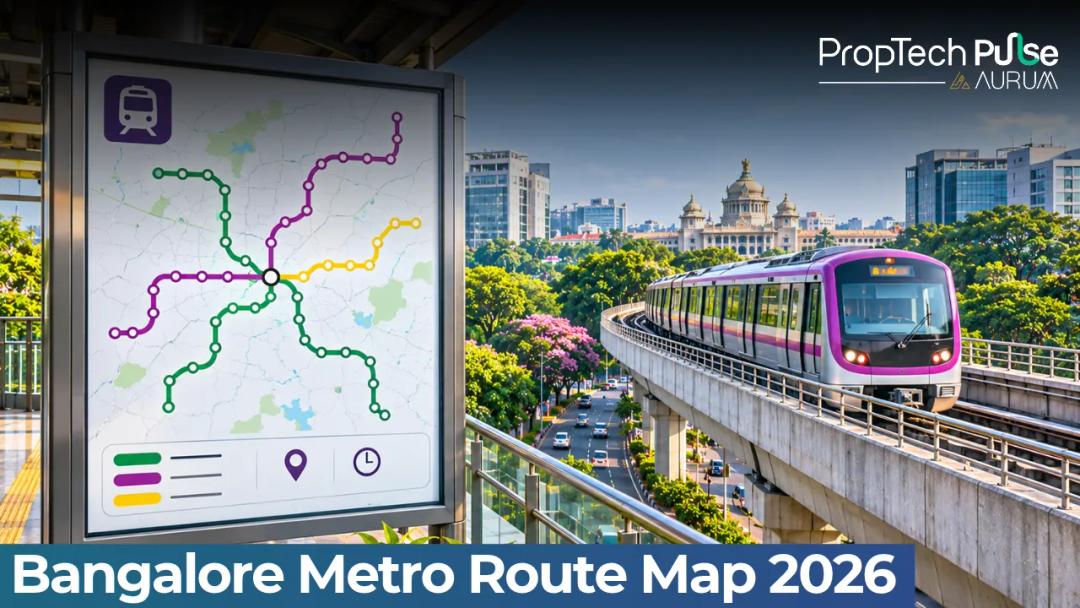
Bangalore Metro Route Map 2026: Lines, Stations & Timings
Bangalore's transit map shifted again in late 2025. The new Yellow Line pushed the total operational network to three lines and roughly 96 km of track. Keeping your Bangalore metro route updated matters. Accurate timelines and exact stops dictate how you plan a daily commute or weigh a property purchase. This guide maps the full layout of the Purple, Green, and Yellow lines. We break down every station, handle ticket prices, clarify Monday morning timetables, and pinpoint interchange spots. If you're checking paths near bangalore rajajinagar metro properties sai smaran or mapping your commute to Whitefield and Electronic City, the updated data below covers it. In this guide Bangalore Metro Route Map 2026: All Operational Lines Bangalore Metro Timings and Train Frequency Major Stations and Connectivity Namma Metro Fare Structure and Ticketing Options Upcoming Metro Expansions: Pink and Blue Lines Frequently asked questions Bangalore Metro Route Map 2026: All Operational Lines Quick answer Bangalore's active metro network currently spans 3 lines and roughly 96 km across 83 stations. The Purple Line connects Kadugodi to Challaghatta. The Green Line runs from Madavara to Silk Institute. Meanwhile, the newer Yellow Line bridges the gap from RV Road to Bommasandra via the Electronic City tech hub. The core transit skeleton of the city held firm since the first phase opened in 2011. The 2025 expansion added necessary weight to eastern and southern corridors. Before the Yellow Line launch, connecting East Bangalore to Central and South areas meant long surface commutes. Now, the Bangalore metro route offers direct cross-town cuts. Green Line: Madavara to Silk Institute This western-heavy spine covers 33.4 km across 32 stations. It runs from Madavara in the northwest to Silk Institute in the southwest. Commuter traffic spikes through residential pockets like Peenya, Hebbal, KR Puram, and Banashankari. Residents on the outer western fringes use this line to cut straight into central business districts. Purple Line: Kadugodi to Challaghatta Covering 43.5 km with 37 stations, the Purple Line acts as the city's east-west backbone. It begins at Kadugodi (Whitefield), weaving past massive IT campuses and sprawling residential enclaves. It slices through the city center at City Center (Majestic) before terminating at Challaghatta. If you work in Whitefield but live closer to the airport or Jayanagar, this line dictates your daily commute. Yellow Line: RV Road to Bommasandra Open since August 2025, this 19.15 km stretch features 16 stations. It was the final major piece of Phase 2. The line threads through Electronic City, a critical employment zone, linking it back to the heart of the city via RV Road. Investors tracking namma metro yellow line housing boom bengaluru tech corridor dynamics know this connection reshaped rental demand and property premiums along the entire stretch. Bangalore Metro operational lines summary: lengths, station counts, and primary zones served (October 2026) Line Colour Route Endpoints Total Length & Station Count Key Micro-Markets Covered Purple Line Kadugodi (Whitefield) to Challaghatta 43.5 km | 37 stations Whitefield, Outer Ring Road, Jayanagar, Yelahanka, Airport area Green Line Madavara to Silk Institute 33.4 km | 32 stations Peenya, Hebbal, KR Puram, Banashankari, South Bangalore Yellow Line RV Road to Bommasandra 19.15 km | 16 stations Electronic City, RT Nagar, RV Road Total Network - ~96 km | 83 stations Across all major eastern, western, northern, and southern hubs Bangalore Metro Timings and Train Frequency The namma metro green line bangalore 2026 route map timings fares operate on distinct schedules based on the weekday. Most lines share standard hours, but Monday demands a shift due to the early-start protocol. Sundays follow a relaxed holiday timetable. Weekday, Monday and Sunday Start/End Times On a standard Tuesday through Saturday, the Purple and Green lines begin service at 5:00 AM. They run until roughly 10:40 PM to 11:00 PM. The newly added Yellow Line starts slightly later at 6:00 AM and ends closer to 11:55 PM. If you commute on Monday mornings, expect trains to start earlier on the Purple and Green lines. Service kicks off at 4:15 AM to handle the heavy influx of workers starting their week. Sunday public holidays follow the relaxed schedule, with the earliest trains arriving at 7:00 AM across the network. Peak Hour Intervals and Delays Frequency drops significantly during rush hours. Between 8:00 AM and 10:00 AM, and again from 5:30 PM to 8:00 PM, trains arrive every 5 to 8 minutes. Off-peak intervals widen to 10 to 15 minutes. During extreme heat waves or monsoon disruptions, delays can occur. BMRCL typically adjusts schedules dynamically rather than halting service entirely. Major Stations and Connectivity Understanding where the lines intersect matters. Switching tracks rarely forces you above ground. The system uses two primary interchange hubs designed to funnel traffic efficiently. Key Interchange Stations at Majestic and RV Road Majestic (also known as City Center) sits at the absolute middle of the network, allowing smooth transfers between the Purple and Green lines. Traffic here never stops, making it the busiest node in the city. For passengers using the newer routes, RV Road serves as the critical junction. It allows direct transfers between the Green Line and the Yellow Line, effectively bridging older city infrastructure with the rapidly developing Electronic City tech belt. This specific intersection has become a focal point for commercial real estate due to sheer footfall volumes. Essential Stops Around metro station rajajinagar and Jayanagar Rajajinagar holds significant value in the transit layout. Commuters relying on the bangalore rajajinagar metro properties sai smaran context often look for precise stop locations. Located directly on the Purple Line, it provides quick access to both the CBD and the northeastern industrial belts. From here, switching to bus rapid transit or local trains for further reach outside the metro perimeter is straightforward. Nearby Jayanagar, sitting on the Green Line, completes the inner-city triangle that supports dense residential living. Assessing how transit accessibility alters real estate values is key to modern purchasing decisions. Check how does proximity to a metro station affect apartment pricing to understand premium variances before committing capital. Namma Metro Fare Structure and Ticketing Options Fares operate on a sliding scale tied to travel distance. The minimum ticket price starts at ₹10. Depending on your origin and destination combination, the maximum cap generally falls between ₹60 and ₹90 for longer cross-city runs. Calculating Your Travel Cost with Tokens and Smart Cards You have two primary ways to pay. Single-journey tokens can be purchased instantly from automated machines located at every station entrance. These accept cash and debit cards. Regular commuters should invest in a Namma Metro smart card. Loading funds onto the card grants a flat discount ranging from 5% to 10% off every trip. It also saves time at the gates since tapping the card bypasses the queue for token purchases. Students and certain government employees may qualify for subsidized special cards, which require valid documentation at designated booking centers. Tip: Avoid buying multiple single tokens for the same day. A single smart card load beats the hassle of standing at the machine, especially when trains start running every five minutes. Upcoming Metro Expansions: Pink and Blue Lines Beyond the current 96 km footprint, Phase 3 construction continues to push outward. Two highly anticipated routes are currently in the works. The Pink Line will cut diagonally across the southern suburbs, stretching from Kalena Agrahara to Nagawara near the airport. The Blue Line promises to be the largest infrastructure project yet, offering a 58 km underground tunnel directly connecting Central Silk Board to Kempegowda International Airport. Understanding what is the bengaluru metro phase 3 route effect on property helps buyers locate undervalued assets before these concrete pillars go up and land prices jump. When you trace the future Bengaluru metro route on paper, it clearly shows where the next wave of rental demand will hit. Before you plan your next move The Bangalore metro is no longer a luxury for urban planners; it is the baseline requirement for any viable property investment today. Planning your Bangalore metro route starts by checking the official BMRCL map first. Whether you target high-yield rentals near the Yellow Line or plan a family home on the Green Line, transit access dictates resale value and rental demand more consistently than almost any other factor in the current market. Frequently asked questions What are the operating hours for the Purple and Green lines? On Tuesdays through Saturdays, both lines begin service at 5:00 AM and terminate operations around 11:00 PM. On Mondays, expect an earlier start at 4:15 AM to accommodate early workers. Public holidays and Sundays run on a reduced schedule, with the first trains arriving at 7:00 AM. Always keep a buffer if you are catching the very first or last train of the day. When did the new Yellow Line open and what are its stations? The Yellow Line officially launched in August 2025, adding nineteen kilometers and sixteen stations to the existing network. It connects RV Road directly to Bommasandra, cutting straight through the Electronic City technology park. This route bridges a massive transport gap for professionals who previously relied on congested road networks to reach their offices. How much does a single journey cost on Namma Metro? Fares are calculated based on the distance traveled. The base entry fee is ₹10. As you traverse further across the city grid, costs rise, capping out at approximately ₹90 for the longest possible rides. Using a registered Namma Metro smart card secures a steady 5 to 10 percent discount off every individual trip. Which station connects the Purple, Green, and Yellow lines? Majestic (City Center) acts as the primary interchange between the Purple and Green lines, sitting right in the middle of the older city. RV Road serves as the crucial transfer point for the newer Yellow Line, allowing passengers moving toward Electronic City to switch from the main Green Line without exiting paid areas. Where can I find the official Bangalore metro route map? You can download the latest high-resolution PDF route maps directly from the BMRCL official website. These files detail all current Phase 2 stations, future Phase 3 alignments, and platform-level information. Keep a digital copy on your phone, as signal drops occasionally make live app navigation difficult deep underground. Sources BMRCL Official Website: Route maps, station listings, and operational timetables (accessed November 2026) Enjoyed this blog article? Visit PropTech Pulse for more interesting blogs.

PropTech Pulse Editorial
24th November 2026

Uncategorized
Akrama Sakrama Scheme 2026: Update, Eligibility & Guide
Bangalore plot owners often face a quiet panic when discovered homes sit just beyond approved setback lines. Older layouts constructed under laxer rules usually hold minor deviations. Buyers chase the Akrama Sakrama scheme to close those gaps without triggering demolition orders or punitive fines. The administrative window shut permanently in late 2025 after a Supreme Court intervention. Owners currently navigate a frozen process with no clear reopening date. This guide cuts through recycled boilerplate. We break down exactly what happens to pending applications. You will also see which penalty calculations still hold water under the 2025 Municipal Amendments. Finally, we clarify how this settlement path differs from premium FAR allowances. Every section ends with a concrete next step. In this guide What is the Akrama Sakrama scheme? Akrama Sakrama 2026: Current Status & Legal Challenges Eligibility Criteria & Violation Limits Step-by-Step Akrama Sakrama Application Process Penalty Structure & Calculation Example Akrama Sakrama vs Premium FAR & Bagair Hukum What Property Owners Should Do While the Scheme Is Paused Frequently asked questions What is the Akrama Sakrama scheme? Quick answer Akrama Sakrama is a Karnataka government regularisation programme designed to fix minor building setbacks and plot deviations. Launched in 2013, it allows property owners to pay a graded penalty based on guidance values to legalise non-compliant constructions built on or before October 2013. New applications are currently paused following a Supreme Court order, though existing filings remain valid. The title roughly means "step-by-step" in Kannada, reflecting its phased approach to clearing urban irregularities. Builders and individual plot holders could declare actual built-up areas against sanctioned layout plans. The shortfall triggered a fine tied directly to government guidance values. State officials targeted a specific pain point: thousands of independent homes and smaller apartment complexes carrying paperwork mismatches that blocked loans, sales, and occupancy handovers. By offering a structured payment pathway, the programme aimed to bring these assets back into the formal property register without paralyzing the broader housing supply chain. Akrama Sakrama 2026: Current Status & Legal Challenges Search trends around akrama sakrama 2026 spike whenever property owners worry about compliance deadlines. The reality this year is quieter but structurally significant. The scheme remains registered under state regulations but actively accepts zero new submissions following judicial intervention. Why the Supreme Court Stay Matters A constitutional bench froze fresh intake during hearings on land-use governance. That order pauses administrative processing without invalidating existing filings. Owners who submitted complete dossiers before the stay retain their queue positions while the apex court reviews the framework. The court must determine whether settlement frameworks create dangerous precedents for future builders. If developers plan setbacks just to pay lower fines later, that creates a flawed incentive structure. File processing waits for a definitive verdict on the programme's legal standing. Alternative Regularisation Routes Under the 2025 Municipal Amendments While courts deliberate, municipal corporations accelerated parallel enforcement tools. The Karnataka Municipal Corporations (Amendment) Act of 2025 tightened inspection protocols considerably. Local authorities now wield power to halt work swiftly using streamlined directives. Ongoing projects relying on older permits must align instantly with fresh height limits. Misaligned paperwork triggers faster rejections than it did just twenty-four months ago. Compliance note Do not attempt hidden additions or partial constructions while the main programme sits on hold. Municipal drones and ward-level audits now flag minute deviations that previously went unnoticed, triggering direct penalty notices unrelated to settlement channels. Eligibility Criteria & Violation Limits Knowing your plot's position relative to baseline rules dictates whether you qualify for relief or face straight enforcement. The criteria hinge on three anchors: construction timing, physical setback ratios, and land classification type. Building Age, Setback Thresholds & Excluded Lands Structures erected on or before October 19, 2013 form the core eligible cohort. Any building completed after that mark faces standard violation penalties. Layout planners must also stick to set percentage thresholds regarding private open spaces. Residential setbacks tolerate deviations up to fifty percent of the required distance. Commercial plots allow only quarter-distance slack before triggering full sanctions. Lakebeds, protected green belts, and encroached public pavements never qualified and remain permanently ineligible regardless of interpretation changes. Step-by-Step Akrama Sakrama Application Process Documents You Must Submit Citizens preparing an application must assemble a tightly organised packet. Missing one notarised sheet stalls the file indefinitely. Grab the khata extract confirming ownership lineage immediately. Secure certified boundary survey maps from a licensed surveyor. File the original BBMP or DTCP-approved layout plan alongside current property tax receipts. Never skip the no-object certificates from fire and environmental agencies. When compiling these papers, pair them with a thorough property due diligence checklist to avoid missing title deed discrepancies or pending litigation that could sink the filing entirely. Where to File & Tracking Updates Submission channels bypass internet portals for the time being. Physical counters at urban local body offices handle all intake. Ward secretariats log every paper packet against a unique serial number. Track progress by visiting the documentation desk weekly or dialling the zone's citizen helpline. While online dashboards occasionally launch as pilots, physical acknowledgments remain the legally binding receipts. Penalty Structure & Calculation Example Graded levies replace flat fines to match actual breach severity. The matrix scales with percentage deviation from the granted footprint. Setback violation limits and applicable penalty slabs under the Akrama Sakrama scheme Violation Extent Applicable Penalty Rate Basis of Calculation Up to 25% of prescribed setback 6% Guidance/market value of the violated portion 25% to 50% of prescribed setback 8% Guidance/market value of the violated portion Total payable on irregular floor area 6% to 8% Depends on exact deviation percentage Worked ₹ Example for a 40% Setback Violation Arithmetic clarity prevents both overpayment and underfunding. Imagine a residential plot carrying a government guidance value of ₹80 lakh. Sanctioned layouts demand forty percent as private open space. The constructed house pushes outward, stealing thirty percent of that required green buffer. That deviation drops perfectly into the twenty-five to fifty bracket, activating the eight percent penalty tier. Isolate the guidance value attached to the irregular patch first. Thirty percent of ₹80 lakh equals ₹24 lakh. The eight percent rate converts that surplus area into a ₹1.92 lakh penalty settlement. Factor in standard registration duties and stamp charges on top of that base figure. Timely payments trigger automatic modified sale deed transfers. Before clearing any dues, check the latest stamp duty and registration rates in Bengaluru so you account for base market adjustments. Akrama Sakrama vs Premium FAR & Bagair Hukum Property forums routinely bundle three separate government programmes, fueling genuine confusion. Akrama Sakrama repairs past construction errors. Premium floor area ratio acts as a reward for providing forward-looking public concessions. Builders offering wider roads or community parks inside project boundaries often earn extra permissible carpet area. Premium FAR injects usable square footage legally right from the initial design phase. This route carries absolutely zero punitive element. Bagair hukum sits entirely outside standard urban building codes. The programme specifically targets agricultural land tenure. It regularises families who farmed government tracts before 2004 without formal leases. Strict eligibility checks lock onto continuous farm activity, household acreage caps, and minimum age brackets. Neither scenario touches residential setback reconciliation. Maintaining strict boundaries between these pathways stops buyers from combining mismatched forms. What Property Owners Should Do While the Scheme Is Paused Pause does not mean paralysis. Owners must triage standing violations and adjust timelines accordingly. Small discrepancies sitting comfortably within the first tier demand minimal attention. Secure and store every scanned document, receipt, and correspondence in cloud backups. Prepare for eventual resubmission once judicial clearance arrives. Larger deviations exceeding fifty percent rarely survive future scrutiny phases. A property lawyer specialising in municipal bye-laws should review any visible modification plans first. Rapid renovations designed to shift measured footprints trigger immediate ward inspections. Sticking strictly to newly sanctioned envelopes removes the need for retroactive forgiveness entirely. Strict adherence to approved layouts shields the asset even while the scheme rests in legal limbo. New developments require full DTCP or BBMP alignment alongside a mapped-out occupancy certificate compliance path. Frequently asked questions Is Akrama Sakrama still valid in 2026? Yes, the scheme remains legally active but currently accepts no new filings. The original framework launched in 2013 continues to govern pending cases while a Supreme Court review determines its long-term viability. Owners who submitted complete documentation before the recent regulatory pause retain their place in the queue. Once the apex court delivers its final verdict on urban settlement mechanisms, the state urban authority will decide if intake reopens under the new municipal codes. How much penalty does Akrama Sakrama charge? The penalty operates on a graduated scale calculated strictly against the guidance value of the irregular construction area rather than the total plot price. Minor deviations covering up to twenty-five percent of the mandated setback attract a six percent levy on the excess footprint. Larger infractions ranging between twenty-five and fifty percent trigger an eight percent rate on the exact surplus floor space. These percentages reflect a deliberate policy design to recover public revenue losses while discouraging unchecked sprawl. Can I apply for Akrama Sakrama online? Physical submission remains the only accepted channel for routine processing. Urban local bodies across Karnataka require paper dossiers bearing original ownership proofs, certified site surveys, layout approvals, and statutory no-object certificates from fire or pollution departments. Applicants receive a physical acknowledgment receipt containing a unique tracking identifier. While certain states have piloted digital portals for real estate settlements, the current implementation relies on manual counter verification to prevent fraud. What is Bagair Hukum and is it the same as Akrama Sakrama? Bagair hukum regulates agricultural allotments and unauthorised farming plots on state-owned tracts, whereas akrama sakrama addresses urban architectural deviations like encroaching setbacks and floor-area miscalculations. The former demands continuous cultivation predating twenty-four, a family acreage cap, and specific age brackets. The latter targets completed residential or commercial structures within notified town layouts. Both share a regularisation philosophy but operate under entirely separate revenue and municipal codes. Difference between Akrama Sakrama and Premium FAR Premium floor area ratio grants extra constructed square footage as compensation for providing public infrastructure like wider corridors or parkland. It functions as an upfront trade-in during the initial design phase and carries no punitive component. The Karnataka settlement program penalises past planning mistakes by charging a percentage of the market guidance value. Premium FAR boosts usable space legally from day one. The settlement route merely sanitises existing breaches through financial recovery. Sources Karnataka Revenue Department: Guidelines on land regularization and plot allotment limits (accessed November 2026) Greater Bengaluru City Municipal Corporation: Building plan approval procedures and setback enforcement notices (accessed November 2026) Enjoyed this blog article? Visit PropTech Pulse for more interesting blogs.
PropTech Pulse Editorial
24th November 2026
Uncategorized
Mysore Road Metro Station: Timings, Routes & Parking Guide
Your alarm rings at 7:30 AM. Traffic on Mysore Road stiffens long before you hit Outer Ring Road. Catching the train cuts the commute in half and buys you a predictable window to cross toward Whitefield. This guide covers the station layout, short loops, fares, and parking realities so you plan better. In this guide Location, Layout, and Entry Gates Purple Line Routes and Peak-Hour Short Loops Timings, Fares, and Smart Card Discounts Parking Availability and Costs Nearby Areas and Property Connectivity Frequently asked questions Location, Layout, and Entry Gates Quick answer Mysore Road Metro Station sits in Deepanjali Nagar off Mysore Road, adjacent to Muthachari Industrial Estate. The station operates from 5:14 AM to 11:19 PM, depending on direction. Four main entry points exist, with Gates A and D offering wheelchair ramps and elevator access to the paid concourse level. The station carries both names interchangeably across maps and local signage. Official records list it as Mysuru Road Metro Station under the BMRC schedule, while street directions still rely on Mysore Road. The physical address remains unchanged regardless of which spelling you type into a navigation app. The station occupies a flat plot just west of the Bellary Road junction, placing it within comfortable walking distance from the satellite bus terminus and several major manufacturing yards that draw thousands of daily workers. Four gates control passenger flow through the plaza. Gate A sits closest to the industrial estate side and provides the sharpest connection to major factory entrances and office parks. Gate B opens toward the quieter residential pockets behind the old stadium. Gate C faces the open plaza space used for temporary events and public transport pickups. Gate D mirrors Gate A on the opposite side of the concourse and houses the primary customer service counter alongside the ticket vending machines. Morning crowds typically funnel through Gates A and D because those barriers feed directly into the central escalator bank. Gates A and D carry the designated barrier-free infrastructure. You will find tactile paving leading from the footpath straight to the elevator shafts, which drop down to the mezzanine level. Elevators run continuously through operating hours but can face minor delays during maintenance windows announced on the BMRCL notice board. If you travel with heavy luggage, strollers, or mobility aids, stick to Gates A and D rather than forcing stairs at the middle gates. The platform sits above ground level, meaning step-free access is essential for safe boarding. Purple Line Routes and Peak-Hour Short Loops The Mysore road metro connects riders to the western fringes of Bengaluru and the eastern tech corridor in a single ride. Trains running from Challaghatta terminate at Whitefield or Kadugodi during standard service. That single line covers roughly thirty-seven active stations, cutting out the need for transfers at Major Sports Complex or Malleshwaram. Commuters rarely encounter platform crowding outside the 7 AM to 10 AM and 5 PM to 8 PM windows. Morning operations shift quickly. The ops team splits incoming trains into short loops rather than sending every carriage south. These segments cycle between Mysuru Road Metro Station and intermediate hubs, saving commuters twenty minutes compared to waiting for a full-length train. Track allocation runs automatically; watch the destination LEDs. Garudacharpalya runs eastbound short trains starting at 7:45 AM and wrapping up around 9:00 AM. The frequency hits a train every eight to ten minutes during the worst squeeze. Riders bound for Electronic City or Devarabeesanahalli should watch the destination board carefully and board only cars tagged for Garudacharpalya. Full-length trains arriving at this hour will push you through three more stops before stopping again. Evening services flip the direction. Pattandur Agrahpa forms the western short loop, departing Mysore Road Metro Station between 4:00 PM and 8:00 PM. These carriages head toward Sahakarnagar and stop shortly after crossing the river bridges. If you work shifts that end around 6:30 PM and cannot miss the 7:15 full train to Challaghatta, the Pattandur Agrahpa loop delivers you to your preferred transfer point almost twenty minutes faster. Short loops run on fixed departure times stamped on the digital boards above the platforms. Treat them like scheduled buses rather than unpredictable extras. Platform staff wear blue vests and stand near the stairwell landings during rush minutes. They will shout the destination name five seconds before doors close. Listen for Garudacharpalya or Pattandur Agrahpa and hold your position until the boarding crowd thins slightly. Boarding blindly leads to being shut out at the next intersection. Carry your smart card or loaded QR scanner ready; fumbling for tokens slows entry and causes bottlenecks at the turnstiles. Timings, Fares, and Smart Card Discounts Trains depart Challaghatta around 5:14 AM and leave Whitefield or Kadugodi near 11:19 PM. Reverse timings shift by five to seven minutes depending on seasonal daylight adjustments and special event clearance protocols. Check the daily timetable published on bmrc.co.in closer to your move date. Weekend schedules sometimes reduce frequency by fifteen percent, so verify rotations before planning late-day trips. Fare calculation follows strict distance slabs. The base ticket covers the initial segment and climbs incrementally as you add stations toward the eastern terminus. Most passengers traveling from Mysore Road Metro Station to central districts pay between thirty and seventy rupees one way. Long stretches toward Challaghatta or Whitefield sit closer to the eighty-five to ninety rupee mark. You can purchase tokens at automated machines or counters, though cash handling slows the line significantly during the morning rush. Smart cards cut costs and speed up entry. Using a rechargeable card reduces base fares by five to eight percent compared to token pricing, depending on the recharge amount. A typical twenty-station ride to Central Business District costs sixty rupees as a single token. Loading value onto a card drops that per-trip cost to approximately fifty-five rupees, plus you bypass the ticket counter queues entirely. Students and senior citizens carry separate identity-linked cards that apply fixed lower slabs across the entire network. Cards require renewal at designated offices once the validity year closes, even if monetary balance remains untouched. Fare comparison: Mysore Road Metro Station to key destinations Journey Segment Standard Token Fare Smart Card Discount Range Mysore Road to Central Business District ₹40 – ₹60 ₹5 to ₹8 saved per trip Mysore Road to Challaghatta (West Terminus) ₹75 – ₹85 ₹6 to ₹9 saved per trip Mysore Road to Whitefield / Kadugodi (East Terminus) ₹85 – ₹90 ₹7 to ₹10 saved per trip Monthly Commute (Approx. 40 trips) ₹2,400 – ₹3,200 ₹200 – ₹320 saved Total monthly savings scale quickly if you commute five days a week. Keep the card charged near fifty rupees to prevent automatic system locks at the exit barriers. Reload via the BMRC official app or at any major terminal kiosk to avoid carrying loose cash through the station corridors. Circle rate calculator tools matter less for your daily commute than transit costs, but understanding fare efficiency helps you weigh proximity versus rental premiums when hunting for a new flat near this station. Parking Availability and Costs Two-wheeler space dominates the parking lot because bike commuters form the largest share of early arrivals. The paved compound holds around 1,500 bikes arranged in tight parallel rows. Four-wheeler slots sit further back, accommodating roughly 250 cars spread across marked bays. Both zones use a contractor-managed payment model that collects fees through designated kiosks or QR scanners placed near the exit lanes. Cash payments are still accepted but drive longer queues at peak hours. Two-wheeler charges hover around fifteen rupees per session. Cars generally run higher, reflecting the larger footprint and tighter supply relative to demand. Rates update seasonally when contractors renegotiate municipal leases, so treat posted tariffs as baseline figures until a fresh tariff notice lands on the BMRC portal. Night parking is available but discouraged due to limited lighting beyond the perimeter fence. Morning slots fill by 8:15 AM. If you arrive after 8:40 AM on weekdays, you will likely walk past three rows searching for an empty patch. Evening returns offer more breathing room until 6:00 PM, after which the return surge pushes capacity tight again. Security guards monitor camera feeds and patrol randomly between 10:00 AM and midnight, but never leave valuables visible on the seat or in the glove compartment. Theft prevention relies on locking compartments fully and removing helmets when stepping inside the station concourse. If you rely on driving to the station consistently, consider whether the combined cost of petrol, vehicle depreciation, and daily parking outweighs loading a smart card for frequent rides. Some riders split the difference by cycling partway and parking briefly, though cycle racks remain scarce compared to motorized options. Electric vehicle charging stations are gradually being installed but are not yet widespread across all commuter lots. Nearby Areas and Property Connectivity Western Bengaluru expands steadily along this corridor. Developers have pushed multiple mid-rise residential towers into the Deepanjali Nagar fringe, targeting young professionals who want direct rail access without crossing the ring road daily. Properties here command steadier resale values compared to older interior streets because the station removes the last mile friction for office commuters. Independent houses still dominate the immediate vicinity, but approved township layouts are replacing agricultural plots at a steady pace. a href="https://www.aurumproptech.in/pulse/blog/kumbalgodu-buyers-guide-2026-property-rates-plots-metro">Kumbalgodu buyers guide 2026 property rates plots metro shows a broader pattern repeating across the outer west belt: metro proximity adds fifteen to twenty percent premium over comparable distances away from the line. Buyers evaluating units near Mysore Road Metro Station should compare carpet area against listing size, since super built-up loading still drives quoted prices across Karnataka. Checking verified construction status through RERA registered projects on Mysore Road protects against stalled site payments. Always request the latest encumbrance certificate and building completion certificate before signing agreement drafts. Eastern connectivity benefits equally. Once trains slip past HAL Old Town, the line funnels directly into the Electronic City employment belt. Flats along Bannerghatta Road and Varthur see rising rents because employees prefer living closer to their actual workplace instead of commuting twice across the city. The metro effectively doubles the catchment radius for office seekers who refuse to spend three hours daily in traffic. Rental yield for two-bedroom apartments within one kilometre of the station currently sits between 3.2 and 3.8 percent annually, driven by consistent corporate relocation flows. Flats in Bangalore rates and area guide materials highlight another reality: connectivity lifts demand, but land supply dictates price ceilings. Municipal approvals pace slower in some newer pockets along Mysore Road, meaning inventory stays thin while builder margins stay high. Watch for ready-to-move stock rather than booking early-stage launch units if commute stability matters more than speculative appreciation. Transaction taxes also factor into overall holding costs. Review the latest Bengaluru stamp duty and registration charges before finalising any paperwork, since state levies shift periodically without altering underlying market fundamentals. Factor documentation fees, lawyer retainer costs, and society transfer charges into your total acquisition budget to avoid cash crunches at the registry office. Before you plan your daily commute or visit the locality, verify current fare slabs and gate maintenance statuses directly on bmrc.co.in. Transit conditions change faster than printed guides, and confirming platform elevators or parking contractor updates on arrival day saves awkward detours. Lock in your monthly travel pass early in the quarter to avoid fare revision hikes, and always carry a backup payment method for toll plazas or intercity cab bookings outside the metro zone. Frequently asked questions Where is Mysore Road metro station located? The station sits in Deepanjali Nagar off Mysore Road, right next to Muthachari Industrial Estate. It falls squarely in the northern reaches of the purple line network. The location places it within comfortable walking distance from the satellite bus terminus and several major manufacturing yards that draw thousands of daily workers. Is there parking at Mysore Road metro station? Yes. The compound holds approximately 1,500 two-wheeler spaces and about 250 four-wheeler slots spread across marked bays. Both areas operate through a contracted management model that collects session fees at kiosks. Morning arrivals often struggle to find empty spots after 8:15 AM on regular weekdays. What is the timing of Mysuru Road metro station? Trains depart Challaghatta around 5:14 AM and leave the eastern termini near 11:19 PM. Exact reverse times shift slightly based on daylight adjustments and operational clearances. Always check the daily schedule on the official portal before your first ride, since weekend frequencies sometimes differ from business day rotations. How far is Mysore Road metro station from Satellite Bus Stand? The distance runs roughly one kilometre along Mysore Road. Pedestrian pathways connect the station plaza directly to the bus terminus through a continuous footbridge layout. Walkers typically cover the gap in twelve to fifteen minutes depending on crowding near the vendor stalls. How do morning peak-hour short loops work at Mysore Road metro station? Short loops split the regular fleet during rush windows. The Garudacharpalya segment runs eastbound from 7:45 AM to 9:00 AM, delivering riders to Electronic City nodes much faster than full trains. Destination boards display the exact short-loop name, and platform staff direct crowds toward matching carriages. Sources Bengaluru Metro Rail Corporation Limited (bmrc.co.in): Operating timetables, short loop schedules, and station layouts (accessed November 2026) Bengaluru Metro Rail Corporation Limited (bmrc.co.in): Passenger information guidelines including accessibility features and fare policy notes (accessed November 2026) Enjoyed this blog article? Visit PropTech Pulse for more interesting blogs.
PropTech Pulse Editorial
24th November 2026
Uncategorized
Bangalore Metro Route Map 2026: Lines, Stations & Timings
Bangalore's transit map shifted again in late 2025. The new Yellow Line pushed the total operational network to three lines and roughly 96 km of track. Keeping your Bangalore metro route updated matters. Accurate timelines and exact stops dictate how you plan a daily commute or weigh a property purchase. This guide maps the full layout of the Purple, Green, and Yellow lines. We break down every station, handle ticket prices, clarify Monday morning timetables, and pinpoint interchange spots. If you're checking paths near bangalore rajajinagar metro properties sai smaran or mapping your commute to Whitefield and Electronic City, the updated data below covers it. In this guide Bangalore Metro Route Map 2026: All Operational Lines Bangalore Metro Timings and Train Frequency Major Stations and Connectivity Namma Metro Fare Structure and Ticketing Options Upcoming Metro Expansions: Pink and Blue Lines Frequently asked questions Bangalore Metro Route Map 2026: All Operational Lines Quick answer Bangalore's active metro network currently spans 3 lines and roughly 96 km across 83 stations. The Purple Line connects Kadugodi to Challaghatta. The Green Line runs from Madavara to Silk Institute. Meanwhile, the newer Yellow Line bridges the gap from RV Road to Bommasandra via the Electronic City tech hub. The core transit skeleton of the city held firm since the first phase opened in 2011. The 2025 expansion added necessary weight to eastern and southern corridors. Before the Yellow Line launch, connecting East Bangalore to Central and South areas meant long surface commutes. Now, the Bangalore metro route offers direct cross-town cuts. Green Line: Madavara to Silk Institute This western-heavy spine covers 33.4 km across 32 stations. It runs from Madavara in the northwest to Silk Institute in the southwest. Commuter traffic spikes through residential pockets like Peenya, Hebbal, KR Puram, and Banashankari. Residents on the outer western fringes use this line to cut straight into central business districts. Purple Line: Kadugodi to Challaghatta Covering 43.5 km with 37 stations, the Purple Line acts as the city's east-west backbone. It begins at Kadugodi (Whitefield), weaving past massive IT campuses and sprawling residential enclaves. It slices through the city center at City Center (Majestic) before terminating at Challaghatta. If you work in Whitefield but live closer to the airport or Jayanagar, this line dictates your daily commute. Yellow Line: RV Road to Bommasandra Open since August 2025, this 19.15 km stretch features 16 stations. It was the final major piece of Phase 2. The line threads through Electronic City, a critical employment zone, linking it back to the heart of the city via RV Road. Investors tracking namma metro yellow line housing boom bengaluru tech corridor dynamics know this connection reshaped rental demand and property premiums along the entire stretch. Bangalore Metro operational lines summary: lengths, station counts, and primary zones served (October 2026) Line Colour Route Endpoints Total Length & Station Count Key Micro-Markets Covered Purple Line Kadugodi (Whitefield) to Challaghatta 43.5 km | 37 stations Whitefield, Outer Ring Road, Jayanagar, Yelahanka, Airport area Green Line Madavara to Silk Institute 33.4 km | 32 stations Peenya, Hebbal, KR Puram, Banashankari, South Bangalore Yellow Line RV Road to Bommasandra 19.15 km | 16 stations Electronic City, RT Nagar, RV Road Total Network - ~96 km | 83 stations Across all major eastern, western, northern, and southern hubs Bangalore Metro Timings and Train Frequency The namma metro green line bangalore 2026 route map timings fares operate on distinct schedules based on the weekday. Most lines share standard hours, but Monday demands a shift due to the early-start protocol. Sundays follow a relaxed holiday timetable. Weekday, Monday and Sunday Start/End Times On a standard Tuesday through Saturday, the Purple and Green lines begin service at 5:00 AM. They run until roughly 10:40 PM to 11:00 PM. The newly added Yellow Line starts slightly later at 6:00 AM and ends closer to 11:55 PM. If you commute on Monday mornings, expect trains to start earlier on the Purple and Green lines. Service kicks off at 4:15 AM to handle the heavy influx of workers starting their week. Sunday public holidays follow the relaxed schedule, with the earliest trains arriving at 7:00 AM across the network. Peak Hour Intervals and Delays Frequency drops significantly during rush hours. Between 8:00 AM and 10:00 AM, and again from 5:30 PM to 8:00 PM, trains arrive every 5 to 8 minutes. Off-peak intervals widen to 10 to 15 minutes. During extreme heat waves or monsoon disruptions, delays can occur. BMRCL typically adjusts schedules dynamically rather than halting service entirely. Major Stations and Connectivity Understanding where the lines intersect matters. Switching tracks rarely forces you above ground. The system uses two primary interchange hubs designed to funnel traffic efficiently. Key Interchange Stations at Majestic and RV Road Majestic (also known as City Center) sits at the absolute middle of the network, allowing smooth transfers between the Purple and Green lines. Traffic here never stops, making it the busiest node in the city. For passengers using the newer routes, RV Road serves as the critical junction. It allows direct transfers between the Green Line and the Yellow Line, effectively bridging older city infrastructure with the rapidly developing Electronic City tech belt. This specific intersection has become a focal point for commercial real estate due to sheer footfall volumes. Essential Stops Around metro station rajajinagar and Jayanagar Rajajinagar holds significant value in the transit layout. Commuters relying on the bangalore rajajinagar metro properties sai smaran context often look for precise stop locations. Located directly on the Purple Line, it provides quick access to both the CBD and the northeastern industrial belts. From here, switching to bus rapid transit or local trains for further reach outside the metro perimeter is straightforward. Nearby Jayanagar, sitting on the Green Line, completes the inner-city triangle that supports dense residential living. Assessing how transit accessibility alters real estate values is key to modern purchasing decisions. Check how does proximity to a metro station affect apartment pricing to understand premium variances before committing capital. Namma Metro Fare Structure and Ticketing Options Fares operate on a sliding scale tied to travel distance. The minimum ticket price starts at ₹10. Depending on your origin and destination combination, the maximum cap generally falls between ₹60 and ₹90 for longer cross-city runs. Calculating Your Travel Cost with Tokens and Smart Cards You have two primary ways to pay. Single-journey tokens can be purchased instantly from automated machines located at every station entrance. These accept cash and debit cards. Regular commuters should invest in a Namma Metro smart card. Loading funds onto the card grants a flat discount ranging from 5% to 10% off every trip. It also saves time at the gates since tapping the card bypasses the queue for token purchases. Students and certain government employees may qualify for subsidized special cards, which require valid documentation at designated booking centers. Tip: Avoid buying multiple single tokens for the same day. A single smart card load beats the hassle of standing at the machine, especially when trains start running every five minutes. Upcoming Metro Expansions: Pink and Blue Lines Beyond the current 96 km footprint, Phase 3 construction continues to push outward. Two highly anticipated routes are currently in the works. The Pink Line will cut diagonally across the southern suburbs, stretching from Kalena Agrahara to Nagawara near the airport. The Blue Line promises to be the largest infrastructure project yet, offering a 58 km underground tunnel directly connecting Central Silk Board to Kempegowda International Airport. Understanding what is the bengaluru metro phase 3 route effect on property helps buyers locate undervalued assets before these concrete pillars go up and land prices jump. When you trace the future Bengaluru metro route on paper, it clearly shows where the next wave of rental demand will hit. Before you plan your next move The Bangalore metro is no longer a luxury for urban planners; it is the baseline requirement for any viable property investment today. Planning your Bangalore metro route starts by checking the official BMRCL map first. Whether you target high-yield rentals near the Yellow Line or plan a family home on the Green Line, transit access dictates resale value and rental demand more consistently than almost any other factor in the current market. Frequently asked questions What are the operating hours for the Purple and Green lines? On Tuesdays through Saturdays, both lines begin service at 5:00 AM and terminate operations around 11:00 PM. On Mondays, expect an earlier start at 4:15 AM to accommodate early workers. Public holidays and Sundays run on a reduced schedule, with the first trains arriving at 7:00 AM. Always keep a buffer if you are catching the very first or last train of the day. When did the new Yellow Line open and what are its stations? The Yellow Line officially launched in August 2025, adding nineteen kilometers and sixteen stations to the existing network. It connects RV Road directly to Bommasandra, cutting straight through the Electronic City technology park. This route bridges a massive transport gap for professionals who previously relied on congested road networks to reach their offices. How much does a single journey cost on Namma Metro? Fares are calculated based on the distance traveled. The base entry fee is ₹10. As you traverse further across the city grid, costs rise, capping out at approximately ₹90 for the longest possible rides. Using a registered Namma Metro smart card secures a steady 5 to 10 percent discount off every individual trip. Which station connects the Purple, Green, and Yellow lines? Majestic (City Center) acts as the primary interchange between the Purple and Green lines, sitting right in the middle of the older city. RV Road serves as the crucial transfer point for the newer Yellow Line, allowing passengers moving toward Electronic City to switch from the main Green Line without exiting paid areas. Where can I find the official Bangalore metro route map? You can download the latest high-resolution PDF route maps directly from the BMRCL official website. These files detail all current Phase 2 stations, future Phase 3 alignments, and platform-level information. Keep a digital copy on your phone, as signal drops occasionally make live app navigation difficult deep underground. Sources BMRCL Official Website: Route maps, station listings, and operational timetables (accessed November 2026) Enjoyed this blog article? Visit PropTech Pulse for more interesting blogs.
PropTech Pulse Editorial
24th November 2026
Uncategorized
Akrama Sakrama Scheme 2026: Update, Eligibility & Guide
Bangalore plot owners often face a quiet panic when discovered homes sit just beyond approved setback lines. Older layouts constructed under laxer rules usually hold minor deviations. Buyers chase the Akrama Sakrama scheme to close those gaps without triggering demolition orders or punitive fines. The administrative window shut permanently in late 2025 after a Supreme Court intervention. Owners currently navigate a frozen process with no clear reopening date. This guide cuts through recycled boilerplate. We break down exactly what happens to pending applications. You will also see which penalty calculations still hold water under the 2025 Municipal Amendments. Finally, we clarify how this settlement path differs from premium FAR allowances. Every section ends with a concrete next step. In this guide What is the Akrama Sakrama scheme? Akrama Sakrama 2026: Current Status & Legal Challenges Eligibility Criteria & Violation Limits Step-by-Step Akrama Sakrama Application Process Penalty Structure & Calculation Example Akrama Sakrama vs Premium FAR & Bagair Hukum What Property Owners Should Do While the Scheme Is Paused Frequently asked questions What is the Akrama Sakrama scheme? Quick answer Akrama Sakrama is a Karnataka government regularisation programme designed to fix minor building setbacks and plot deviations. Launched in 2013, it allows property owners to pay a graded penalty based on guidance values to legalise non-compliant constructions built on or before October 2013. New applications are currently paused following a Supreme Court order, though existing filings remain valid. The title roughly means "step-by-step" in Kannada, reflecting its phased approach to clearing urban irregularities. Builders and individual plot holders could declare actual built-up areas against sanctioned layout plans. The shortfall triggered a fine tied directly to government guidance values. State officials targeted a specific pain point: thousands of independent homes and smaller apartment complexes carrying paperwork mismatches that blocked loans, sales, and occupancy handovers. By offering a structured payment pathway, the programme aimed to bring these assets back into the formal property register without paralyzing the broader housing supply chain. Akrama Sakrama 2026: Current Status & Legal Challenges Search trends around akrama sakrama 2026 spike whenever property owners worry about compliance deadlines. The reality this year is quieter but structurally significant. The scheme remains registered under state regulations but actively accepts zero new submissions following judicial intervention. Why the Supreme Court Stay Matters A constitutional bench froze fresh intake during hearings on land-use governance. That order pauses administrative processing without invalidating existing filings. Owners who submitted complete dossiers before the stay retain their queue positions while the apex court reviews the framework. The court must determine whether settlement frameworks create dangerous precedents for future builders. If developers plan setbacks just to pay lower fines later, that creates a flawed incentive structure. File processing waits for a definitive verdict on the programme's legal standing. Alternative Regularisation Routes Under the 2025 Municipal Amendments While courts deliberate, municipal corporations accelerated parallel enforcement tools. The Karnataka Municipal Corporations (Amendment) Act of 2025 tightened inspection protocols considerably. Local authorities now wield power to halt work swiftly using streamlined directives. Ongoing projects relying on older permits must align instantly with fresh height limits. Misaligned paperwork triggers faster rejections than it did just twenty-four months ago. Compliance note Do not attempt hidden additions or partial constructions while the main programme sits on hold. Municipal drones and ward-level audits now flag minute deviations that previously went unnoticed, triggering direct penalty notices unrelated to settlement channels. Eligibility Criteria & Violation Limits Knowing your plot's position relative to baseline rules dictates whether you qualify for relief or face straight enforcement. The criteria hinge on three anchors: construction timing, physical setback ratios, and land classification type. Building Age, Setback Thresholds & Excluded Lands Structures erected on or before October 19, 2013 form the core eligible cohort. Any building completed after that mark faces standard violation penalties. Layout planners must also stick to set percentage thresholds regarding private open spaces. Residential setbacks tolerate deviations up to fifty percent of the required distance. Commercial plots allow only quarter-distance slack before triggering full sanctions. Lakebeds, protected green belts, and encroached public pavements never qualified and remain permanently ineligible regardless of interpretation changes. Step-by-Step Akrama Sakrama Application Process Documents You Must Submit Citizens preparing an application must assemble a tightly organised packet. Missing one notarised sheet stalls the file indefinitely. Grab the khata extract confirming ownership lineage immediately. Secure certified boundary survey maps from a licensed surveyor. File the original BBMP or DTCP-approved layout plan alongside current property tax receipts. Never skip the no-object certificates from fire and environmental agencies. When compiling these papers, pair them with a thorough property due diligence checklist to avoid missing title deed discrepancies or pending litigation that could sink the filing entirely. Where to File & Tracking Updates Submission channels bypass internet portals for the time being. Physical counters at urban local body offices handle all intake. Ward secretariats log every paper packet against a unique serial number. Track progress by visiting the documentation desk weekly or dialling the zone's citizen helpline. While online dashboards occasionally launch as pilots, physical acknowledgments remain the legally binding receipts. Penalty Structure & Calculation Example Graded levies replace flat fines to match actual breach severity. The matrix scales with percentage deviation from the granted footprint. Setback violation limits and applicable penalty slabs under the Akrama Sakrama scheme Violation Extent Applicable Penalty Rate Basis of Calculation Up to 25% of prescribed setback 6% Guidance/market value of the violated portion 25% to 50% of prescribed setback 8% Guidance/market value of the violated portion Total payable on irregular floor area 6% to 8% Depends on exact deviation percentage Worked ₹ Example for a 40% Setback Violation Arithmetic clarity prevents both overpayment and underfunding. Imagine a residential plot carrying a government guidance value of ₹80 lakh. Sanctioned layouts demand forty percent as private open space. The constructed house pushes outward, stealing thirty percent of that required green buffer. That deviation drops perfectly into the twenty-five to fifty bracket, activating the eight percent penalty tier. Isolate the guidance value attached to the irregular patch first. Thirty percent of ₹80 lakh equals ₹24 lakh. The eight percent rate converts that surplus area into a ₹1.92 lakh penalty settlement. Factor in standard registration duties and stamp charges on top of that base figure. Timely payments trigger automatic modified sale deed transfers. Before clearing any dues, check the latest stamp duty and registration rates in Bengaluru so you account for base market adjustments. Akrama Sakrama vs Premium FAR & Bagair Hukum Property forums routinely bundle three separate government programmes, fueling genuine confusion. Akrama Sakrama repairs past construction errors. Premium floor area ratio acts as a reward for providing forward-looking public concessions. Builders offering wider roads or community parks inside project boundaries often earn extra permissible carpet area. Premium FAR injects usable square footage legally right from the initial design phase. This route carries absolutely zero punitive element. Bagair hukum sits entirely outside standard urban building codes. The programme specifically targets agricultural land tenure. It regularises families who farmed government tracts before 2004 without formal leases. Strict eligibility checks lock onto continuous farm activity, household acreage caps, and minimum age brackets. Neither scenario touches residential setback reconciliation. Maintaining strict boundaries between these pathways stops buyers from combining mismatched forms. What Property Owners Should Do While the Scheme Is Paused Pause does not mean paralysis. Owners must triage standing violations and adjust timelines accordingly. Small discrepancies sitting comfortably within the first tier demand minimal attention. Secure and store every scanned document, receipt, and correspondence in cloud backups. Prepare for eventual resubmission once judicial clearance arrives. Larger deviations exceeding fifty percent rarely survive future scrutiny phases. A property lawyer specialising in municipal bye-laws should review any visible modification plans first. Rapid renovations designed to shift measured footprints trigger immediate ward inspections. Sticking strictly to newly sanctioned envelopes removes the need for retroactive forgiveness entirely. Strict adherence to approved layouts shields the asset even while the scheme rests in legal limbo. New developments require full DTCP or BBMP alignment alongside a mapped-out occupancy certificate compliance path. Frequently asked questions Is Akrama Sakrama still valid in 2026? Yes, the scheme remains legally active but currently accepts no new filings. The original framework launched in 2013 continues to govern pending cases while a Supreme Court review determines its long-term viability. Owners who submitted complete documentation before the recent regulatory pause retain their place in the queue. Once the apex court delivers its final verdict on urban settlement mechanisms, the state urban authority will decide if intake reopens under the new municipal codes. How much penalty does Akrama Sakrama charge? The penalty operates on a graduated scale calculated strictly against the guidance value of the irregular construction area rather than the total plot price. Minor deviations covering up to twenty-five percent of the mandated setback attract a six percent levy on the excess footprint. Larger infractions ranging between twenty-five and fifty percent trigger an eight percent rate on the exact surplus floor space. These percentages reflect a deliberate policy design to recover public revenue losses while discouraging unchecked sprawl. Can I apply for Akrama Sakrama online? Physical submission remains the only accepted channel for routine processing. Urban local bodies across Karnataka require paper dossiers bearing original ownership proofs, certified site surveys, layout approvals, and statutory no-object certificates from fire or pollution departments. Applicants receive a physical acknowledgment receipt containing a unique tracking identifier. While certain states have piloted digital portals for real estate settlements, the current implementation relies on manual counter verification to prevent fraud. What is Bagair Hukum and is it the same as Akrama Sakrama? Bagair hukum regulates agricultural allotments and unauthorised farming plots on state-owned tracts, whereas akrama sakrama addresses urban architectural deviations like encroaching setbacks and floor-area miscalculations. The former demands continuous cultivation predating twenty-four, a family acreage cap, and specific age brackets. The latter targets completed residential or commercial structures within notified town layouts. Both share a regularisation philosophy but operate under entirely separate revenue and municipal codes. Difference between Akrama Sakrama and Premium FAR Premium floor area ratio grants extra constructed square footage as compensation for providing public infrastructure like wider corridors or parkland. It functions as an upfront trade-in during the initial design phase and carries no punitive component. The Karnataka settlement program penalises past planning mistakes by charging a percentage of the market guidance value. Premium FAR boosts usable space legally from day one. The settlement route merely sanitises existing breaches through financial recovery. Sources Karnataka Revenue Department: Guidelines on land regularization and plot allotment limits (accessed November 2026) Greater Bengaluru City Municipal Corporation: Building plan approval procedures and setback enforcement notices (accessed November 2026) Enjoyed this blog article? Visit PropTech Pulse for more interesting blogs.
PropTech Pulse Editorial
24th November 2026

Ask Pulse Ai anything about real estate

Unlock the Latest in Real Estate
News, Infographics, Blogs & More! Delivered to your inbox.

