New Launch - India Real Estate Report 2026.

Services
Knowledge Hub
Resources
Tools

Ask Pulse Ai
©PropTech Pulse 2025, All rights reserved.


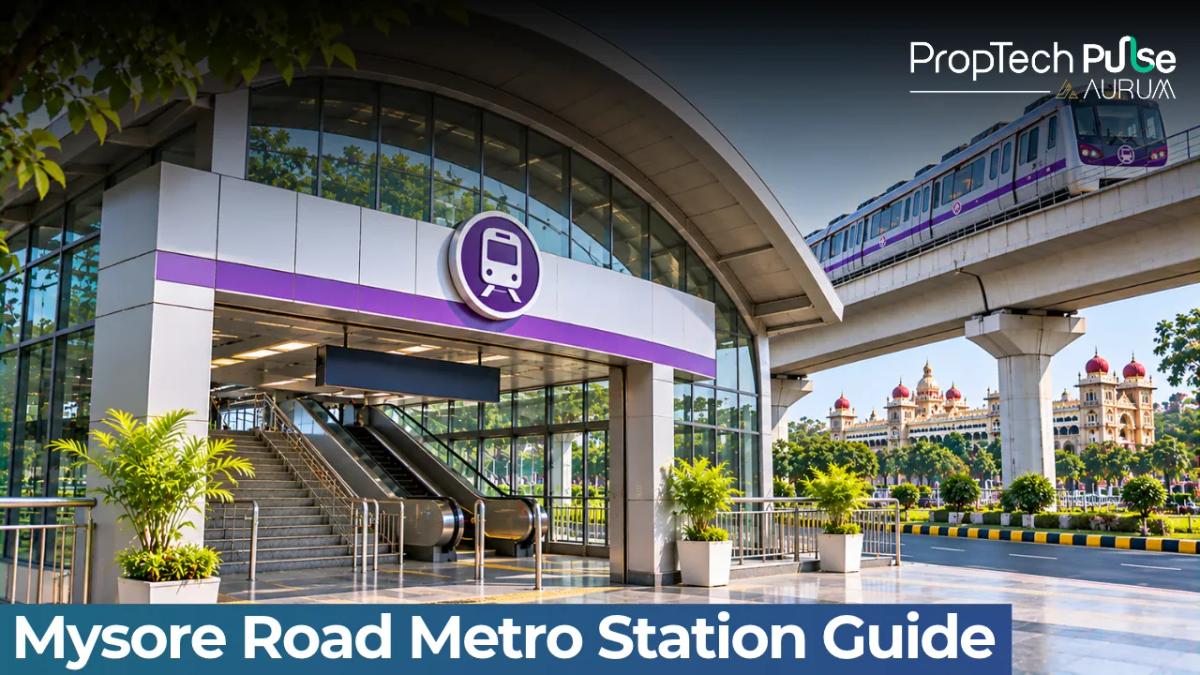
Your alarm rings at 7:30 AM. Traffic on Mysore Road stiffens long before you hit Outer Ring Road. Catching the train cuts the commute in half and buys you a predictable window to cross toward Whitefield. This guide covers the station layout, short loops, fares, and parking realities so you plan better.
Location, Layout, and Entry Gates
Quick answer
Mysore Road Metro Station sits in Deepanjali Nagar off Mysore Road, adjacent to Muthachari Industrial Estate. The station operates from 5:14 AM to 11:19 PM, depending on direction. Four main entry points exist, with Gates A and D offering wheelchair ramps and elevator access to the paid concourse level.
The physical address remains unchanged regardless of which spelling you type into a navigation app.
The station occupies a flat plot just west of the Bellary Road junction, placing it within comfortable walking distance from the satellite bus terminus and several major manufacturing yards that draw thousands of daily workers. Four gates control passenger flow through the plaza. Gate A sits closest to the industrial estate side and provides the sharpest connection to major factory entrances and office parks.
Gate B opens toward the quieter residential pockets behind the old stadium. Gate C faces the open plaza space used for temporary events and public transport pickups.
Gate D mirrors Gate A on the opposite side of the concourse and houses the primary customer service counter alongside the ticket vending machines. Morning crowds typically funnel through Gates A and D because those barriers feed directly into the central escalator bank.
Gates A and D carry the designated barrier-free infrastructure. You will find tactile paving leading from the footpath straight to the elevator shafts, which drop down to the mezzanine level.
Elevators run continuously through operating hours but can face minor delays during maintenance windows announced on the BMRCL notice board.
If you travel with heavy luggage, strollers, or mobility aids, stick to Gates A and D rather than forcing stairs at the middle gates. The platform sits above ground level, meaning step-free access is essential for safe boarding.
Purple Line Routes and Peak-Hour Short Loops
The Mysore road metro connects riders to the western fringes of Bengaluru and the eastern tech corridor in a single ride. Trains running from Challaghatta terminate at Whitefield or Kadugodi during standard service.
That single line covers roughly thirty-seven active stations, cutting out the need for transfers at Major Sports Complex or Malleshwaram. Commuters rarely encounter platform crowding outside the 7 AM to 10 AM and 5 PM to 8 PM windows.
Morning operations shift quickly. The ops team splits incoming trains into short loops rather than sending every carriage south.
These segments cycle between Mysuru Road Metro Station and intermediate hubs, saving commuters twenty minutes compared to waiting for a full-length train. Track allocation runs automatically; watch the destination LEDs.
Garudacharpalya runs eastbound short trains starting at 7:45 AM and wrapping up around 9:00 AM. The frequency hits a train every eight to ten minutes during the worst squeeze.
Riders bound for Electronic City or Devarabeesanahalli should watch the destination board carefully and board only cars tagged for Garudacharpalya. Full-length trains arriving at this hour will push you through three more stops before stopping again.
Evening services flip the direction. Pattandur Agrahpa forms the western short loop, departing Mysore Road Metro Station between 4:00 PM and 8:00 PM.
These carriages head toward Sahakarnagar and stop shortly after crossing the river bridges. If you work shifts that end around 6:30 PM and cannot miss the 7:15 full train to Challaghatta, the Pattandur Agrahpa loop delivers you to your preferred transfer point almost twenty minutes faster.
Short loops run on fixed departure times stamped on the digital boards above the platforms. Treat them like scheduled buses rather than unpredictable extras.
Platform staff wear blue vests and stand near the stairwell landings during rush minutes. They will shout the destination name five seconds before doors close.
Listen for Garudacharpalya or Pattandur Agrahpa and hold your position until the boarding crowd thins slightly. Boarding blindly leads to being shut out at the next intersection. Carry your smart card or loaded QR scanner ready; fumbling for tokens slows entry and causes bottlenecks at the turnstiles.
Timings, Fares, and Smart Card Discounts
Trains depart Challaghatta around 5:14 AM and leave Whitefield or Kadugodi near 11:19 PM. Reverse timings shift by five to seven minutes depending on seasonal daylight adjustments and special event clearance protocols.
Check the daily timetable published on bmrc.co.in closer to your move date. Weekend schedules sometimes reduce frequency by fifteen percent, so verify rotations before planning late-day trips.
Fare calculation follows strict distance slabs. The base ticket covers the initial segment and climbs incrementally as you add stations toward the eastern terminus.
Most passengers traveling from Mysore Road Metro Station to central districts pay between thirty and seventy rupees one way.
Long stretches toward Challaghatta or Whitefield sit closer to the eighty-five to ninety rupee mark. You can purchase tokens at automated machines or counters, though cash handling slows the line significantly during the morning rush.
Smart cards cut costs and speed up entry. Using a rechargeable card reduces base fares by five to eight percent compared to token pricing, depending on the recharge amount.
A typical twenty-station ride to Central Business District costs sixty rupees as a single token. Loading value onto a card drops that per-trip cost to approximately fifty-five rupees, plus you bypass the ticket counter queues entirely.
Students and senior citizens carry separate identity-linked cards that apply fixed lower slabs across the entire network. Cards require renewal at designated offices once the validity year closes, even if monetary balance remains untouched.
| Journey Segment | Standard Token Fare | Smart Card Discount Range |
|---|---|---|
| Mysore Road to Central Business District | ₹40 – ₹60 | ₹5 to ₹8 saved per trip |
| Mysore Road to Challaghatta (West Terminus) | ₹75 – ₹85 | ₹6 to ₹9 saved per trip |
| Mysore Road to Whitefield / Kadugodi (East Terminus) | ₹85 – ₹90 | ₹7 to ₹10 saved per trip |
| Monthly Commute (Approx. 40 trips) | ₹2,400 – ₹3,200 | ₹200 – ₹320 saved |
Total monthly savings scale quickly if you commute five days a week. Keep the card charged near fifty rupees to prevent automatic system locks at the exit barriers. Reload via the BMRC official app or at any major terminal kiosk to avoid carrying loose cash through the station corridors.
Circle rate calculator tools matter less for your daily commute than transit costs, but understanding fare efficiency helps you weigh proximity versus rental premiums when hunting for a new flat near this station.Parking Availability and Costs
Two-wheeler space dominates the parking lot because bike commuters form the largest share of early arrivals. The paved compound holds around 1,500 bikes arranged in tight parallel rows.
Four-wheeler slots sit further back, accommodating roughly 250 cars spread across marked bays. Both zones use a contractor-managed payment model that collects fees through designated kiosks or QR scanners placed near the exit lanes.
Cash payments are still accepted but drive longer queues at peak hours.
Two-wheeler charges hover around fifteen rupees per session. Cars generally run higher, reflecting the larger footprint and tighter supply relative to demand.
Rates update seasonally when contractors renegotiate municipal leases, so treat posted tariffs as baseline figures until a fresh tariff notice lands on the BMRC portal. Night parking is available but discouraged due to limited lighting beyond the perimeter fence.
Morning slots fill by 8:15 AM. If you arrive after 8:40 AM on weekdays, you will likely walk past three rows searching for an empty patch. Evening returns offer more breathing room until 6:00 PM, after which the return surge pushes capacity tight again.
Security guards monitor camera feeds and patrol randomly between 10:00 AM and midnight, but never leave valuables visible on the seat or in the glove compartment.
Theft prevention relies on locking compartments fully and removing helmets when stepping inside the station concourse.
If you rely on driving to the station consistently, consider whether the combined cost of petrol, vehicle depreciation, and daily parking outweighs loading a smart card for frequent rides.
Some riders split the difference by cycling partway and parking briefly, though cycle racks remain scarce compared to motorized options. Electric vehicle charging stations are gradually being installed but are not yet widespread across all commuter lots.
Nearby Areas and Property Connectivity
Western Bengaluru expands steadily along this corridor. Developers have pushed multiple mid-rise residential towers into the Deepanjali Nagar fringe, targeting young professionals who want direct rail access without crossing the ring road daily.
Properties here command steadier resale values compared to older interior streets because the station removes the last mile friction for office commuters.
Independent houses still dominate the immediate vicinity, but approved township layouts are replacing agricultural plots at a steady pace.
<a href="https://www.aurumproptech.in/pulse/blog/kumbalgodu-buyers-guide-2026-property-rates-plots-metro">Kumbalgodu buyers guide 2026 property rates plots metro shows a broader pattern repeating across the outer west belt: metro proximity adds fifteen to twenty percent premium over comparable distances away from the line. Buyers evaluating units near Mysore Road Metro Station should compare carpet area against listing size, since super built-up loading still drives quoted prices across Karnataka. Checking verified construction status through RERA registered projects on Mysore Road protects against stalled site payments. Always request the latest encumbrance certificate and building completion certificate before signing agreement drafts.
Eastern connectivity benefits equally. Once trains slip past HAL Old Town, the line funnels directly into the Electronic City employment belt. Flats along Bannerghatta Road and Varthur see rising rents because employees prefer living closer to their actual workplace instead of commuting twice across the city.
The metro effectively doubles the catchment radius for office seekers who refuse to spend three hours daily in traffic. Rental yield for two-bedroom apartments within one kilometre of the station currently sits between 3.2 and 3.8 percent annually, driven by consistent corporate relocation flows.
Flats in Bangalore rates and area guide materials highlight another reality: connectivity lifts demand, but land supply dictates price ceilings. Municipal approvals pace slower in some newer pockets along Mysore Road, meaning inventory stays thin while builder margins stay high. Watch for ready-to-move stock rather than booking early-stage launch units if commute stability matters more than speculative appreciation. Transaction taxes also factor into overall holding costs. Review the latest Bengaluru stamp duty and registration charges before finalising any paperwork, since state levies shift periodically without altering underlying market fundamentals. Factor documentation fees, lawyer retainer costs, and society transfer charges into your total acquisition budget to avoid cash crunches at the registry office.Before you plan your daily commute or visit the locality, verify current fare slabs and gate maintenance statuses directly on bmrc.co.in. Transit conditions change faster than printed guides, and confirming platform elevators or parking contractor updates on arrival day saves awkward detours.
Lock in your monthly travel pass early in the quarter to avoid fare revision hikes, and always carry a backup payment method for toll plazas or intercity cab bookings outside the metro zone.
Frequently asked questions
Where is Mysore Road metro station located?
The station sits in Deepanjali Nagar off Mysore Road, right next to Muthachari Industrial Estate. It falls squarely in the northern reaches of the purple line network. The location places it within comfortable walking distance from the satellite bus terminus and several major manufacturing yards that draw thousands of daily workers.
Is there parking at Mysore Road metro station?
Yes. The compound holds approximately 1,500 two-wheeler spaces and about 250 four-wheeler slots spread across marked bays. Both areas operate through a contracted management model that collects session fees at kiosks. Morning arrivals often struggle to find empty spots after 8:15 AM on regular weekdays.
What is the timing of Mysuru Road metro station?
Trains depart Challaghatta around 5:14 AM and leave the eastern termini near 11:19 PM. Exact reverse times shift slightly based on daylight adjustments and operational clearances. Always check the daily schedule on the official portal before your first ride, since weekend frequencies sometimes differ from business day rotations.
How far is Mysore Road metro station from Satellite Bus Stand?
The distance runs roughly one kilometre along Mysore Road. Pedestrian pathways connect the station plaza directly to the bus terminus through a continuous footbridge layout. Walkers typically cover the gap in twelve to fifteen minutes depending on crowding near the vendor stalls.
How do morning peak-hour short loops work at Mysore Road metro station?
Short loops split the regular fleet during rush windows. The Garudacharpalya segment runs eastbound from 7:45 AM to 9:00 AM, delivering riders to Electronic City nodes much faster than full trains. Destination boards display the exact short-loop name, and platform staff direct crowds toward matching carriages.
Sources
- Bengaluru Metro Rail Corporation Limited (bmrc.co.in): Operating timetables, short loop schedules, and station layouts (accessed November 2026)
- Bengaluru Metro Rail Corporation Limited (bmrc.co.in): Passenger information guidelines including accessibility features and fare policy notes (accessed November 2026)
Enjoyed this blog article? Visit PropTech Pulse for more interesting blogs.


Ask Pulse Ai anything about real estate

Unlock the Latest in Real Estate
News, Infographics, Blogs & More! Delivered to your inbox.

