New Launch - India Real Estate Report 2026.

Services
Knowledge Hub
Resources
Tools

Ask Pulse Ai
©PropTech Pulse 2025, All rights reserved.


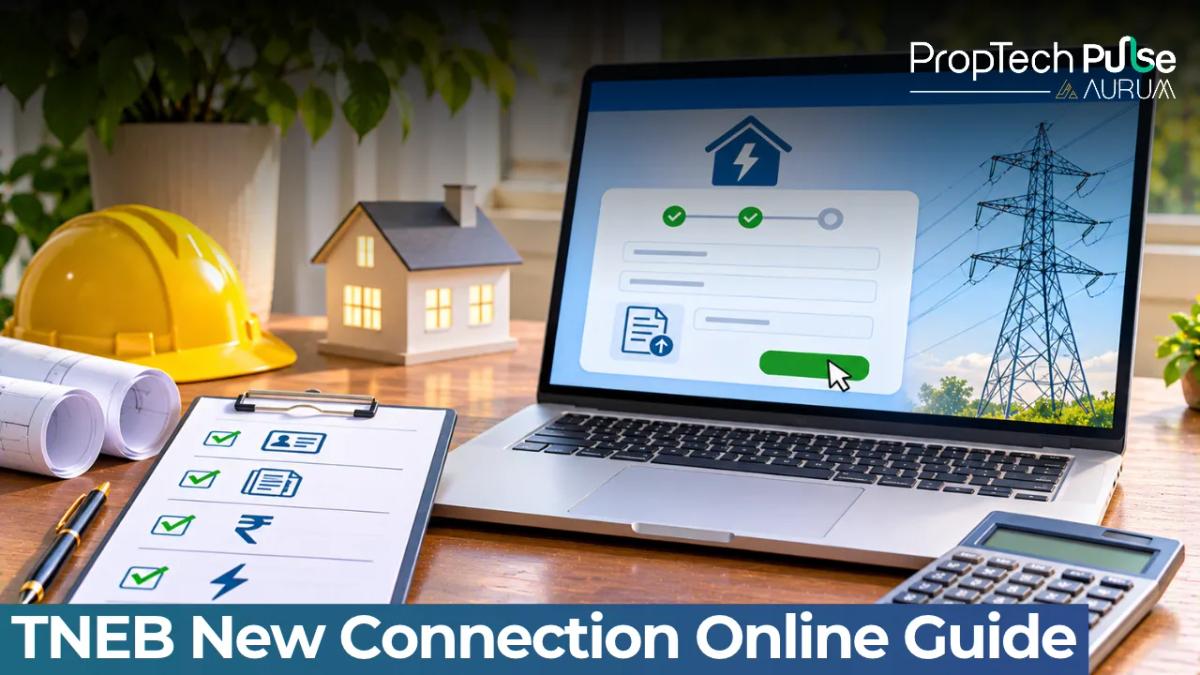
Moving into a new flat or finishing construction in Tamil Nadu hits a snag if the lights won't switch on. Securing a TNEB new connection is the final hurdle between handing over the keys and actually living in the space.
Many buyers stall because they confuse legacy naming, miss a single consent form, or underfund their security deposit.
This guide walks you through the live TNPDCL portal steps, clarifies owner versus tenant document rules, maps statutory timelines, and explains exactly how the Assistant Engineer calculates your deposit.
You get concrete numbers, regulator-backed deadlines, and a readiness checklist so you never get stuck securing a TNEB new connection.
What is a TNEB new service connection?
Quick answer
A TNEB new service connection is the official electricity supply registered under Tamil Nadu's distribution network. While people still call it TNEB, the operational entity is now TNPDCL. You apply through the centralised government portal, pay a load-based security deposit, and wait for a field inspection before the meter is fitted.
Naming confusion stalls more applications than procedural errors. The original state board dissolved into separate generation, transmission, and distribution entities years back.
Current power reaches you through TNPDCL, yet the consumer portal stubbornly retains the legacy TNEB label.
Keep the distinction in mind, because the new-connection process applies uniformly across every district whether you are wiring a two-bedroom flat, a commercial shop, or an independent home.
The connection stays linked to the land record. Any change in ownership requires a fresh application or a formal transfer request. Builders handling project allocations usually clear bulk applications, but resale buyers and independent homeowners must file individually.
Who can submit a TNEB application?
Property owners: mandatory ownership documents
If you own the plot or apartment, you hold the authority to apply. You must prove title and identity in a single digital packet. The sub-divisional office rejects incomplete sets immediately, so prepare everything before logging in.
- Copy of the sale deed or patta in your name
- Latest property tax receipt or khata extract
- Valid photo ID (Aadhaar or voter card) and a mobile number registered in your name
- Recent passport-size photograph
- Site plan showing exact meter placement on the compound wall or building façade
Owners often skip the site plan. Keep it handy. The Junior Assistant needs a clear diagram to mark the transformer tap point during the preliminary visit.
Tenants & lawful occupants: Form 5 vs Form 6 explained
Tenants face stricter documentation because electricity liability falls on someone who doesn't hold title. The distributor requires the legal owner's written consent.
Form 5 applies when the owner is present and willing to sign. You submit the prescribed form alongside the owner's identity proof, property tax receipt, and your lease agreement. The system links the account to the owner's land record for verification.
Form 6 covers cases where the owner cannot be traced or refuses to cooperate. Lawful occupiers can still apply by attaching proof of possession plus a notarised indemnity bond stating you accept full financial responsibility for consumption and penalties.
The Assistant Engineer may require a longer verification window for these submissions.
How to complete the tneb online application step-by-step
The digital workflow lives on a single portal URL. Type the address directly into your browser, select Tamil Nadu as the state, and choose the New Connection option from the dashboard menu.
You register using your mobile number, receive an OTP, and enter your email to create the initial ledger.
The screen prompts for your district and sub-division. Pick the exact office that governs your locality instead of guessing. Wrong routing delays file assignment by several days.
Next, upload your scanned PDFs. The system accepts files under two megabytes only. Compress large scans first, or the upload fails silently.
Declare your connected load with precision. A standard two-bedroom apartment typically draws enough power for a single-phase 3 kW to 5 kW sanction.
Independent residences or small workshops juggling multiple air conditioners and geysers generally push past 9 kW and require a three-phase line. Inflating your declared load unnecessarily inflates the upfront deposit.
Declaring too little guarantees nuisance trips when every appliance starts simultaneously during peak summer months.
Once the summary loads, generate the payment reference number. The platform redirects you to the authorised bank gateway.
Complete the transaction, return to the portal, and capture the success screenshot. Your application moves to the Junior Assistant queue for technical clearance.
Connection charges, deposits & how the demand notice works
Securing a line costs more than the application fee. Distributors tie the TNEB new connection deposit directly to your sanctioned load category and whether you chose single or three-phase supply.
Expect separate line items for meter caution money and earthing equipment fees.
Connected load measures the absolute kilowatt ceiling your fixtures consume simultaneously. Square footage rarely predicts electrical demand here.
Most apartments function reliably on a capped 5 kW single-phase allotment. Large villas or rental properties running heavy cooling and heating gear regularly breach the 9 kW threshold, forcing a mandatory shift to three-phase wiring.
Selecting the correct capacity tier initially prevents costly revision applications down the line.
Previews show rough ranges, but the exact figure arrives later. Clear the initial payment, and the Junior Assistant routes the file to the Assistant Engineer for a site inspection within seven working days.
The AE measures cable length, checks phase availability, and cross-checks your load declaration against real appliance specs. They then issue a formal Demand Notice through the ledger system.
Pay this notice before the physical crew visits. Unpaid flags trigger automatic holds. Once cleared, crews install the sealed meter, energise the line, and dispatch your digital welcome letter.
Statutory timelines for your TNEB new service connection
Speed depends entirely on geography and file completeness. The Ministry of Power built hard deadlines into the Rights of Consumers Rules, 2020. TNPDCL must adhere to these calendar limits from the day you clear the first payment.
| District Category | Target Days |
|---|---|
| Metropolitan areas including Chennai city limits | 3 days |
| Municipal towns and urban census areas | 7 days |
| Rural villages and undeveloped sectors | 15 days |
| Total processing window | 15 days maximum |
Missing data points often frustrate applicants. These deadlines start ticking only after the Department pays the initial charge and receives valid occupancy proof. Delays caused by transformer overload, right-of-way disputes on public roads, or missing owner signatures fall outside the statutory window.
Regulators mandate delay compensation when the department breaches these timelines without recorded justification. You can claim reimbursement through the consumer protection cell once the connection finally activates.
The daily rate updates annually via TNERC tariff orders.
Tracking status, first bill cycles & grievance channels
The digital ledger tracks every movement step-by-step. Watch the status flip from pending inspection to AE verification, then demand notice issuance, followed by payment clearing, and finally meter installation.
Every timestamp logs each transition date. Record those exact moments when filing complaints about unexplained gaps. Specific dates crush vague allegations of bureaucratic inertia.
Expect bi-monthly billing shortly after activation. The first invoice often carries a higher reading because it covers roughly sixty days of usage. Ensure your water tank pumps and geysers run efficiently before that first meter strike.
Escalation follows a strict protocol when deadlines evaporate. Drop your complaint into Minnamagam, call 1912, or message the verified WhatsApp helpline.
Always paste your unique application reference number into every ticket or call log. Blind phone calls to the local sub-division office rarely dislodge files queued behind documented grievances.
For homeowners preparing to take possession, understanding local utility mapping prevents nasty surprises. You can explore properties mapped with existing infrastructure notes here.
Why a TANGEDCO new connection gets delayed (and how to prevent it)
Most delays stem from preventable filing errors when applicants rush a TNEB new connection.
They frequently attach blurred images of property tax receipts, upload owner consent forms signed without dates, or declare wildly inaccurate load capacity. Every mismatch sends the file bouncing between tiers.
Draft a quick pre-inspection checklist first. Verify your chosen meter position faces the street or boundary wall. Inner courtyards trap the crew.
Strip vegetation blocking overhead drop lines early. Confirm your leased property sits firmly inside the active feeder radius. Crossing boundaries triggers lengthy inter-office referrals.
Water and electricity connections usually run on parallel tracks. Coordinating both permits avoids double mobilisation costs. Check municipal water approval processes to align your submission dates. Similarly, understanding yoke infrastructure systems helps you map external cabling routes accurately before the technician arrives.
Administrative bottlenecks rarely survive structured tracking. When you're ready to budget for a TNEB new connection, compare home loan emi calculators to forecast monthly cash flows alongside utility upgrades.
Before you pay the token
Verify two critical details before signing any sale deed or paying the booking fee. Check whether the existing transformer in your colony or lane can absorb extra capacity without tripping.
Then confirm whether the builder already settled the initial deposit for your specific unit. Several developers prepay these extension costs as part of their broader estate servicing.
Which means you should not face a second security demand. Secure this clarification in writing before moving ahead.
Frequently asked questions
How long does it take to activate a new electricity line?
Statutory deadlines depend on your location. Metropolitan areas like Chennai require three days. Municipal urban zones need seven working days. Rural villages get fifteen days. These counts begin only after you pay the initial application fee and the junior assistant completes the file routing. Transformer capacity constraints or right-of-way disputes extend these windows legally.
What documents do I need for a TNEB application?
Owners must submit a sale deed copy, latest property tax receipt, valid photo identification, a recent passport photo, and a site plan marking the proposed meter position. Both groups must provide a registered mobile number. Scanned uploads must stay under two megabytes per file. Blurry or incorrectly formatted documents trigger immediate rejection at the sub-division level.
How much security deposit do I need to pay upfront?
The distributor calculates deposits based on your declared connected load and phase type. Single-phase residential lines cost significantly less than three-phase setups required for high-load homes. The exact figure arrives later through a formal demand notice issued after the assistant engineer inspects your site. Pay this second batch before the physical crew visits.
Can renters apply for electricity without the landlord's signature?
Yes, provided you qualify as a lawful occupier under Regulation 27. You must attach proof of possession such as a registered rent agreement, plus a notarised indemnity bond accepting full financial liability for consumption and penalties. The assistant engineer allows extra time to verify occupancy claims when the primary owner remains untraceable.
What happens if TNPDCL misses the installation deadline?
Consumers are entitled to delay compensation when the department breaches statutory timelines without recorded justification. You must claim reimbursement through the consumer protection cell after the final energisation date. The daily compensation rate updates annually via tariff orders published by the state regulatory commission.
Enjoyed this blog article? Visit PropTech Pulse for more interesting blogs.


Ask Pulse Ai anything about real estate

Unlock the Latest in Real Estate
News, Infographics, Blogs & More! Delivered to your inbox.

