New Launch - India Real Estate Report 2026.











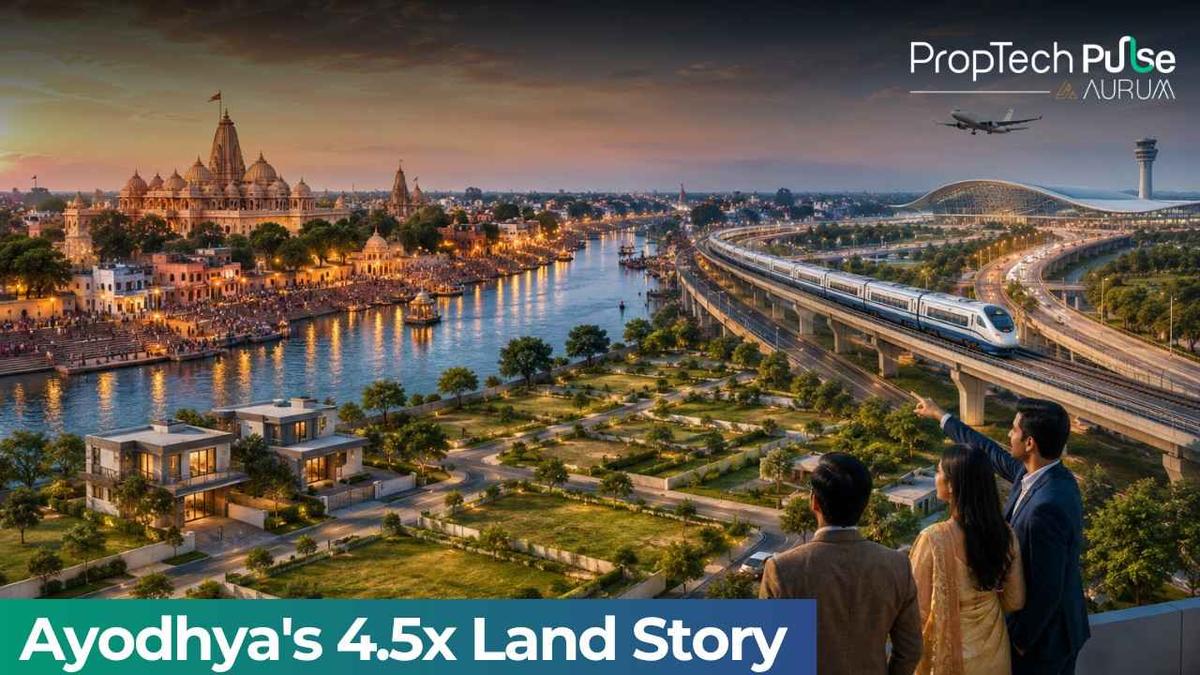
Ayodhya has become one of the most discussed real estate markets in India in a remarkably short period of time. Land values in key areas including the Sarayu riverfront and the Ram Mandir corridor have appreciated by more than 4.5 times between 2020 and 2025, a rate of growth that sits well above any comparable Indian city over the same period. Understanding what has driven that appreciation, and whether the conditions sustaining it are durable, matters for anyone tracking where India's next wave of property investment is forming.
Ayodhya land values and the infrastructure behind them
The appreciation story is not primarily a sentiment story, even if sentiment has played a role. It rests on a substantial infrastructure transformation. The expansion of Ayodhya's international airport, improved road and rail connectivity into the city, and the construction of the Ram Mandir have together converted a historically under-connected pilgrimage town into a destination with the physical infrastructure to handle vastly larger visitor volumes. Footfall is a direct driver of hospitality, retail and residential demand in pilgrimage cities, and Ayodhya's visitor numbers have grown dramatically: the city reportedly receives around 250 million visitors annually, a figure that comfortably exceeds major international religious destinations. When that volume of human activity flows through a city, real estate demand follows.
📈
Land Values Soar
Land prices in Ayodhya's prime locations have increased by over 4.5x between 2020 and 2025, making it one of India's fastest-growing real estate markets.
🏗️
Infrastructure Boost
The Ram Mandir, international airport and upgraded road and rail connectivity are driving sustained demand across the city.
🛕
Religious Tourism Growth
With an estimated 250 million annual visitors, Ayodhya is emerging as a major destination for hospitality, retail and residential investment.
🌟
High-Net-Worth Interest
Celebrity and HNI investments highlight Ayodhya's growing appeal as both a lifestyle destination and a long-term property investment market.
🏡
Rise of Branded Development
Organised developers are bringing planned, branded land projects to Ayodhya, improving buyer confidence through better infrastructure and title clarity.
The celebrity buyer signal and what it means for the market
Abhinandan Lodha, founder and CMD of The House of Abhinandan Lodha, has shared an account of receiving a personal call from a prominent Bollywood actor in 2023 regarding a 15,000 sq ft land parcel in Ayodhya, a transaction that reportedly concluded at around ₹15 crore. The significance of that anecdote for the market is less about the individual transaction and more about what it illustrates: the city had, by 2023, already crossed a threshold where high-net-worth individuals with no commercial compulsion were choosing to invest in Ayodhya land as a combination of personal and financial decisions. That kind of buyer participation signals that the market has moved beyond early-mover developers and institutional land banks into broader, aspirational demand.
The structural demand drivers going forward
Religious tourism in India is structurally underserved relative to its scale. JLL data cited alongside the Ayodhya story projects the religious tourism market to reach $59 billion by 2031, with religious sites contributing around 15% of total tourism GDP currently, with projections suggesting this could reach 25% by 2035. Ayodhya, now backed by national infrastructure investment and strong state-level policy support from Uttar Pradesh, is positioned to capture a meaningful share of that growth. The combination of pilgrimage volume, infrastructure quality, and brand recognition built around the Ram Mandir makes it one of the more defensible real estate theses in the country: visitor demand is structural and recurring rather than event-driven.
HoABL's role and what it signals for branded land development
The House of Abhinandan Lodha has sold over 13 million sq ft of developed land within five years of its founding, with around 25 million sq ft currently under active development across five states. Its growth reflects a broader shift in how plotted and land-based real estate is being positioned in India: away from unbranded, unserviced plots sold purely on location, toward developer-branded parcels with clear planning, servicing and community infrastructure. In pilgrimage cities where title clarity and development quality have historically been concerns for buyers, the branded land developer model addresses both barriers simultaneously. As Ayodhya's market matures, the gap between organised, branded development and informal land transactions is likely to widen in favour of the former.
Enjoyed this update? Visit PropTech Pulse for more real estate news and market insights.


