New Launch - India Real Estate Report 2026.

Services
Knowledge Hub
Resources
Tools

Ask Pulse Ai
©PropTech Pulse 2025, All rights reserved.


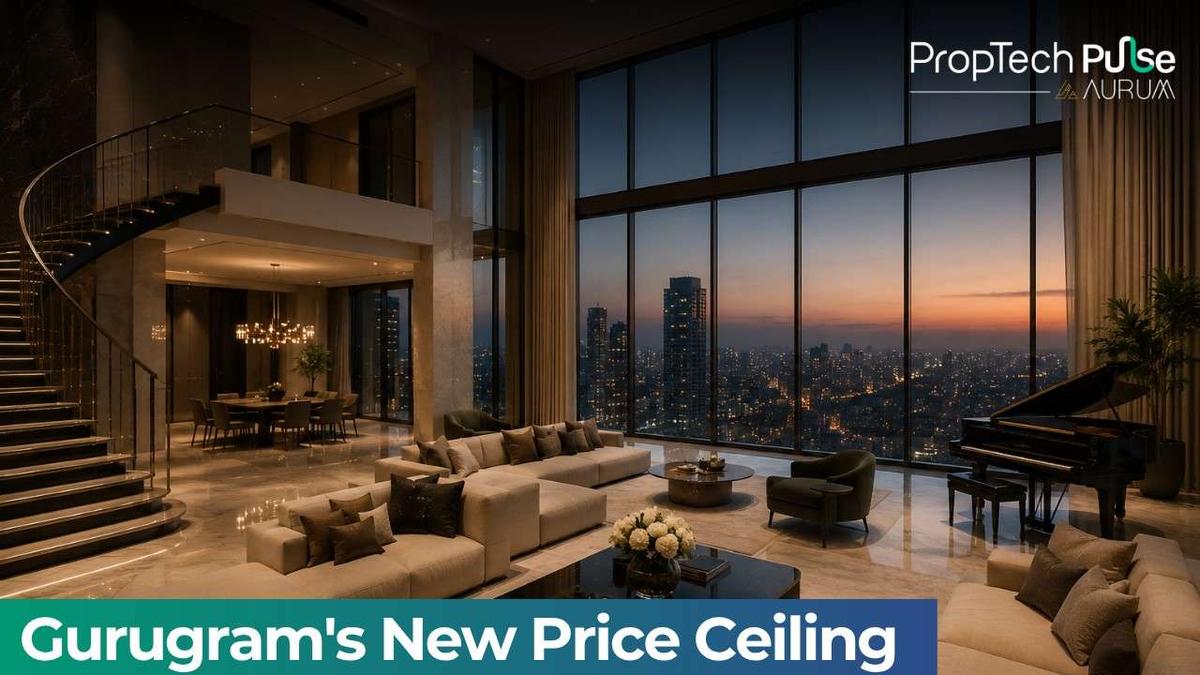
₹2.6 lakh per square foot. That's the new benchmark a single Gurugram penthouse just set, and it's worth sitting with that number for a second before asking what it means for everyone who isn't buying at that price point.
The deal that reset the ceiling
A penthouse at DLF's The Dahlias in Gurugram changed hands for ₹271 crore, ranking among the most expensive single-unit residential transactions ever reported in India. The unit carries a super area of 17,200 sq ft and a carpet area of 10,500 sq ft, working out to roughly ₹1.58 lakh per sq ft on super area and nearly ₹2.6 lakh per sq ft on carpet area. The transaction puts Gurugram's luxury segment firmly in the same conversation as Mumbai's most expensive homes, a city that's held that title uncontested for years.
This isn't an isolated spike, it's a pattern
The Dahlias alone has produced a run of headline-making transactions in the past year. In April, an apartment in the same project sold for over ₹120.71 crore at roughly ₹1.93 lakh per sq ft. Back in October 2025, four adjoining units totalling nearly 35,000 sq ft sold together for around ₹380 crore, designed to be interconnected into a single expansive residence. February 2025 saw another unit go for close to ₹69 crore.
Four separate transactions, four different price points, all trending upward within the same 7.5 million sq ft development. That's not noise. That's a market repricing itself in real time at the very top.
What DLF says is actually driving this
Aakash Ohri, Managing Director at DLF Home Developers, framed the pricing trajectory plainly during a recent investor call: entry-level floors at The Dahlias now start around ₹100 crore, climbing to ₹160-170 crore at the upper end. He's described the broader ambition behind projects like Camellias and Dahlias as building what he calls the Beverly Hills of India, a deliberate positioning move rather than incidental pricing.
What's genuinely striking is where the demand is coming from. Ohri noted that 25 to 30% of the project's business is now originating from outside Delhi-NCR entirely, spanning the rest of India and NRI buyers. That's a national and international capital pool competing for a small handful of ultra-luxury units in one Gurugram development, which is precisely the kind of demand concentration that keeps pushing per-square-foot records higher with each new deal.
The affordability question this raises
Here's the tension worth naming directly. While a handful of buyers compete for units priced at ₹100-270 crore, the mainstream housing market in the same cities is dealing with rising construction costs, tighter affordable supply, and buyers stretching EMIs to close much smaller gaps. These aren't separate markets operating in isolation; they're segments of the same urban land and construction economy, competing for the same skilled labour, the same prime locations, and increasingly, the same developer attention.
The honest answer isn't that luxury housing shouldn't exist; demand at the top has always found a way to build something to match it. The real question is whether India's mid-income and affordable housing pipeline is scaling anywhere close to the pace at which ₹100 crore-plus apartments are finding buyers. Right now, the data on ultra-luxury transactions is unambiguous and fast-moving. The data on affordable housing delivery keeping pace with demand is considerably harder to find, and that gap itself may be the more important story here than any single record-breaking sale.
Enjoyed this update? Visit PropTech Pulse for more real estate news and market insights.