New Launch - India Real Estate Report 2026.











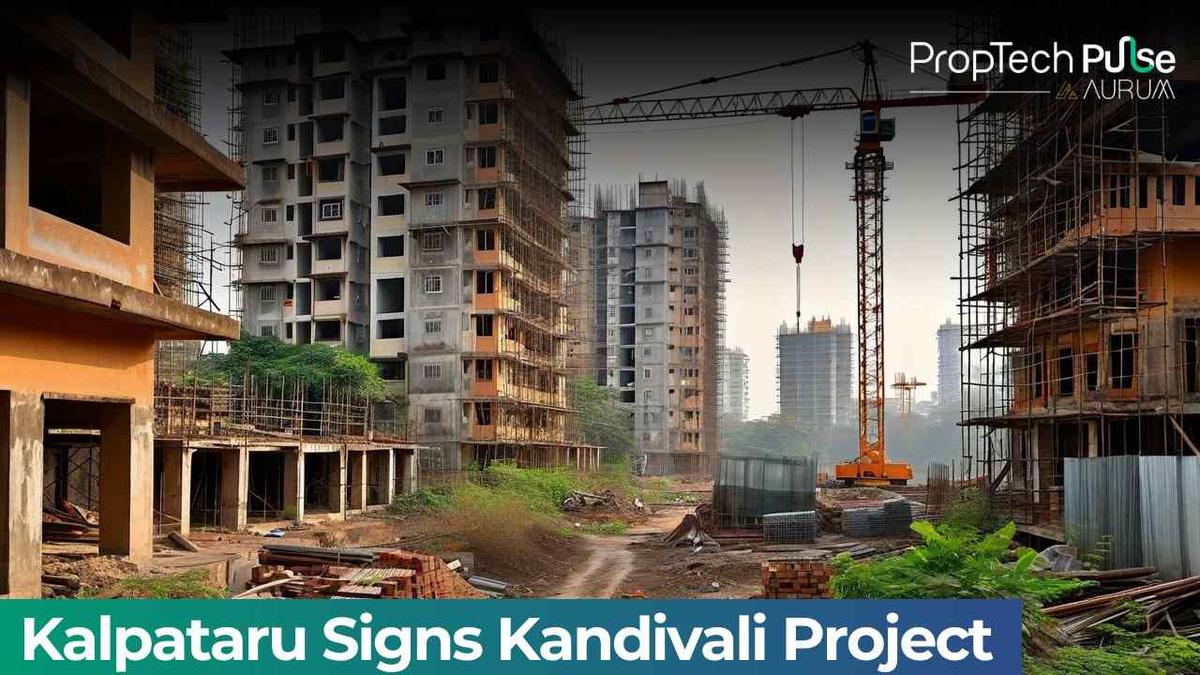
In a major structural expansion within Mumbai's high-velocity housing market, listed real estate pioneer Kalpataru Limited has formally entered into a comprehensive development agreement to execute a large-scale cluster redevelopment project. The marquee venture consolidates five adjacent standalone housing societies located within the premium Ashok Nagar micro-market of Kandivali East. Legally and commercially designated as the Ashokgram Cluster, the listed developer projects that the centralised residential and retail transformation will unlock an absolute revenue potential of ₹1,250 crore upon completion, cementing the firm's market leadership across the city's western suburbs.
Structural Parameters and Land-Use Mechanics
The engineering footprint of the Ashokgram Cluster represents an integrated urban planning approach, extending across a continuous land parcel of more than 2.8 acres. Under the underwritten parameters of the contract, the consolidation enables Kalpataru to unlock a substantial free-sale potential of 0.37 million square feet of residential and high-street retail carpet area. Managing Director Parag Munot noted that the venture is master-planned as a future-ready, transit-oriented neighbourhood designed to blend local suburban heritage with expansive green spaces, state-of-the-art civic utilities, and modern retail networks. The asset benefits from immediate connectivity to primary metro lines and major arterial roadway corridors.
Five-Decade Legacy Reinforces Micro-Market Dominance
The signing of the Ashokgram Cluster reinforces Kalpataru's long-standing operational dominance in Kandivali East, where the developer has already delivered six landmark residential complexes, including Kalpataru Jharokha, Kalpataru Vatika, Kalpataru Gardens, Kalpataru Tower, Kalpataru Avenue, and Kalpataru Vienta. Backed by a corporate legacy spanning more than 50 years, the developer has been aggressively accelerating its brownfield acquisition strategy. This latest western suburban project follows a massive ₹1,400 crore redevelopment project signed in Andheri East earlier this March, highlighting a deliberate strategy to capture market share across high-demand Mumbai transport nodes.
Mumbai's Surging Redevelopment Quadrant
According to comprehensive sector data compiled by market intelligence firm Knight Frank India, Mumbai’s broader real estate redevelopment quadrant is experiencing an aggressive structural expansion. The city’s ageing building revamp segment grew by a phenomenal 16% in 2025, logging 229 formal Development Agreements (DAs) compared to 196 agreements registered in 2024. This momentum has accelerated further through the opening half of 2026. Remarkably, within the first 74 days of the year, up to March 15, developers locked in 70 new deals, representing nearly 30% of the entire previous year's volume. Over a wider six-year tracking loop from January 2020 to March 2026, the city has witnessed 1,094 signed redevelopment pacts, effectively unlocking 432 acres of premium urban land for modernised capitalisation.
The Geographic Matrix of Micro-Market Re-Ratings
A granular analysis of the 1,094 historical development pacts shows a clear geographic concentration, with Borivali topping the chart with 217 signed agreements, unlocking 90.4 acres of residential land. Andheri ranks as the second most active hub with 115 deals (74.8 acres unlocked), followed strictly by Bandra at 74 deals (24.4 acres), Malad hosting 67 pacts (26.6 acres), and Ghatkopar anchoring the top five eastern nodes with 59 transactions unlocking 14.1 acres. By combining isolated, low-density buildings into master-planned clusters like Ashokgram, Tier-1 developers can circumvent restrictive plot sizes to deliver comprehensive infrastructure, modern lifestyle spaces, and wide interior roadways, successfully rewriting the macro real estate dynamics of the Mumbai Metropolitan Region.
Enjoyed this update? Visit PropTech Pulse for more real estate news and market insights.