New Launch - India Real Estate Report 2026.

Services
Knowledge Hub
Resources
Tools

Ask Pulse Ai
©PropTech Pulse 2025, All rights reserved.


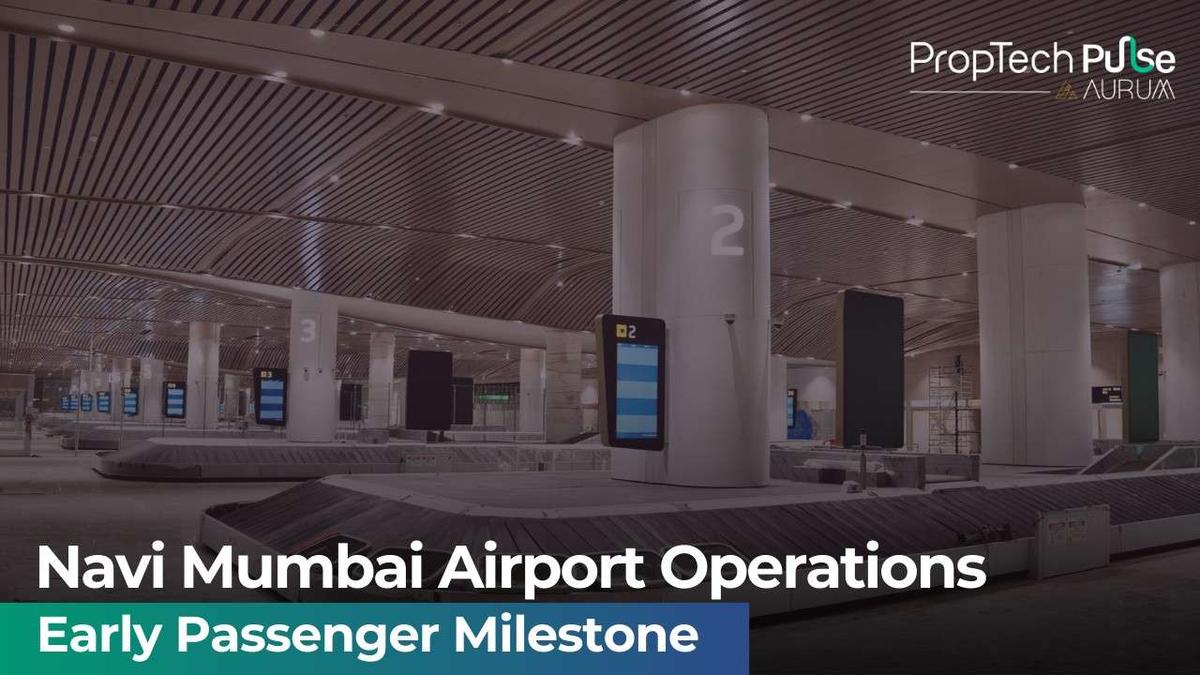
Initial Operational Performance
In the initial phase following its inauguration, Navi Mumbai International Airport has reported handling over 100,000 passengers in approximately 19 days, as per information shared by airport authorities. This early passenger throughput is being viewed as an indicator of operational preparedness during the airport’s phased rollout.
Airport officials have clarified that these figures reflect scheduled flight movements and controlled passenger volumes, consistent with a gradual ramp-up strategy commonly adopted for new aviation infrastructure.
Passenger Traffic Trends
The early passenger numbers include primarily domestic travellers, with flight operations calibrated to test systems, processes, and coordination among multiple stakeholders. Such controlled operations allow airport management to assess real-time performance across security, baggage handling, terminal management, and ground services.
Authorities have noted that traffic levels are expected to evolve progressively as additional routes, frequencies, and airline partnerships are introduced in later phases.
Infrastructure and Operational Capabilities
Navi Mumbai International Airport has been developed with a focus on modern aviation standards. Key operational features highlighted by authorities include state-of-the-art terminal infrastructure, integrated security screening systems, and technology-enabled passenger processing designed to support efficiency and scalability.
Facilities such as automated check-in options, streamlined boarding processes, and centralised operational control systems are intended to support smooth passenger movement as volumes increase.
Airline Interest and Connectivity Potential
Airport management has indicated that stable early operations are an important factor in building airline confidence. Consistent performance during the initial phase can encourage carriers to evaluate additional services, contributing to expanded regional and national connectivity.
Over time, the airport is expected to complement existing aviation infrastructure in the Mumbai Metropolitan Region by absorbing incremental passenger demand and supporting network diversification.
Phased Growth Approach
Officials have emphasised that the airport is following a phased operational model, under which capacity, services, and commercial offerings will be scaled in line with demand. This approach enables continuous monitoring, process fine-tuning, and the resolution of operational challenges before full-scale deployment.
Such phased implementation is considered critical for ensuring safety, reliability, and service quality during the transition from limited operations to higher passenger volumes.
Economic and Regional Significance
Beyond passenger handling, the airport is viewed as a key infrastructure asset for regional development. Increased air connectivity can support business travel, tourism, and logistics activity, contributing to broader economic growth in Navi Mumbai and surrounding areas.
Employment generation during both construction and operational phases is also cited as an important outcome associated with the airport’s development.
Looking Ahead
While early passenger numbers offer an initial snapshot of performance, airport authorities have noted that long-term success will be measured by sustained operational stability, passenger experience, and network expansion. Ongoing coordination with airlines, regulators, and service providers will remain central as operations scale up.
The reported early milestone positions Navi Mumbai International Airport as a growing aviation facility, with its future trajectory expected to unfold gradually as planned phases are implemented.
Enjoyed this update? Visit PropTech Pulse for more real estate news and market insights.


