New Launch - India Real Estate Report 2026.









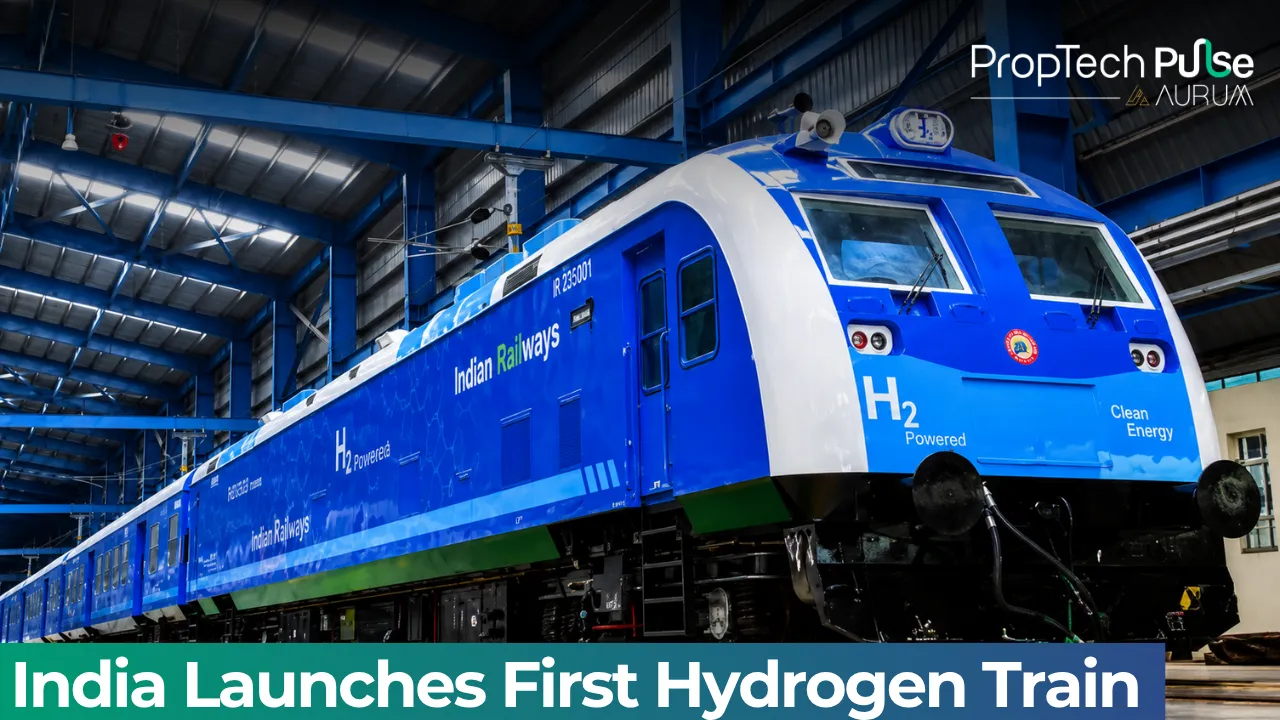
India's first hydrogen-powered passenger train made its debut on Friday, with Prime Minister Narendra Modi inaugurating the train at Jind, Haryana, as part of a wider tour launching infrastructure projects worth more than Rs 25,000 crore across Haryana, Chandigarh and Punjab. Designed and built in India, the train is one of the world's longest and most powerful hydrogen-powered passenger trains, featuring 10 coaches, capacity for around 2,600 passengers, and a 3,200-horsepower propulsion system, compared to most hydrogen trains worldwide, which typically run only two to four coaches on short regional routes.
Route and Timings
The train will initially operate on the 89-km Jind-Sonipat section of Northern Railway, covering stations including Jind Junction, Jind City, Pandu Pindara Junction, Lalit Khera Halt, Bhambhewa, Isapur Kheri Halt, Butana Halt, Khandrai Halt, Rabrah Halt, Lath Halt, Mohana, Barwasni Halt, Sonipat New, and Sonipat. It will begin operations at a maximum speed of 75 km/h, though it has been designed for speeds of up to 110 km/h, with the route selected to test operational viability, safety, and reliability under regular conditions.
How the Technology Works
Unlike conventional electric or diesel trains, the hydrogen fuel cell train generates its own electricity onboard using a Proton Exchange Membrane (PEM) fuel cell, where hydrogen stored in high-pressure cylinders reacts with oxygen from the air to produce electricity, releasing only water vapour and heat with no combustion involved. The train comprises two Hydrogen Driving Power Cars (DPCs), one at each end, and eight passenger trailer coaches. Each power car produces 1,200 kW (1,600 hp) and houses hydrogen fuel cells, Lithium Iron Phosphate (LFP) batteries, and high-pressure hydrogen storage cylinders working together for smooth operation.
- Route: 89-km Jind-Sonipat section, Northern Railway
- Starting speed: 75 km/h; designed top speed: 110 km/h
- Configuration: 2 power cars + 8 passenger coaches, ~2,600 passenger capacity
- Power output: 1,200 kW (1,600 hp) per power car
- Hydrogen storage at Jind: nearly 3,000 kg, approved by PESO
Also Read: Govt Approves ₹14,448cr Elevated Ganga Corridor Varanasi
Where the Hydrogen Comes From
Indian Railways has built what it describes as the country's largest railway hydrogen refuelling facility at Jind, producing hydrogen through electrolysis. The hydrogen is compressed to 500 bar for storage and supplied to the train at 350 bar through two independent dispensers, allowing simultaneous refuelling of both power cars and reducing turnaround time.
Built-In Safety Systems
The project follows the "defence in depth" safety principle, using multiple independent protective layers rather than a single system. Both the train and refuelling facility are equipped with hydrogen leak, flame, heat, and smoke detectors, continuous ventilation, automatic isolation and shutdown systems, and real-time cab monitoring. Before entering passenger service, the entire hydrogen ecosystem underwent independent safety assessment by TÜV SÜD, Germany, complying with international standards including NFPA-2 and the ISO 19880 series, alongside statutory requirements from India's Petroleum and Explosives Safety Organisation (PESO).
A Milestone for Indian Railways
The launch builds on one of the world's largest railway electrification programmes, with more than 99% of India's broad-gauge network now electrified. The hydrogen train marks the creation of India's first integrated hydrogen railway ecosystem, spanning production, storage, refuelling infrastructure, and train operations — the next stage in the country's shift away from overhead wires and diesel engines.
Enjoyed this update? Visit PropTech Pulse for more real estate news, investment insights, and property market trends.