New Launch - India Real Estate Report 2026.

Services
Knowledge Hub
Resources
Tools

Ask Pulse Ai
©PropTech Pulse 2025, All rights reserved.


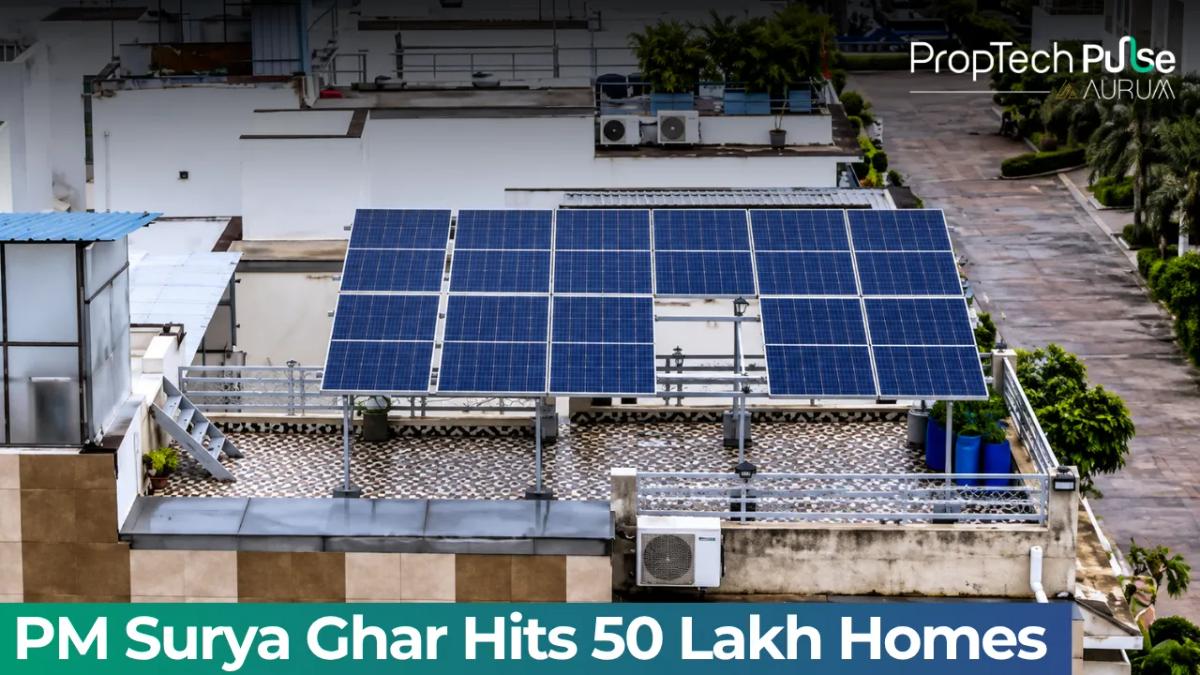
The Centre's flagship PM Surya Ghar: Muft Bijli Yojana has crossed a major milestone, with more than 50.06 lakh households across India now benefiting from rooftop solar installations.
The target has been achieved in just over two years since the scheme's launch, marking a sharp acceleration in India's clean energy transition, according to the Ministry of New and Renewable Energy (MNRE).
The scheme, launched with an outlay of Rs 75,021 crore, is now adding one lakh beneficiary households every six days, making it one of the fastest-growing rooftop solar programmes globally.
The achievement compares with just 7.94 lakh rooftop solar installations recorded over the previous 10 years.
July 2026 sets new monthly installation record
The ministry said the pace of installations has increased 3.2 times over the past nine months, rising from 5,038 installations per day in October 2025 to nearly 16,328 per day in July 2026.
July 2026 alone recorded rooftop solar installations in 5.06 lakh households, the highest monthly figure since the scheme was launched. The government said 14.8 GW of rooftop solar capacity has been commissioned under the programme so far.
Subsidies, savings and financing for households
To support the scheme, the government has released Rs 28,024 crore in subsidies directly to beneficiaries through the Direct Benefit Transfer (DBT) mechanism.
- Nearly 19 lakh households now receive zero electricity bills
- More than 12 lakh households earned Rs 421 crore in FY 2024-25 by selling surplus electricity to the grid, around Rs 3,500 per household annually
- 1.6 lakh installations completed for PMAY, BPL and SC/ST households across four states under the Utility Led Aggregation model, with rollout approved in 12 states
- Concessional loans at 5.75 per cent sanctioned to 21.87 lakh applicants, with 17.5 lakh installations already completed through loan financing
The scheme runs entirely through an online platform, integrating Jan Samarth for paperless loans, the Public Financial Management System (PFMS) for subsidy disbursal within 15 days, and API integration with over 80 Discoms for seamless processing.
A Digital Net Metering Agreement, vendor rating framework and Domestic Content Requirement (DCR) portal integration have also been introduced to improve transparency and compliance.
Also Read: Yogi Adityanath Launches ₹8,200 Crore SAEL Solar Facility In Jewar
Vendor ecosystem and government buildings join the push
The programme has helped build a nationwide rooftop solar ecosystem, with 34,219 registered vendors, including 29,469 active vendors, while over 2.32 lakh people have been trained under capacity-building initiatives.
Additionally, 32 states and Union Territories have removed application and net-metering charges for rooftop solar systems and the Centre has introduced deemed approvals and feasibility waivers for systems of up to 10 kW.
According to the ministry, 1.06 lakh government buildings have been solarised so far, including 25,255 Central government buildings (872 MW) out of 41,542 identified, and 81,329 state government buildings (1,450 MW) out of around 3.2 lakh identified.
Rs 3,807.6 crore has been released as incentives to Discoms and around Rs 104 crore to Urban Local Bodies, alongside a City Accelerator Programme across 46 cities and around 23,000 third-party quality inspections.
Enjoyed this update? Visit PropTech Pulse for more real estate news, investment insights and property market trends.


