New Launch - India Real Estate Report 2026.

Services
Knowledge Hub
Resources
Tools

Ask Pulse Ai
©PropTech Pulse 2025, All rights reserved.


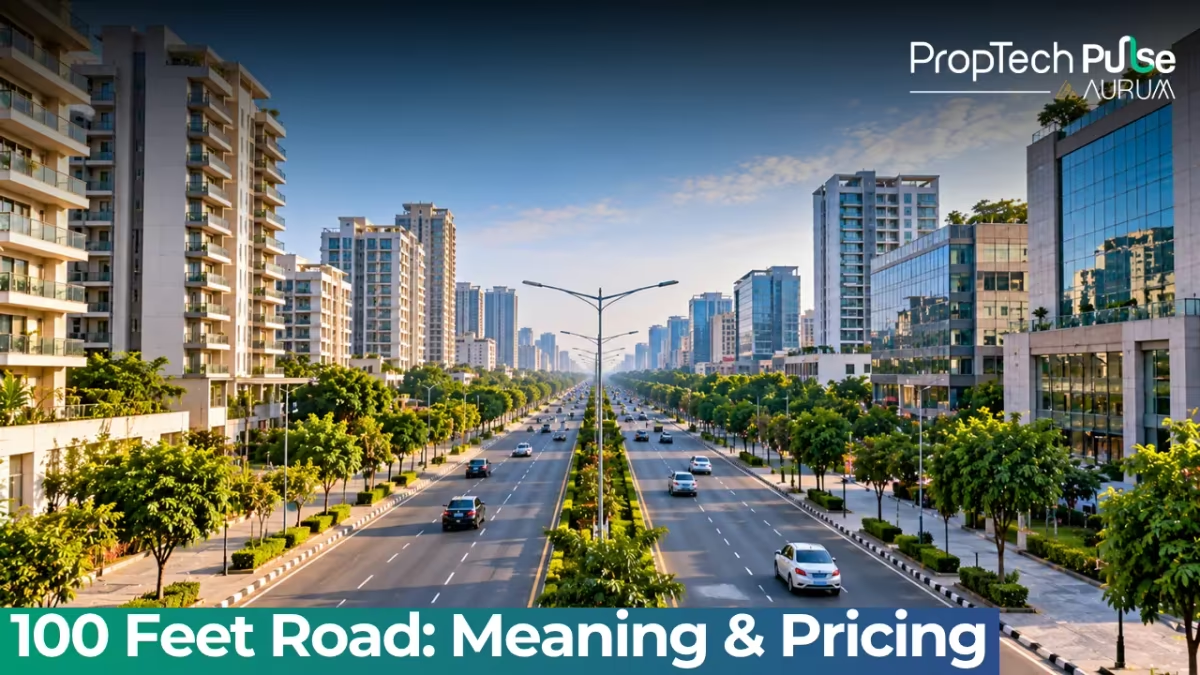
When agents say a flat faces a 100 feet road, they usually mean two things: you will pay a higher price per square foot, and you will get better liquidity later.
That premium comes from municipal rules, wider setbacks, and direct connectivity to major business parks. Buying along a wide arterial corridor makes sense if you value easy access to public transport and daily commutes.
It stops working quickly if you work from home, have young children who need quiet play spaces, or dislike constant traffic noise.
What is a 100 feet road in Indian real estate?
Quick answer
A 100 feet road refers to a municipal arterial corridor roughly thirty metres wide. In practice, this means wider setbacks for buildings, higher Floor Space Index allowances for builders, and stronger connectivity to central business districts. Properties on these roads carry a visible price premium because demand always outweighs supply along major transit routes.
The term originated in planned city layouts, most famously in Bengaluru. The Bangalore Development Authority drew straight, thirty-metre corridors through older neighbourhoods decades ago to future-proof traffic flow. You still see them running through established areas like Indiranagar and Domlur. Developers treat these alignments as prime land, and homebuyers accept the higher entry cost for the convenience factor.
Other cities handle wide roads differently. Hyderabad does not call every broad corridor a hundred-feet road, but its new township zones strictly enforce thirty-metre widths. State town planning directives require this clearance to separate heavy commercial traffic from inner residential grids. Chennai and Pune follow similar municipal rules for major distributor roads that feed into ring roads or metro lines.
Municipal corporations tie building permissions directly to road width. A thirty-metre clearance triggers larger ground-floor setbacks, stricter fire safety clearances, and higher floor space index caps.
Builders absorb that extra land value and pass it to buyers. The end result is consistently higher per-square-foot rates compared to properties tucked inside narrow twenty-feet lanes.
How the 100 feet road premium actually works
You do not pay for pavement. You pay for the development rights that a wide road enables. Municipal authorities calculate buildable area as a percentage of the plot size.
A thirty-metre road width typically bumps the permissible Floor Space Index from two point four to three point zero. That difference creates additional saleable carpet area across every floor. Builders price that extra volume into the final sale rate.
Here is how the math plays out in typical tier-one markets. We compare two identical ten-storey towers in the same micro-market. One fronts a standard twenty-feet lane. The other fronts a thirty-metre arterial road.
| Factor | Property on standard lane | Property on wide arterial road |
|---|---|---|
| Base price premium | Baseline market rate | Typically 12% to 20% higher per square foot |
| Builder land cost share | Standard peripheral rate | Higher acquisition cost due to FSI leverage |
| Saleability during resale | Steady absorption cycle | Faster exit window in tight markets |
| Rental yield differential | Matches micro-market average | Usually slightly above average due to commuter demand |
The table shows consistent trends rather than exact rupee figures, because micro-markets shift quarter by quarter. What stays constant is the liquidity advantage.
Buyers prefer wide-road flats when they move, which keeps rental yields healthy and reduces time-on-market pressure.
Real benefits of living on a broad road
Ventilation improves noticeably. Wind tunnels rarely form between high-rises when the frontage opens onto a wide corridor. Every unit facing outward gets steady cross-breezes without fighting blocked airflow from adjacent structures.
Daily commutes become predictable. Homeowners save time avoiding signal delays that choke narrower collector roads. Public transport operators route buses along these arteries anyway. Metro stations almost always anchor wide-road intersections. Rideshare pickup points stay accessible even during peak evening hours.
Gated communities benefit from controlled access points. Entry and exit gates widen smoothly instead of spilling traffic back onto inner streets. Fire brigade trucks reach the complex faster, which sometimes helps insurance teams rate your home policy favourably.
The downsides buyers frequently underestimate
Noise levels never drop below a baseline hum. Arterial roads host commercial freight vehicles, municipal waste trucks, bus fleets, and private cars throughout the day.
Evening rush hours stretch well past sunset. Upper floors mitigate the volume, but the vibration travels through structural slabs.
Dust accumulation demands stricter cleaning routines. Roadside pollen mixes with tyre wear particulate and brake dust.
Balcony filters need monthly washing if you grow potted plants. Window seals degrade faster when exposed to constant fine sand loads.
Pedestrian safety requires vigilance. Street vending spreads across wide medians. Crossing points sit far apart when municipalities prioritise vehicle throughput over footpaths.
Families with small children usually restrict outdoor play to inner society compounds rather than open verges.
Budget reality check Factor in acoustic-grade windows and heavier exterior maintenance costs before calculating your total purchase budget. These are ongoing expenses, not one-time payments.
Is a wide road property a sound investment right now?
The answer depends entirely on your holding period and lifestyle priorities. Short-term flippers chase quick gains and prefer locations near upcoming metro stations or special economic zones.
Wide-road assets move slower but hold value steadier during market corrections. Capital appreciation trails speculative hotspots, but depreciation rarely catches up either.
Long-term holders usually win. Salaried professionals prioritize commute reliability over marginal location premiums.
They rent early, lease annually, and renew without relocating. This tenant profile produces stable cash flows that justify paying extra upfront.
Commercial street-level spaces fare even better. Retail outlets on broad roads capture pedestrian spill-over from bus stands and parking hubs.
Ground-floor shops command significantly higher rents than interior lane shops, offsetting maintenance charges for upper-floor residents.
Tax treatment remains identical regardless of road width. Section 54 exemptions apply equally whether you sell a lane-facing flat or a wide-corridor apartment. However, capital gains calculations work better on assets with higher base values. Broader road properties tend to appreciate steadily without violent volatility, making tax planning smoother for long-term owners.
Before you pay the token amount
Check the master plan amendment records. Some plots sitting beside wide corridors still bear legacy zoning restrictions that prevent mixed-use development.
Verify setback compliance with the local town planning department before signing any builder agreement.
Visit the site at seven in the evening. Traffic patterns shift dramatically after office hours. Listen to the ambient noise level from both the ground floor and an upper balcony.
Talk to existing residents in the society about parking availability and garbage truck timings. Those details never appear in brochure photography.
If the property meets your noise tolerance and fits within a twelve percent premium compared to comparable inner-lane inventory, the trade-off usually works out.
You gain reliable access and easier resale later. Accept the minor daily inconveniences, and the premium pays for itself over a five-year holding period.
Sources
- Ministry of Housing and Urban Affairs: General guidelines on urban road classification and municipal development standards (accessed October 2026)
- Bangalore Development Authority: Master plan provisions regarding arterial road widths and setback norms (accessed October 2026)
- Reserve Bank of India: House price index trends and housing credit dynamics impacting tier-one urban markets (accessed October 2026)
- National Housing Bank: State-wise housing development indicators and urban planning policy updates (accessed October 2026)
Frequently asked questions
What exactly is a 100 feet road in real estate?
It refers to any municipal arterial corridor measuring roughly thirty metres in width. Town planners build these roads specifically to ease traffic flow between major districts, replacing narrow residential lanes with wide, multi-lane connectors. Because they serve as primary movement arteries, they bypass the gridlock that chokes inner-city streets and dictate stricter commercial zoning boundaries along their edges.
Why do homes on a 100 feet road sell at a premium?
Builders pay substantially more for peripheral land because wider roads allow higher Floor Space Index limits. When development authorities permit construction of taller structures and larger units on the same plot footprint, the value of the underlying parcel rises immediately. End buyers absorb that inflated land cost while gaining direct highway access, wider structural setbacks, and predictable ground-floor retail footfall.
Are there serious downsides to living on such a wide road?
Noise pollution and heavy particulate loads are the most frequent complaints. An arterial connection never pauses; heavy commercial trucks, public transport buses, and private vehicles pass continuously day and night. Free street parking disappears almost entirely, and finding safe walking spaces for children drops significantly. Professional acoustic treatment and reinforced exterior cladding become mandatory rather than optional expense items.
Can a 100 feet road property generate strong rental income?
Yes, particularly when targeting young professionals employed in adjacent commercial parks. Daily commuters consistently value being minutes away from corporate campuses without navigating choked side alleys. Market data repeatedly shows faster leasing cycles and steeper annual rent escalations compared to similar-sized units tucked inside quiet residential grids. Retail footfall above ground floors further subsidizes maintenance charges for lower-rise towers.
How does the 100 feet road concept work in Bangalore versus Hyderabad?
Bangalore uses the term literally across many historic planned pockets like Indiranagar, reflecting mid-century civic directives that standardized certain major corridors. Hyderabad applies the metric functionally rather than linguistically. New township zones strictly follow the thirty-metre width rule. State development departments enforce this clearance for commercial and residential hubs. The layout supports modern logistics and IT employment clusters without relying on historical naming patterns.
Enjoyed this blog article? Visit PropTech Pulse for more interesting blogs.





Ask Pulse Ai anything about real estate

Unlock the Latest in Real Estate
News, Infographics, Blogs & More! Delivered to your inbox.

