New Launch - India Real Estate Report 2026.

Services
Knowledge Hub
Resources
Tools

Ask Pulse Ai
©PropTech Pulse 2025, All rights reserved.


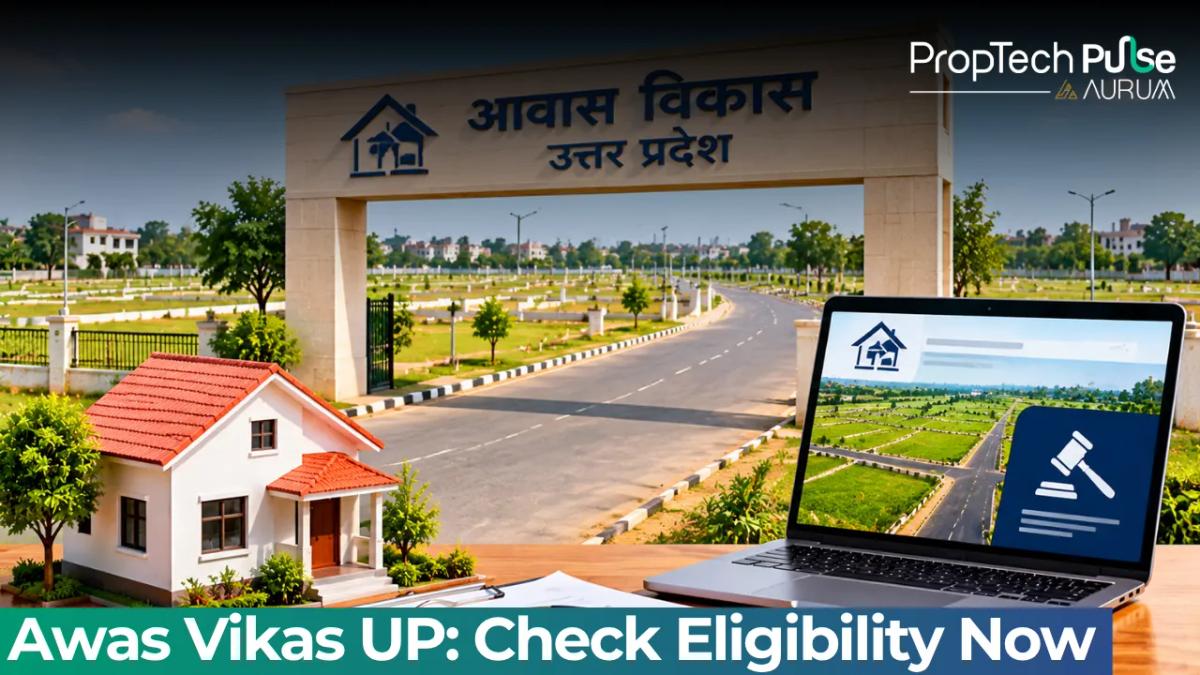
Buying a plotted development in Uttar Pradesh is shifting from physical file pushing to fully digital bidding. If you have been searching for “awas vikas” options, you are likely weighing the trade-offs between raw land acquisition and constructed apartments. The Uttar Pradesh Awas Evam Vikas Parishad has modernized its operations significantly, moving almost all transactions onto secure government portals.
Whether you want a subsidized home through the standard allotment route or an open plot through online bidding, the workflow is now transparent and paperless.
What is UP Awas Vikas Parishad?
Quick answer
Applicants must prove they do not own a pucca house and meet the income ceiling set in the latest board circular. They then register through the official e-auction platform or apply during standard allotment drives. Registration carries no fee. Token money scales with the plot's reserve price, and payment deadlines are strictly enforced within 7 to 15 days.
UP Awas Evam Vikas Parishad operates as a state-owned entity tasked with delivering affordable residential land and low-cost flats across Uttar Pradesh. Unlike private developers chasing peak margin spreads, UPAVP focuses on clearing land encumbrances, surveying parcels, laying out wide internal roads, and routing electricity and water lines to the site boundary.
This agency aligns closely with the Pradhan Mantri Awas Yojana framework to route central subsidies directly to eligible lower-income families. You can monitor ongoing registrations and upcoming plot windows directly through their departmental portal at https://upavp.in.
Structure the project budget around cleared earth and municipal infrastructure. The board handles those basics differently than commercial builders who chase peak margins. Base costs stay predictable, though you must factor in your own construction timeline and local registration fees. Comparing plot dimensions against apartment floorspace remains crucial. Review our built up area vs carpet area guide before you sign.
Token money vs full payment In an open auction, you never pay the full market value upfront. You bid against other registered participants, and only the highest bidder settles the final balance minus the initial token already deposited. Treat the token as a serious-intention deposit that legally binds you to close the transaction once you win.
Who Can Apply? (UP Awas Vikas Eligibility)
Before investing weeks into building a bid history or compiling paperwork, confirm you satisfy the baseline parameters. The UP Awas Vikas Parishad publishes these thresholds clearly. They rarely shift overnight, but the board adjusts ceilings periodically to track wage inflation.
| Criterion | Requirement |
|---|---|
| Age limit | 21 to 55 years at the time of application |
| Household income | Below ₹3 lakh per annum for EWS brackets; adjusts upward for MIG categories |
| Property ownership | No existing pucca house anywhere in India |
| Aadhaar linkage | Mandatory for identity verification and subsidy routing |
If tight finances limit your options or you plan a joint purchase with family members, cross-referencing central PMAY rules clarifies how state allotments interact with national loans. Read our affordable housing schemes in India PMAY 2.0 guide for a clear map of those overlaps.
What Do You Get? (Amenities, EWS vs MIG Options)
Available parcels typically split into two tracks: Economically Weaker Section (EWS) and Middle Income Group (MIG). EWS layouts pack tighter on smaller footprints, usually ranging from 60 to 90 square yards, with narrow service lanes and shared drainage. MIG stretches run wider, commonly hitting 100 to 150 square yards, and anchor closer to main carriageways where local retail emerges later.
Beyond the four corners of your deed, the board commits to baseline civic services. You get concrete internal roads, overhead storage tanks feeding lateral taps, subsurface sewer lines, and basic electrification poles along the perimeter. You manage everything inside the boundaries once possession papers clear. Buyers often choose plotting because it removes waiting times for high-rise concrete work and avoids the cost overruns common in private launches.
How to Check and Register for Active Housing Schemes
Locating active UP awas vikas yojana applications happens directly through the official dashboard. The board splits its pipeline into continuous open auctions and periodic allotment windows. Closed rounds require applicants to submit structured forms listing preferred locations and target sizes. Released inventory appears publicly during open rounds for immediate bidding.
Track openings by visiting the Online Services menu on https://upavp.in. Select the E-Auction tab for your target district. Read the schedule PDF closely and note the reserved price per square yard. Confirm the mandatory token percentage and the exact time the bidding window shuts.
Verify your PAN, Aadhaar, and primary savings account details ahead of time. Modern processes rarely accept physical cheques; electronic clearance is mandatory.
Administrative tracking matters too. Sorting out local municipal contacts or postal deliveries becomes easier when you know the exact postal codes for established neighborhoods. Reference directories like the Farrukhabad Awas Vikas Colony pin code database when you need localized data without making repeated phone calls.
How to Participate in UP Awas Vikas E-Auctions
Accessing the bidding interface requires calm preparation and a disciplined review of the tender documentation. Successful participants generally follow this sequence.
Finding the Live Property List
Filter the published property reports on the departmental site. Look for active tender notices in your preferred district. Lucknow, Kanpur Nagar, Varanasi, Agra, and Meerut consistently draw the highest participation rates. Extract the valuation schedule and compare the reserve price against recent transaction records nearby. If the government price does not undercut prevailing neighborhood rates significantly, consider whether the logistical effort outweighs the upside.
Registering as a Bidder on the Official Portal
Select the E-Auction button to reach the certified procurement engine. Build an account using a mobile number and active email. Upload scans of your Aadhaar card, PAN card, and a blank cheque leaf matching your address. System validation usually clears within twenty-four hours. Unverified profiles cannot access the live bidding matrix.
Understanding Token Money and Payment Deadlines
The deposit is fixed per lot, scaling with the total reserved value rather than applying a flat fee. Compact EWS units require a few thousand rupees to secure login rights, while spacious MIG sites carry proportionally larger caps.
Transfer funds strictly through the integrated banking gateway inside the seven to fifteen-day window noted in your tender packet. Delay triggers automatic forfeiture and bans you from that specific allocation round.
Payment security warning Bypass offline collection agents promising “priority processing.” Legitimate UPAVP auctions route every transaction through the encrypted payment layer visible on the official tender page. Any individual requesting direct UPI transfers to personal wallets is operating fraudulently.
Where Are Plots Available Right Now?
Inventory rotation moves fast as the board clears older phases and notifies fresh survey numbers. Lucknow absorbs disproportionate interest as metro infrastructure expands eastward. Speculative chatter rises even among first-timers.
Kanpur delivers steady parcels near manufacturing belts, attracting buyers targeting short-term rental yields. Varanasi and Gorakhpur sustain reliable pipelines for families relocating from surrounding rural tehsils.
Browse current Lucknow Sultanpur Road plot listings for granular tracking. Examine early-stage allocations in the Gangotri Enclave project in Amar Shaheed Path for context.
Mapping wider regional trends alongside state initiatives strengthens your positioning strategy. The real estate investment India 2026 overview highlights broader macro shifts affecting northern corridors.
Before You Bid
The UP awas vikas plot scheme works well for buyers seeking controlled entry costs, ironclad titles, and immediate site access. It falls short if you expect finished villas, clubhouse access, or managed maintenance communities from day one. Run the projection first.
Multiply your accepted bid by the reserve value, then add roughly ten percent for stamp duty and registration fees. Check our Uttar Pradesh stamp duty and registration charges 2025 breakdown.
Verify whether your cash buffer or sanctioned loan cap survives the math. Place your opening bid only after the calculation clears.
Frequently asked questions
Is there an online e-auction for awas vikas plots?
Yes. The board runs fully digital bidding cycles through a certified procurement engine rather than physical halls. You locate the active tender notice on the official website, complete KYC verification, deposit the mandatory token money via the integrated gateway, and place bids inside the scheduled time window until the system locks the lot.
How much is the token money for a government plot auction?
There is no universal flat fee. Token amounts scale directly with the plot's reserved price and total square footage. Smaller EWS parcels might ask for a couple of thousand rupees to lock your eligibility, whereas larger MIG sites carry proportionally higher caps. Always read the specific tender PDF attached to the auction listing to confirm the exact requirement for that parcel.
What documents are required for awas vikas registration?
You need a valid Aadhaar card mapped to your mobile number, permanent account number for tax tracking, and an active bank account capable of generating immediate electronic fund transfers. If you apply under a specific income bracket, attach income certificates or salary slips as defined by the current circular. All files must be legible scans in standard PDF format.
How do I check active UP awas vikas yojana schemes?
Navigate directly to the department’s homepage and hover over the Online Services tab. Select E-Auction or Allotment Drives based on your preference. The dashboard lists every currently open window, downloadable schedules, reserved prices, and closing timestamps. Refresh weekly, since new districts rotate onto the list as previous phases clear.
Enjoyed this blog article? Visit PropTech Pulse for more interesting blogs.



Ask Pulse Ai anything about real estate

Unlock the Latest in Real Estate
News, Infographics, Blogs & More! Delivered to your inbox.

