New Launch - India Real Estate Report 2026.

Services
Knowledge Hub
Resources
Tools

Ask Pulse Ai
©PropTech Pulse 2025, All rights reserved.


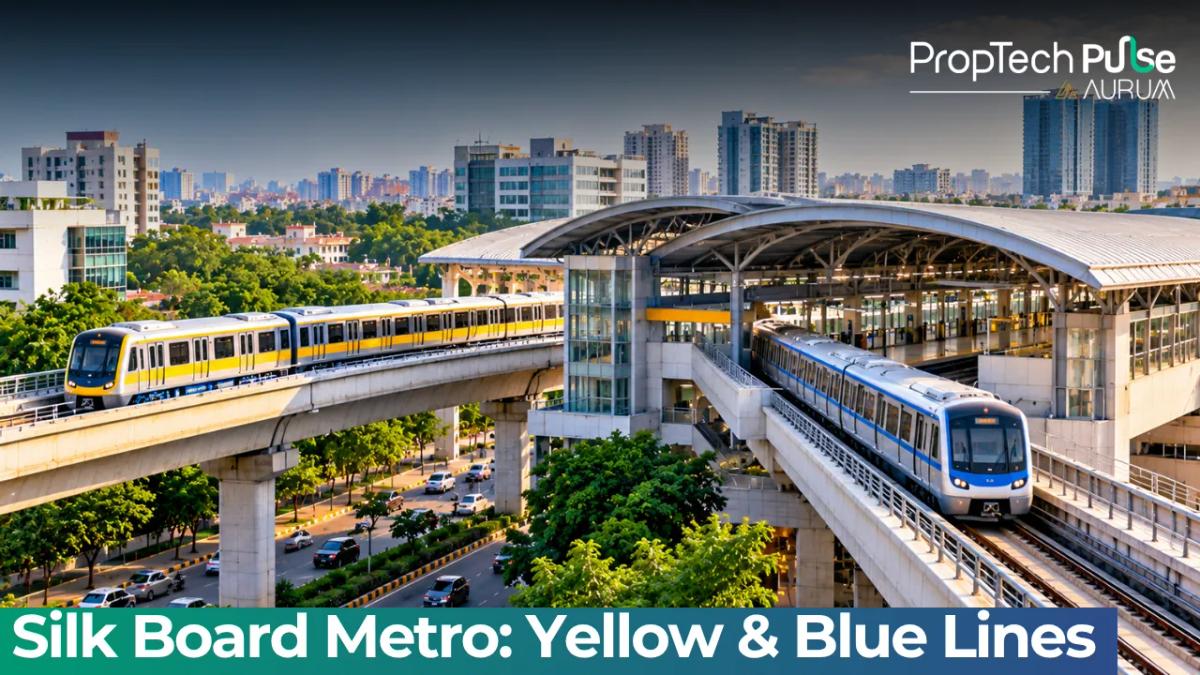
If you have ever tried to cross the Silk Board intersection during evening rush hour, you know it is less a traffic jam and more a physical barrier.
The silk board metro station offers a reliable escape from East Bangalore's worst gridlock.
Using it well means knowing exactly where to step off the main road, which train door to face, and how the upcoming Blue Line shifts rental demand.
In peak evening hours, driving from Silk Board Junction to Electronic City typically takes forty-five minutes or more.
The same trip on the metro takes twenty-eight minutes and removes the stress of weaving through hundreds of commercial trucks. This guide covers the practical realities of living and commuting near this station, separating verified infrastructure facts from marketing claims.
Where Is the Central Silk Board Metro Station Located?
Quick answer
The station sits 390 metres from the congested Silk Board junction on the raised viaduct. Accessible via Points A, B, and C with lifts and ramps, it provides a direct east-west rail link connecting Electronic City to Whitefield.
The central silk board metro station rests on the concrete viaduct along the Outer Ring Road, roughly 390 metres from the chaotic surface-level intersection.
Three dedicated exit points, Points A, B, and C, spread across both approaches. All exits include wheelchair ramps and lifts, eliminating the need to navigate street-level crossings just to enter the building.
Navigating from the main Silk Board junction to the station stairs takes about five minutes. Expect a careful walk rather than a relaxed stroll as vendor-spawned paths shrink fast.
Cross the road at the designated flyover ramp first, then head down to the station base. Pack your bags? Budget ten minutes instead.
Which Lines Serve the silk board yellow line?
The station currently operates on the North-South Corridor, widely referred to as the silk board yellow line. Trains heading northbound reach Bommanahalli, Marathahalli, and Missing Bridge, connecting directly to Whitefield's tech hubs.
Trains heading southbound descend toward BTM Layout, Jayanagar, and the southern terminals at Nagasandara or Kundalahalli, depending on the scheduled loop.
Platform layouts here differ from standard stations. Track curvature affects door alignment as trains pull in. Screens at the edge of the platform show which way the doors will open.
Trains arriving from Electronic City generally open doors on the left when facing south. Trains arriving from the north open on the right. Waiting on the wrong side wastes a full head-to-head cycle.
DIRECTION CHECK: Always glance at the blue LED direction board mounted above the platform doors. It shows the final terminus. If your destination is beyond Silk Board, you usually want the carriage closer to the front of the train.
For investors watching long-term yields, the station anchors the busiest node between two major employment centres. You can read up on housing boom along the Namma Metro Yellow Line to see how property values responded during the first eighteen months of operations.
What's Coming on the Blue Line Phase 2A Extension?
Phase 2A construction actively links Whitefield and Hosur through a new interchange network. By December 2027, this station transforms from a single-line stop into a primary intermodal hub.
Daily passenger capacity handles nearly fifty percent more volume once the Blue Line platform decks commission.
| Network Feature | Current Status (Yellow Line) | Planned Status (Blue Line Phase 2A) |
|---|---|---|
| Operational Phase | Running since August 2025 | Targeted completion December 2027 |
| Primary Direction | East-West connector across ORR | North-East to South-West cross-city link |
| Key Interchange Hubs | Direct feed to BTM Layout & Whitefield | Links Solar School, Bommasandra, Hosur Road |
| Expected Impact | Stabilized rental premiums of 8–12% | Projected 15–20% jump in high-rise apartment demand |
This expansion pulls rental gravity away from Whitefield and toward Hosur Road industrial belts. Tenants looking for shorter commutes to manufacturing plants and export zones will cluster near properties in Central Silk Board Colony and surrounding pockets.
Operating Hours, Ticketing, and Peak Capacity
Rail services run from 05:30 AM to 11:00 PM daily. Morning peaks pack the tracks tight between 07:30 AM and 10:30 AM, with arrivals spaced just nine minutes apart. Evening shifts compress that window slightly.
Frequencies hold steady at fourteen minutes between 11:00 AM and 05:00 PM. Workers returning after 10:45 PM face a narrow window before the final departure.
Ticket kiosks melt down during rush hour. Queues spill onto the concourse floor within four minutes. Load the official commuter app beforehand instead.
Digital passes or smart cards zip through automated Fare Collection gates in under four seconds. Paper tokens drag on for twelve seconds per person. That difference costs twenty-one extra minutes standing in crowded corridors over a single work month.
| Facility Type | Rates & Availability |
|---|---|
| CMPDCL Managed Two-Wheeler Lot | Free. First 30 mins complimentary. Fills by 10:15 AM weekdays. |
| Private Car Parking (Near Exit B) | ₹80 to ₹120 per hour. Covers 40 vehicles. Overflow forces drives to Koodanguppe road. |
| BMTC Feeder Bus Route M227 | Departs 06:30 AM, 08:15 AM, 05:45 PM, 07:30 PM. 15-min frequency drops after 08:00 PM. |
Last-Mile Connectivity: Parking, Autos, and Feeder Services
Driver access to the station creates the single biggest bottleneck for commuters. Official car parking does not exist inside the station footprint. Informal private operators run paid lots nearby, charging ₹80 to ₹120 per hour. These spots fill by 09:00 AM on weekdays, forcing latecomers to walk an extra eight hundred metres to Exit A.
Auto-rickshaws queue behind Exit B. Commuters routinely wait thirty to forty minutes between 06:00 PM and 09:00 PM. Many switch to app-based cabs or shared bikes once they hit the street. BMTC feeder buses supposedly connect adjacent residential pockets to the station. Schedules rotate without warning. Real-world travel times between stops often beat walking speed.
Rental Yields and Nearby Apartment Inventory
Micro-market data reveals a sharp split in rental performance around this node. Two-bedroom furnished flats in societies like Mantri Aura and Brigade Serene command ₹38,000 to ₹45,000 monthly.
IT professionals flock to these listings, absorbing them within seven days due to corridor proximity. Ground-floor independent homes in Central Silk Board Colony average ₹22,000, attracting older tenants who skip lifts.
Buying power stretches further right now, capturing prices before Blue Line integration peaks. Builders pushing ready-to-move units with modular kitchens see immediate absorption. New launches within a kilometre radius price carpet space at ₹7,200 to ₹7,800 per square foot. Resale transactions move slower, held back by payment plans tied to construction milestones.
Before You Decide: Who Actually Gains From This Location?
Living next to this station rewards specific routines. Electronic City, HSR Layout, or BTM Layout employees save hours on daily commutes. The metro guarantees arrival windows regardless of surface road accidents or monsoon flooding. Peripheral roads shut down routinely during July rains. Elevated tracks stay dry and moving.
Weekend visitors or parents managing evening school runs fight the packed autos and lack of parking. Buyers wanting quiet residential streets free of commercial overflow should look two kilometres inland.
Following infrastructure timelines beats chasing finished amenities. Use tools tracking property value shifts after a new metro opening to time your entry correctly.
Frequently asked questions
Which Namma Metro line serves the central silk board metro station right now?
The station currently operates exclusively on the Yellow Line (North-South Corridor). Trains connect Electronic City in the south directly to Missing Bridge in the north, passing through critical employment nodes like Jayanagar, Marathahalli, and Whitefield.
How far is the central silk board metro station from the main intersection?
It sits roughly 390 metres away from the congested Silk Board junction along the elevated outer ring road. While mapped as a five-minute walk, real-world navigation requires crossing multi-lane flyover ramps and navigating temporary construction barriers near Exit B.
Does the station provide free official parking or reliable feeder buses?
Only free two-wheeler parking is managed by the operator. There is no corporate-run car parking. BMTC feeder buses exist on paper but suffer from rotating schedules that rarely sync with train arrivals, making auto-rickshaws or app-cabs the standard last-mile choice.
When will the Blue Line Phase 2A extension open at this station?
Construction targets a December 2027 completion window for the Blue Line integration. Until then, the station functions solely as a Yellow Line stop, though contractor activity accelerates significantly throughout the second half of 2026.
Sources
- Bangalore Metro Rail Corporation Ltd. (bmrc.co.in): Station coordinates, access specifications, and fare card procedures (accessed October 2026).
- Prime Minister of India Official Website: Yellow Line inauguration announcements and operational start dates (accessed October 2026).
Enjoyed this blog article? Visit PropTech Pulse for more interesting blogs.




Ask Pulse Ai anything about real estate

Unlock the Latest in Real Estate
News, Infographics, Blogs & More! Delivered to your inbox.

