New Launch - India Real Estate Report 2026.

Services
Knowledge Hub
Resources
Tools

Ask Pulse Ai
©PropTech Pulse 2025, All rights reserved.


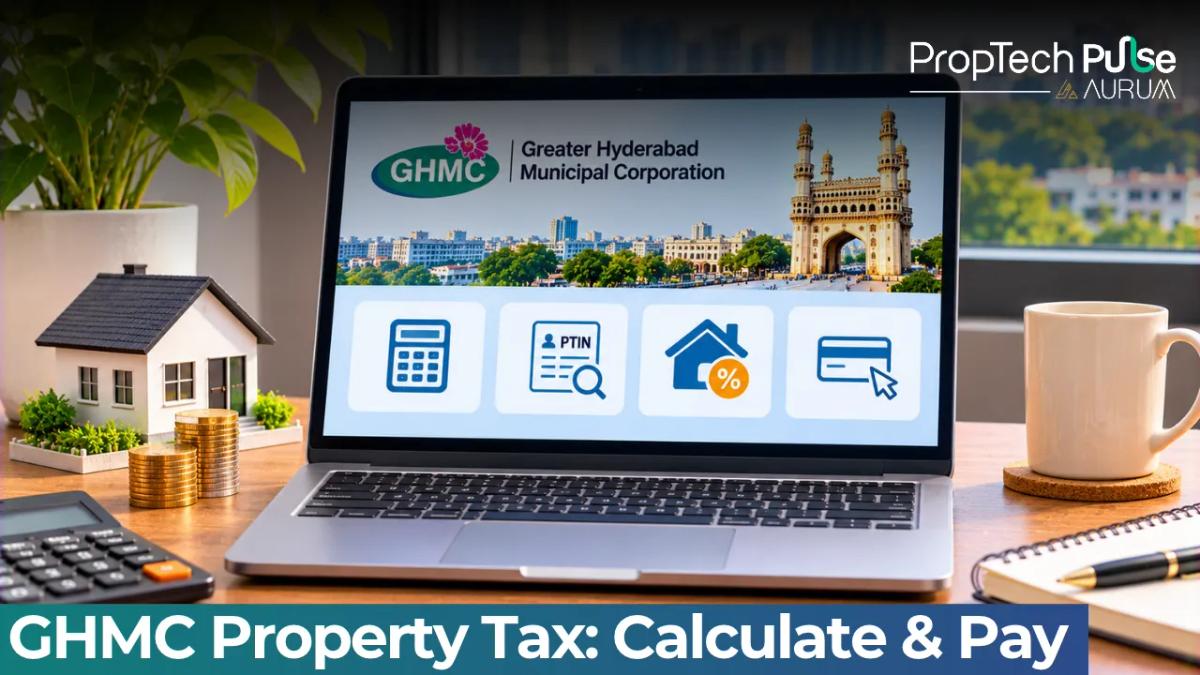
The Greater Hyderabad Municipal Corporation no longer covers all of urban Hyderabad. Following the February 2026 split, western localities like Gachibowli pay tax to CMC, while eastern tracts like LB Nagar report to MMC.
Sending your payment to the outdated portal keeps the liability active under your name until you correct the jurisdiction.
This guide maps every boundary shift, shows the exact calculation for residential and commercial buildings, and walks you through finding your PTIN and clearing pending dues online.
Whether you are settling a current quarter or checking for hidden arrears before buying, the steps below cover what you actually need to do.
Which corporation handles your property?
The February 2026 split followed the merger of 27 surrounding municipalities back into Hyderabad on 2 December 2025. The new arrangement divides duties across three bodies:
- GHMC (Core Hyderabad): Keeps the traditional municipal zone including areas like Banjara Hills, Secunderabad, Koti, and parts of Ghatkesar.
- CMC (Cyberabad Municipal Corporation): Covers the western corridor. Includes Gachibowli, Kokapet, Nanakramguda, Kondapur, and Shamshabad airport zone.
- MMC (Medchal-Malkajgiri Municipal Corporation): Covers the eastern and northern fringes. Includes LB Nagar, Uppal, JBS Circle, Alwal, and Muchinda.
| Corporation | Key localities covered | Official portal |
|---|---|---|
| GHMC | Banjara Hills, Secunderabad, Koti, Dilsukhnagar, parts of Ghatkesar | Online payments gateway |
| CMC | Gachibowli, Kokapet, Kondapur, Shamshabad, Malla Reddy district pockets | Civic media portal |
| MMC | LB Nagar, Uppal, JBS Circle, Alwal, Muchinda, parts of Vikarabad border | Municipal administration portal |
| Note | Always verify via door number or ROR extract. Portals redirect automatically once your mobile or tax ID is entered. | |
Quick answer
Your tax authority depends on your exact location following the February municipal split. Central wards stay with GHMC, western corridors shifted to CMC, and eastern tracts moved to MMC. Enter your door number or ROR extract on the portal you access first to trigger automatic forwarding to the correct civic body.
Administrative overload reversed the December 2025 merger just two months later. Fast-growing localities like Tellapur and Narsingi were carved out of the main corporation again.
Your tax head changed overnight, so do not assume your old GHMC login still works for payments or search tools.
How house tax in Hyderabad is calculated
Telangana property tax follows the central valuation method used across most Indian states.
The formula ties your liability to the gross annual rental value rather than your sale price. For residential buildings, the calculation strips away age-based depreciation before applying the slab rate.
Residential formula:
(Plinth area × Market Rental Value × 12) − 10% depreciation × applicable slab rate + 8% library cess.
The municipal office assigns a Market Rental Value band to your ward based on road width, proximity to main arteries, and building type.
Two identical flats pay different amounts simply because their wards sit on different rate bands. Here is a practical worked example.
A 1,200 sq ft flat in Jubilee Hills carries an assessed rental value of ₹10 lakh. Deduct the standard 10% depreciation to reach a taxable base of ₹9 lakh. Apply the prevailing 20% slab rate plus the 8% library cess to land an annual liability of ₹1,94,400.
Check your actual ROR. The figure above uses a representative ward band. Your Record of Rights extract lists the exact Gross Annual Rental Value assigned by the deputy collector. Compare it against your latest bill before disputing.
Commercial tax calculation:
Commercial properties skip the rental slip method. The tax authority applies a straight multiplier of 3.5 to the plinth area multiplied by the current construction cost rate published by the public works department.
A 2,000 sq ft showroom in Shamshabad pays significantly higher upfront than a comparable warehouse because retail footfall triggers a premium valuation tier. Review understanding SUC in your property bill to see how service utility charges stack on top of the base tax.
Finding and using your PTIN
Every taxable parcel receives a Permanent Tax Identification Number. Think of the PTIN as your property's social security number for municipal accounts.
Banks demand it during home loan processing, and developers cannot issue legal possession certificates without a clean tax history linked to it. If your deed transfer didn't update the PTIN, the seller's arrears stay attached to the land.
You don't need to carry a printed paper trail. Modern portals support ghmc property search through four entry points:
- PTIN: Enter the full identifier if you have it from a previous receipt.
- Door number: Provide the exact sequence from the ROR extract or electric meter.
- Owner name: Works best when combined with the village or mohalla name.
- Registered mobile number: Many recent transfers auto-associate the mobile to the new taxpayer profile.
New constructions require a self-assessment declaration once the plinth reaches completion. An assistant engineer verifies the built-up area against approved drawings before the deputy collector issues the PTIN.
Contractors should stick strictly to the sanctioned layout to prevent variation application delays.
How to pay ghmc property tax payment online
Municipal authorities operate their own citizen dashboards. The interfaces look similar because they share backend validation scripts with the state revenue department. Here is the clean flow that avoids the common checkout drop-offs.
Access the portal. First, visit the official site for your corporation. Use the direct domain listed in the jurisdiction table above. Skip third-party aggregator links that promise faster clearance but charge extra transaction fees.
Retrieve your challan. Query the database using your PTIN or door number. The system pulls pending instalments, past unpaid ledgers, and any penalty accruals. Select the financial year you want to settle.
Select payment mode. UPI processes transactions instantly, while credit and debit cards attract processing surcharges. Mee Seva kiosks also accept printed QR codes for offline bridging. Keep your reference number ready until the confirmation page confirms settlement.
Archive the receipt. Save the PDF receipt alongside your property deed. Lenders pull these documents during the technical appraisal phase.
Missing a single quarter's clearance can trigger a manual verification loop that stalls disbursement by weeks.
If you are tracking down multiple records after inheriting family land, run a full ghmc property search on the Revenue Department's public interface. It consolidates fragmented ward histories that individual municipal portals sometimes hide.
Due dates, rebates and late fees
Hyderabad splits annual liability into half-yearly instalments, with deadlines on 31 July and 15 October respectively. Settling both halves before 1 April secures a five percent rebate. Note that corporate ledgers impose late interest from 1 May regardless of local board extensions, so treat that as the hard stop.
Missing an instalment triggers two percent monthly compound interest on the outstanding balance. Municipal debts attach permanently to the land title, meaning lenders will flag unpaid quarters during title scrutiny. Clear older ledgers before marketing, and run a comprehensive registration and encumbrance check to expose hidden liabilities under past owners.
Watch for circular reassignments. When corporations swap territories mid-cycle, outstanding balances travel with the parcel. The new authority inherits the lead. Update your mobile and email on the portal immediately so you receive revised assessment notices instead of chasing ghost drafts from the old corp.
Before you move forward
Tax compliance directly impacts loan eligibility, resale speed, and penalty exposure. Check the 2026 split map to verify your ward, then pull your ROR extract to confirm the assigned rental value.
Clear legacy arrears through the proper corporate portal before listing or applying for equity to keep future stages frictionless.
Frequently asked questions
Which corporation handles my property in Hyderabad 2026?
Your tax authority depends on your exact location following the 11 February 2026 municipal split. Central wards like Secunderabad and Koti fall under GHMC. Western corridors including Gachibowli and Kondapur moved to CMC. Eastern tracts such as LB Nagar and Uppal now report to MMC. Enter your door number on any portal to trigger automatic redirection.
How to calculate house tax in Hyderabad for flat?
Multiply your flat's plinth area by the ward-specific rental band to get the gross annual value. Deduct ten percent for age depreciation, apply the prevailing slab rate between seventeen and thirty percent, then add an eight percent library cess. The final sum forms your yearly liability. Cross-check the rental band against your latest ROR extract.
How to find PTIN if lost?
Search your municipal dashboard using your registered door number, owner name paired with the mohalla or village, or the mobile number linked to the original taxpayer profile. New construction PTINs generate after the deputy collector completes the site verification visit. The number appears on your updated assessment notice and ROR certificate.
What is the penalty for late property tax payment in Telangana?
Missing a half-yearly deadline triggers two percent monthly interest on the unpaid balance. The charge accumulates until you clear the ledger. Municipal debts attach to the property title, meaning lenders will refuse processing until you produce receipts for every overdue quarter. Early payment before April also secures a five percent rebate.
How to pay ghmc property tax online using mobile number?
Enter the registered mobile on the correct corporation's payment gateway. The system pulls your active PTIN and pending quarters automatically. Confirm the details match your physical records, select UPI or card as your settlement method, and save the generated PDF receipt. Offline queues at Mee Seva centres also accept the scanned QR code.
Sources
- Greater Hyderabad Municipal Corporation Official Portal: Corporate tax payment gateway and portal navigation (accessed November 2026)
- Cyberabad Municipal Corporation: Jurisdiction mapping and civic services directory (accessed November 2026)
- Government of Telangana: G.O.Ms.No.55 and municipal governance notifications (accessed November 2026)
Enjoyed this blog article? Visit PropTech Pulse for more interesting blogs.




Ask Pulse Ai anything about real estate

Unlock the Latest in Real Estate
News, Infographics, Blogs & More! Delivered to your inbox.

