New Launch - India Real Estate Report 2026.

Services
Knowledge Hub
Resources
Tools

Ask Pulse Ai
©PropTech Pulse 2025, All rights reserved.


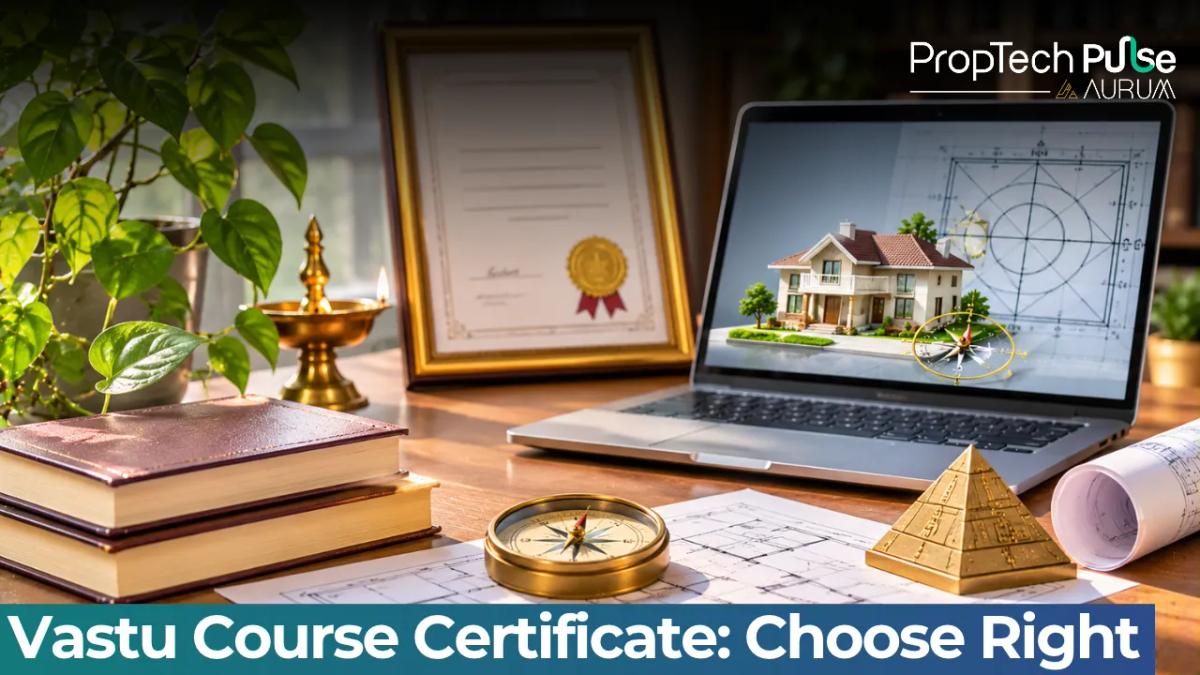
A vastu course certificate verifies that you have completed a structured programme studying traditional Indian spatial design principles, directional energy mapping, and structural harmony.
It does not function as a legal licence. India has no government department that regulates Vastu Shastra practitioners, which means anyone can call themselves a consultant.
However, a valid vastu course certificate signals to clients that you understand classical texts, modern floor-plan analysis, and ethical remedy frameworks.
This guide explains how different certificates work, how to separate genuine academic programmes from marketing claims, and what skills you actually need to advise homeowners and developers responsibly.
What Is a Vastu Course Certificate, and Is It Legally Mandatory?
Quick answer
A vastu course certificate confirms structured learning in traditional spatial design. It is not a legal licence in India. Genuine certification requires multi-month syllabi, classical text study, and floor-plan evaluations.
Self-styled titles flood social media. Many people run weekend webinars and hand out branded certificates immediately after payment.
These documents only prove attendance; they do not verify competence in spatial geometry. Genuine programmes require sustained study alongside practical assignments based on actual layouts.
Government-backed or university-affiliated institutes operate differently. Institutions linked to cultural ministries or state educational boards map their curriculum to classical scriptures such as Manduka Sphuta and Brihat Samhita.
Students analyse room proportions, cardinal directions, and material placements while adhering to strict timelines. The resulting recognised vastu certification carries institutional backing.
Why legitimacy matters more than fancy titles
Clients notice when advice matches established principles versus random adjustments. Homebuyers reviewing how to buy a house in India expect professionals who respect both regulatory standards and traditional values. An authentic certificate demonstrates discipline. It shows you have committed substantial time to understanding load-bearing walls, ventilation corridors, and landscape integration rather than memorising soundbites for social media posts.
Without verified training, you risk offering contradictory remedies that compromise safety or aesthetics. Trust grows slowly. It erodes instantly when consultants recommend structural alterations that contradict building bye-laws.
Top Online Vastu Shastra Course Platforms Compared
Students seeking a vastu shastra course online generally want flexibility paired with rigorous grading. Several platforms operate across India, each blending virtual lectures with practical submission requirements.
Below is a comparison of current providers based on publicly available information.
| Institution | Duration & Format | Fee Structure | Assessment Type |
|---|---|---|---|
| National Vastu Council of India (nvci.in) | Module-based tiered track (FCVS to MVE) | Tiered payments per module (amounts not fixed on homepage) | Written exams, plan analysis, viva voce, portfolio review |
| IGNCA (ignca.gov.in) | 3 months, offline/theoretical focus | ₹10,000 total course fee | Theoretical papers rooted in classical textual interpretation |
| AppliedVastu (appliedvastu.com) | Branded online/offline pathway | Standard package pricing (not public) | Completion assessment within trademark-aligned methodology |
| IIMTU (iimtu.edu.in) | 6 months, entry via 10+2 qualification | Annual tuition model | Semester examinations with career mapping components |
| Shaastree (shaastree.com) | 3–4 months, live sessions with recorded archives | Programme-specific fee | Gov-recognised diploma pathway via affiliated education board |
Red flags to avoid in promotional content
Marketing teams optimise landing pages for quick conversions. Watch for guarantees promising instant wealth or guaranteed client inflow after purchase. Vastu operates as a supportive layer in architectural planning.
It never replaces structural engineering or fire safety compliance.
Ignore programmes boasting lifetime video access without any mid-term or final testing. Genuine mentors grade submissions individually because every apartment layout demands unique adjustments rather than cookie-cutter directives.
Recognised Vastu Certification: How to Verify Authenticity
Before enrolling, treat the selection process like any other professional credential. The absence of a central regulating authority makes independent verification non-negotiable.
Check affiliation, syllabus depth, and assessment rigor
Request the detailed course outline before paying any token amount. Reputable academies publish modules covering planetary energies, five elemental interactions, entrance placement rules, kitchen zoning, and bedroom harmonics alongside remedial interventions.
A credible evaluator assigns numerical grades to architectural drafts rather than issuing pass-fail stamps based solely on quiz scores.
Cross-reference stated affiliations against the respective educational council databases. Demand clarity on whether the institute awards its own title or channels students through an affiliated university stream.
Portfolio-based evaluation versus click-to-certify programs
Authentic programmes ask candidates to document corrections applied to real residential or commercial layouts. You submit before-and-after sketches explaining geometric shifts, furniture realignments, and colour substitutions driven by directional mapping.
Evaluators review your reasoning processes.
Click-to-certify portals automate grading or skip practical reviews entirely. When developers and architects collaborate, they prioritise consultants who demonstrate measurable application over theoretical recall. Building a strong portfolio during training establishes authority faster than collecting generic PDF credentials.
Ethical boundary note Never claim Vastu overrides building bye-laws or structural integrity. Remedies must complement approved blueprints issued by licensed architects and municipal authorities.
Finding the Best Vastu Course in India for Your Goals
Selecting a best vastu course in india depends entirely on your intended outcome. Professional aspirations require deeper immersion compared to hobbyists improving personal residences.
Hobbyist versus professional pathways
Homeowners researching guidelines typically engage with weekend crash courses or introductory books. These resources cover basic south-west heaviness corrections and north-east water body associations.
Professionals pursuing consultancy careers invest in multi-month curricula emphasising mathematical alignments, proportional calculations, and site-specific environmental adaptations.
Career track students often complete internships under established mentors before accepting external commissions.
Time investments reflect the stakes involved. Casual learners enjoy flexibility. Serious candidates commit to structured syllabi that mirror industry expectations.
Hybrid learning and flexible scheduling options
Modern institutions accommodate working adults through evening virtual lectures, recorded masterclasses, and weekend interactive clinics. You retain access to lecture archives while submitting live project drafts for instructor feedback.
Time commitments range from three months for intensive modules up to six months for comprehensive diplomas. Balance pacing with depth to avoid rushing foundational concepts before analysing complex mixed-use developments. Review property due diligence in India regularly to maintain analytical rigour throughout your training phase.
Can You Practice After Completing a Vastu Diploma?
Graduates holding a formal vastu diploma transition into diverse advisory sectors. The pathway blends traditional expertise with contemporary real estate practices.
Industry alignment in real estate and interior design
Collaborations thrive when consultants interface smoothly with builders selling premium inventory.
Residential brokers appreciate specialists who align property tours with auspicious orientation preferences, particularly in Tier 1 markets. Interior studios integrate spatial balancing techniques to enhance livability metrics without altering existing load structures.
Independent practitioners launch small consultancies servicing gated communities, individual plot buyers, and co-working space designers aiming for wellness-centred environments. Reference the RERA Act of 2016 to understand regulatory boundaries governing development projects you may encounter later. Monitor state RERA registered project trackers to observe how new housing units integrate conventional design parameters.
Building credibility without legal mandates
Since Vastu lacks licensing statutes, reputation management relies on client retention and peer referrals.
Publish transparent case studies highlighting layout modifications made within budget limits. Maintain strict neutrality regarding developer brands while delivering actionable insights.
Register your practice name with local trade chambers to signal operational legitimacy to corporate clients. Continual education through advanced seminars keeps you updated on evolving urban planning regulations alongside traditional methodologies. Familiarise yourself with types of residential properties in India to broaden your knowledge base beyond single-family homes. Combine technical proficiency with grounded ethics for sustainable growth in this niche sector.
Next Steps: Join the Pulse Vastu Consultant Waitlist for Guided Learning
If you need structured mentorship and real-world exposure before academic study, explore the Pulse Vastu Consultant waitlist. This programme bridges classroom theory with practical application.
Frequently asked questions
Is there a degree or official licence for Vastu Shastra in India?
No statutory licensing board exists for Vastu Shastra under current Indian law. The profession functions outside formal regulatory frameworks like civil engineering or architecture. Clients choose practitioners based on demonstrated portfolio quality and adherence to classical scripts rather than mandatory government permits. Institutional certificates validate structured learning but do not grant legal执业 rights.
How to become a certified Vastu consultant after a course?
Begin by selecting a multi-month academy with documented syllabi and practical floor-plan assessments. Submit authentic architectural drafts for instructor grading during your training period. Build a portfolio showcasing corrected layouts alongside explanations of geometric adjustments. Approach local interior firms or residential brokers for initial freelance projects once your draft collection reflects consistent accuracy and ethical boundaries.
Are online Vastu course certificates valid for professional practice?
Validity hinges entirely on institutional reputation and assessment rigor rather than statutory recognition. Premium programmes employ manual review of submitted project layouts, written examinations on classical texts, and viva voce sessions verifying conceptual grasp. Avoid automated grading portals offering immediate passes upon payment. Professionals gain traction only when their physical space corrections align accurately with cardinal mapping and material placement guidelines.
What is the average fee and duration for a recognised Vastu programme?
Standard programmes span between three and six months depending on intensity and delivery mode. Government-linked institutes charge fixed tuition fees around ten thousand rupees for dedicated trimester tracks. Private academies price modules variably depending on included mentorship hours and supplementary recorded library access. Factor in commuting expenses for offline classes, whereas virtual models remove travel overhead while maintaining weekly submission deadlines.
Which institutes offer the most credible Vastu Shastra certifications?
Leading platforms include the National Vastu Council of India, IGNCA, AppliedVastu, IIMTU, and Shaastree. Each offers distinct pathways ranging from classical textual interpretation to hybrid virtual classrooms assessing built-environment modifications. Verify affiliations against education councils before enrolling. Evaluate sample syllabi for coverage of directional energies, elemental interactions, and remedial interventions tailored to mixed-use developments.
Do builders and interior designers accept self-taught Vastu experts?
Most developers prefer credentialed specialists who work closely with licensed architects rather than amateurs overriding blueprints. Certified consultants contribute wellness-focused additions without compromising safety compliance. Independent practitioners secure steady contracts through transparent billing, clear scope definitions, and verifiable before-and-after case studies demonstrating respectful alignment with municipal building norms and traditional spatial philosophy.
Sources
- IGNCA Academic Unit: Course duration and fee structure for short-term certification (accessed October 2026)
Enjoyed this blog article? Visit PropTech Pulse for more interesting blogs.



Ask Pulse Ai anything about real estate

Unlock the Latest in Real Estate
News, Infographics, Blogs & More! Delivered to your inbox.

