New Launch - India Real Estate Report 2026.

Services
Knowledge Hub
Resources
Tools

Ask Pulse Ai
Services
FOR BUYERS & RENTERS
FOR REAL ESTATE DEVELOPERS








Refer other Connectors &
Multiply IncomeRefer other Connectors
& Multiply Income
Refer KuberX & earn
commission on every
loan they get
disbursed.


Scan & Download
©PropTech Pulse 2025, All rights reserved.


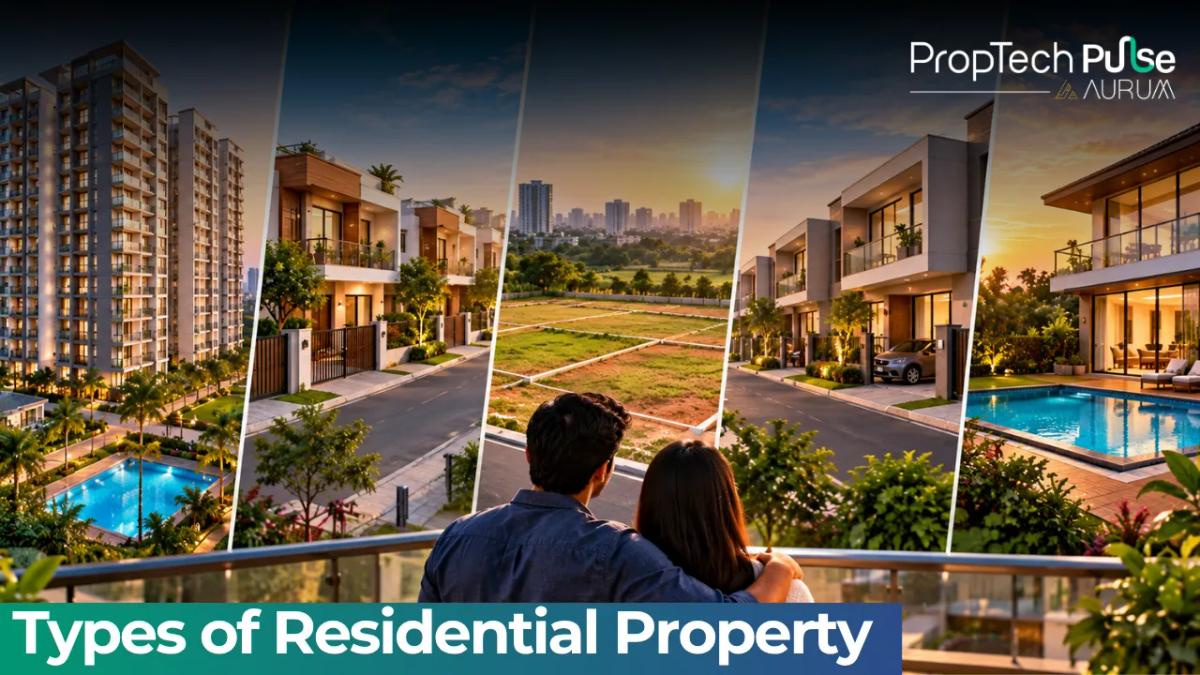
You’re looking at two dozen listings, trying to decide between a G+3 builder floor in Pune, a 3BHK high-rise in Bengaluru, and a standalone house in Noida Extension. The brochure calls them all “homes.” The registration charges differ. The maintenance bills don’t match. And the exit timeline varies wildly.
This guide breaks down the actual types of residential property in India by format, ownership model and project stage. Understanding these options clarifies why registration fees jump unexpectedly. You will stop guessing. We show you exactly how to pick the right match for your budget.
What Are the Main Types of Residential Property in India?
Quick answer
The main types include apartments, independent houses, villas, townhouses and builder floors. Your choice depends on three filters: the physical structure, the legal ownership model and the project stage. Apartments dominate city markets because land scarcity keeps driving prices up.
By Physical Format
Apartments and flats dominate urban supply. They share walls, a common entrance and basic amenities like security staff. High-rises optimise land cost but carry heavier monthly maintenance loads.
Independent houses and bungalows give you exclusive control over the plot and building. You pay for every service separately. Water pumps, solar inverters and waste management raise your annual holding cost even if the purchase price matches a mid-tier flat.
Villas and row houses sit between the two extremes. You own the ground floor and often upper levels within a gated community. Shared driveways, landscaping and perimeter walls bind neighbours together.
Builder floors exist in the transition zone. A G+3 structure split across four separate units offers cheaper entry prices than mid-rise societies. Expect fewer shared amenities and minimal institutional governance beyond the managing committee.
Penthouses crown the tower with larger footprints and higher ceilings. Rooftop access justifies premium pricing, but these units still rely on the parent building’s lift shaft and fire safety systems.
Studios and duplexes serve niche needs. Studios target singles or young couples wanting a low base cost. Duplexes split a single unit vertically inside the same slab for privacy without a full independent house.
By Ownership Model
Freehold means you own the land and the structure indefinitely. State revenue rules apply, but most new gated communities operate on this model.
Leasehold applies where the government retains land ownership. Delhi and parts of Gujarat use this tenure heavily. Ninety-nine year runs are standard. Rental goes to the government and renewals involve fresh payments depending on local law.
Cooperative societies frame ownership through shares rather than title deeds. Membership rights cover the society’s block and plot. Selling requires board approval, which slows liquidity but checks speculative buying.
Joint ownership usually follows marriage or inheritance. Two names appear on the sale deed. One typically holds majority voting power in the society, which matters when maintenance hikes spark disputes.
By Project Stage
Ready-to-move units arrive with occupancy certificates and finished interiors. You can visit the exact layout and test water pressure before signing. Risk sits entirely on the builder’s delivery track record.
Under-construction projects offer lower entry prices and milestone-linked payment plans. RERA mandates dedicated escrow accounts for buyer funds. Possession delays averaging 113 days nationally remain a reality. [VERIFY current delay averages from latest World Bank or state RERA reports]
Newly launched towers often sell units off-plan using 3D floor plans. Pricing locks early, but final carpet areas shift slightly once concrete hardens. Verify that the approved plan matches the showroom display.
Resale flats bypass launch premiums entirely. Liquidity depends on locality demand and building age. Older societies sometimes struggle with loan eligibility if the property crosses the lender’s depreciation threshold.
How Each Property Type Impacts Your Monthly Costs & Maintenance
Purchase price is only half the equation. Holding costs dictate how comfortably you can live there while waiting for appreciation.
| Format | Ideal For | Avg Stamp Duty Impact* | Maintenance Burden | Typical Entry Price Bracket |
|---|---|---|---|---|
| Apartment / Flat | Metro professionals, families seeking amenities | 5%–7% (state dependent) | High (shared amenities, lifts, security) | ₹40 lakh – ₹2 crore+ |
| Independent House | Multigenerational families, privacy seekers | 6%–8% | Low fixed, high variable (self-maintained) | ₹60 lakh – ₹3 crore+ |
| Villa / Row House | NRI investors, long-stay buyers | 5%–8% | Medium (community society maintenance) | ₹1.2 crore – ₹5 crore+ |
| Builder Floor | First-time buyers, cost-conscious families | 5%–7% | Low (minimal shared infrastructure) | ₹30 lakh – ₹80 lakh |
| Penthouse | Luxury buyers, lifestyle-driven buyers | 5%–7% + additional taxes | Very high (premium AMC rates) | ₹2.5 crore onwards |
| *Stamp duty rates vary significantly by state and city classification. Verify local IGR thresholds before calculating total acquisition cost. | ||||
You will notice the independent house looks cheaper on paper until you factor in municipal property tax and self-funded repairs. A cracked terrace slab or failing water membrane costs far more when warranties expire. You hold the entire bill then.
Maintenance trap Avoid properties where the maintenance allocation exceeds ₹30 per square foot unless the society offers rental income potential, like commercial podium space or ample parking leasing. That figure leaves little margin for capital expenditure like roof waterproofing or lift modernisation.
Apartments vs Independent Houses vs Villas: When to Choose Which
Your location and risk appetite usually filter the field faster than price alone.
Commuting costs erode savings faster than monthly maintenance does. Workplaces in Mumbai or Delhi NCR demand locations within walking distance of a metro line. Peripheral suburbs sell space at the expense of daily convenience. You can model the exact trade-off using our rent versus buy financial breakdown.
Yield hunters typically target gated societies near expanding IT hubs. Corporate tenants provide steadier occupancy than older independent housings. Brokerage and stamp duty eat into gross returns before you even move in. Factor those expenses into our flat versus plot investment comparison.
Quick Decision Rule: Pick Your Property Type in 3 Steps
Step one: Lock your maximum monthly outgo. Add 1.5 times the expected EMI to cover property tax, maintenance and unexpected repairs. If the number forces you below a ₹70 lakh ticket price in your target city, look at builder floors or smaller flats. If the number supports ₹1.5 crore plus, you can entertain villas or larger independent plots.
Step two: Match risk to timeline. Under-construction is viable if you can wait eighteen months or more and the developer holds a clean RERA registration. Visit our [INTERNAL LINK: RERA Registration Checker] to verify escrow compliance and past possession history. Steering clear of complex paperwork helps first-time buyers. Understanding the broader types of residential property upfront stops you from mismatching timelines later. Skip under-construction if you need a placement transfer within twelve months.
Step three: Visualise the exit. Do you plan to stay ten years or more? Independent houses command steadier long-term appreciation in stable neighbourhoods. Land values grow faster than concrete structures.
Apartment values ride on amenity upgrades and locational pull instead. Career moves within five years demand high-liquidity formats. Pick standard 2BHK or 3BHK layouts in societies with established reputations.
- ₹30–60 lakh ticket, low risk tolerance, 5-year exit → Builder floor or compact resale flat.
- ₹60–1.5 crore ticket, moderate risk, 7+ year hold → Ready-to-move apartment or low-density independent house.
- Above ₹1.5 crore ticket, high patience, luxury end-use → Gated villa or penthouse.
Frequently asked questions
What are the main types of residential property in India?
They fall into six main formats. Apartments stack vertically in towers. Independent houses sit on private plots. Villas anchor gated communities. Townhouses share boundary walls. Builder floors occupy low-rise structures. Studios cater to singles. The layout directly shapes how much space you use daily and what maintenance falls on you.
Difference between apartment and condominium in India?
India does not use the term condominium widely for standard flats. In practical usage, a condominium refers to a project developed by multiple builders sharing a single large plot, similar to an apartment society but managed collectively. Legal titles function almost identically, though some states treat condo developers differently under local RERA frameworks.
What is freehold vs leasehold property in India?
Freehold gives you permanent ownership of both the building structure and the underlying land until you voluntarily sell it. Leasehold means the government or a designated authority owns the land while you hold the structure for a fixed period, typically ninety-nine years. Leaseholders pay periodic rent to the landowner and face renewal formalities.
Which residential property is better for long-term investment?
Independent houses generally deliver stronger capital appreciation over a decade because land values appreciate faster than built-up concrete structures. However, apartments offer quicker rental yields in metro hubs where tenant demand concentrates near corporate parks. Match the asset class to your target city’s growth corridor.
Are builder floors cheaper than apartments?
Builder floors usually carry a lower per-square-foot rate compared to mid-rise apartment towers in the same locality. The discount reflects the lack of expensive amenities like swimming pools, gyms and elaborate lobbies. Buyers accepting modest infrastructure often find builder floors offer faster ROI because the exit markup stays relatively thin.
Sources
- Ken Research: India Residential Real Estate Market: Sales mix data, market size and permit delay averages (accessed September 2026)
- Reserve Bank of India (RBI): Housing affordability metrics and mortgage trends (accessed September 2026)
- Central Board of Indirect Taxes and Customs (CBIC): GST applicability and property transaction guidelines (accessed September 2026)
- Pradhan Mantri Awas Yojana (PMAY) Official Portal: Subsidy schemes and affordable housing push details (accessed September 2026)
- IGR Maharashtra / IGR Karnataka: State-wise stamp duty slabs and registration fee structures (accessed September 2026)
Enjoyed this blog article? Visit PropTech Pulse for more interesting blogs.





Ask Pulse Ai anything about real estate

Unlock the Latest in Real Estate
News, Infographics, Blogs & More! Delivered to your inbox.