New Launch - India Real Estate Report 2026.

Services
Knowledge Hub
Resources
Tools

Ask Pulse Ai
©PropTech Pulse 2025, All rights reserved.


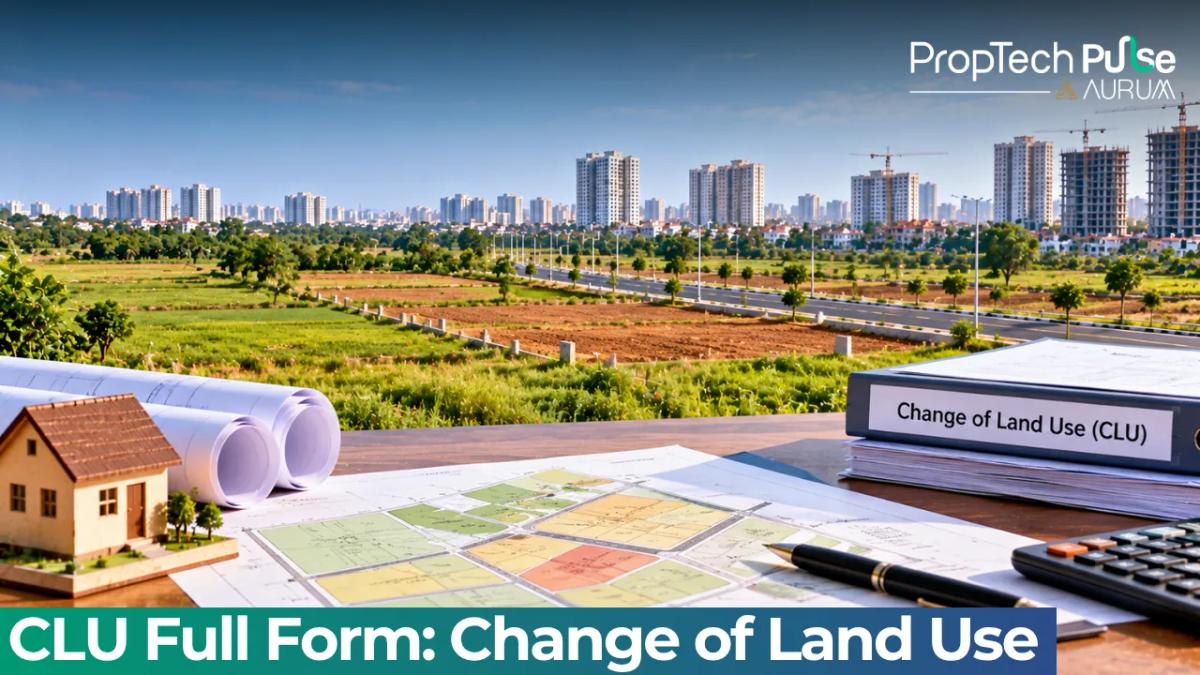
The CLU full form is Change of Land Use. It separates legally buildable assets from raw farmland. If you scout plots outside city limits, the classification on your Jamabandi dictates bank approval and municipal legality. A valid change of land use certificate formally shifts the property from agricultural to residential or commercial zoning. Skip this verification, and you hold onto paper that local authorities can reject overnight.
What does CLU mean in real estate?
Quick answer
Change of Land Use (CLU) is an official government permit that allows a landowner to shift their property's lawful designation, usually from agricultural to residential or commercial. It is issued by the local Revenue Department or Town Planning Authority. Lenders strictly require a valid CLU before approving home loans, and constructing without it risks property sealing and heavy fines.
Every parcel of land in India falls into specific legal categories. The standard classifications include agricultural, residential, commercial, industrial, institutional, and public.
State land revenue acts dictate what activities are permitted on each plot. You cannot simply purchase a farming field and erect a housing society or a shopping complex on it. Doing so violates zoning laws and triggers immediate action from municipal authorities.
This conversion clears that hurdle. Statutory approval allows a plot to shift its intended purpose according to municipal master plans.
You get proof that the developer followed state growth projections rather than guessing at zoning laws. Always ask for the actual government order when sales teams use terms like change of land use approved. Real conversion paperwork shields you from false marketing claims.
Remember: Marketing brochures frequently say CLU Approved. Treat that phrase as a flag to request the actual government order number and verify it physically rather than trusting a sales pitch.
Who issues a CLU certificate and why is it important?
The issuing authority depends entirely on where the land sits. In most rural and peri-urban areas, the application goes through the local Revenue Department.
The Tehsildar or Sub-Divisional Officer reviews the request, checks surrounding land usage, and forwards recommendations for final sanction. In larger cities and planned expansion zones, the Directorate of Town and Country Planning or equivalent Municipal Corporation holds jurisdiction.
Zoning exists to manage infrastructure strain. Residential colonies need different drainage capacity and traffic flow than textile factories.
Government approvals ensure that new developments align with existing civic amenities. If you skip this step during a property purchase, you risk inheriting land that cannot legally support the building type advertised.
Buyers entering the plotted market for the first time should cross-reference these approvals early in the process. We cover similar groundwork in our plot investment india guide 2026, which walks through the baseline checks required before handing over funds.
Understanding the change of land use process from start to finish
Working through the bureaucratic side of land conversion usually follows a rigid path. While every state maintains its own procedural tweaks, the core trajectory remains consistent across India.
Required documents and government fees
Applicants, whether developers or single owners, must submit a formal application detailing the current classification and desired end-use. The supporting paperwork usually includes original ownership deeds and recent tax receipts. You also need a certified site map drawn to scale.
If the plot lies in a restricted transition zone, you must attach No Objection Certificates from neighbours or local welfare associations.
Once the dossier is filed, revenue officials conduct a physical site inspection. They walk the boundaries, talk to locals about the land's historical usage, and confirm there are no active encroachments or pending litigation tied to the plot.
CLU charges and conversion levies
After the field visit, the application moves to fee assessment. Converting agricultural land requires paying a substantial premium. These change of land use charges vary wildly based on the district, distance from city centres, and target zoning.
In rapidly expanding corridors around major metros, conversion fees easily run into lakhs per acre. Rural shifts attract lower percentages, though they still require strict justification to prevent unchecked urban sprawl.
You can read more about the administrative steps involved in our dedicated resource on the process for obtaining a change of land use certificate.
CLU vs DTCP Licence: What's the difference?
This distinction causes massive confusion. Investors eyeing projects in states like Haryana and the Delhi National Capital Region often spot both labels on the same brochure. Many assume they mean identical things. They do not.
Think of CLU as permission to change the soil's label. View DTCP as permission to build upwards and outwards.
The Development Control Programme governs building locations, height restrictions, road setbacks, floor space indices, and parking rules. Holding a valid CLU allows residential use, but you still need DTCP sanctions to lay foundations without halting work midway.
| Aspect | CLU Certificate | DTCP Licence |
|---|---|---|
| Purpose | Shifts land classification (e.g., Agriculture to Residential) | Authorises structural development and zoning compliance |
| Primary Authority | Revenue Department / Local Administrative Offices | Town & Country Planning Directorate / Municipal Corporation |
| Focus Area | Long-term land usage alignment with master plans | Physical layout, building height, setbacks, and infrastructure density |
How to verify a CLU document before buying
Sales teams will flash a laminated copy of a conversion order and call it proof enough. Do not accept it blindly. Paperwork travels fast, but government sanctions move slower. Here is how you actually validate a change of land use certificate on the ground.
- Match the survey numbers: Take the Khasra or Khewat numbers printed on the CLU order and locate them on the official Jamabandi or village registry. They must align perfectly. Even a single digit mismatch signals fraud.
- Review the approved map overlay: Ask to see the master plan map showing the specific ward or sector boundaries. The plot boundaries on the document should match the physical demarcations visible today.
- Check validity dates: Unlike permanent titles, certain temporary permissions expire or require renewal when master plans update. Confirm the order date falls within acceptable municipal windows.
- Trace the file number: Every genuine conversion carries a unique file reference. You can sometimes verify outstanding status through local e-Governance portals linked to state revenue boards.
Lending institutions will force you through exactly this grind. Banks treat raw land conversions as high-risk collateral until independently verified. Preparing these files beforehand saves weeks of delay.
The required documents overlap heavily with our home loan checklist, minus income proofs because we are checking asset legality only.
What happens if you construct without CLU?
Building codes enforce zoning strictly. If a local officer spots a structure rising on unconverted agricultural land, the immediate outcome is usually a work stoppage notice followed by physical gate sealing.
Escalation leads to demolition orders. Rebuilding becomes mathematically impossible after spending crores on concrete.
Beyond physical penalties, capital traps form quickly. Unapproved land fails to appreciate like converted plots.
Resale value drops sharply because legitimate buyers and secondary mortgage markets refuse to touch unconverted inventory.
Banks also draw hard lines here. Under Reserve Bank of India collateral frameworks, housing finance companies cannot book land that lacks clear statutory usability.
If the initial survey flags missing conversion papers, the entire application gets declined. You lose booking money, builder margins vanish, and the dispute enters civil court territory.
Final rule: before you buy or build
Never pay a token amount, brokerage, or builder margin until the land classification matches the intended construction. Verify the document physically, not digitally.
If a developer claims the process is underway, remember that processing takes months, not days. Secure the signed order before signing your own agreement.
Frequently asked questions
What is the CLU full form in real estate?
CLU stands for Change of Land Use. It is an official government permit allowing landowners to shift their property's lawful designation, such as converting agricultural land into residential or commercial zones. Lenders require this certificate to approve financing, and constructing without it invites municipal penalties.
Who issues a CLU certificate?
Issuing authority depends on your region. In rural areas, it is typically the local Revenue Department handled by the Tehsildar. In major metropolitan and planned expansion zones, the Directorate of Town and Country Planning (DTCP) or the Municipal Corporation manages the approvals based on local zoning laws.
How much is the CLU conversion charge?
Conversion costs depend heavily on locality, plot size, and the target zoning category. In high-demand urban fringes, fees easily run into lakhs per acre. Peripheral rural shifts attract lower rates but still face strict scrutiny to prevent uncontrolled sprawl, making it essential to check your specific district's tariff schedule.
What happens if you construct a house without CLU?
Building on unapproved land triggers immediate municipal action. Officers can issue stop-work notices, seal the construction site, or order complete demolition. Banks also reject home loan applications for properties lacking approved land use, trapping your capital until you resolve the legal violation through costly compounding procedures.
Is a CLU mandatory for getting a home loan?
Yes. Housing finance companies strictly verify land classification under Reserve Bank of India collateral norms. Lenders check your soil before checking your salary. If the plot lacks a valid change of land use document, they will reject the loan instantly. Your credit score or income history won't override missing conversion papers.
Sources
- Reserve Bank of India (rbi.org.in): General guidelines on real estate lending and acceptable collateral standards (accessed October 2026)
- National Housing Bank (nhb.org.in): Frameworks for housing finance providers regarding land quality and title verification (accessed October 2026)
Enjoyed this blog article? Visit PropTech Pulse for more interesting blogs.





Ask Pulse Ai anything about real estate

Unlock the Latest in Real Estate
News, Infographics, Blogs & More! Delivered to your inbox.

