New Launch - India Real Estate Report 2026.

Services
Knowledge Hub
Resources
Tools

Ask Pulse Ai
©PropTech Pulse 2025, All rights reserved.


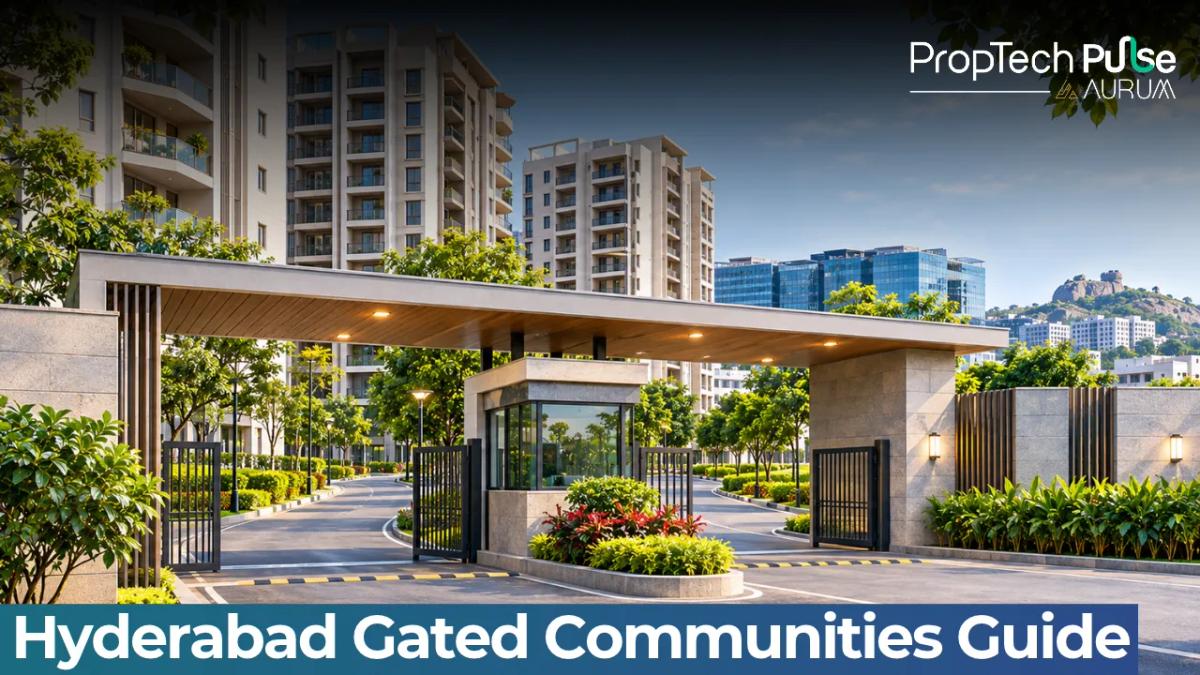
When searching for gated communities in Hyderabad, buyers often focus on renderings instead of the monthly maintenance bill. Paying for a secure perimeter, a swimming pool, and round-the-clock guards sounds ideal until you see the actual invoice.
Buying into one works well when the infrastructure scales right. It fails fast when too many families share limited open space. This guide cuts past the brochure photos.
You will see exactly how maintenance compounds, when GST applies to your society bills, and the exact steps to verify a project before handing over a single rupee.
What makes a gated community different from a standalone building?
Quick answer
A gated society controls access, maintains shared infrastructure like driveways, clubhouses, and stormwater drains, and funds these through monthly fees paid by residents. A standalone apartment block sits within the municipal boundary but usually lacks controlled entry, dedicated recreational space, or a formal resident welfare association to manage common assets.
The physical difference is obvious. Steel gates, CCTV networks, and security booths separate the development from the surrounding streets. The legal difference matters more.
Every residential enclave in Telangana operates under a Residents Welfare Association formed by the buyer agreement.
That entity holds the title deeds to common areas. It appoints the caretaker staff and pays the electricity and water charges for shared zones.
Standalone mid-sized buildings often skip this structure entirely. Informal committees left to manage maintenance struggle with vendor payments and long-term sinking fund accounting.
You will also notice architectural choices shaped by the gated model. Developers design wider internal roads to accommodate fire engine access.
They allocate higher percentages of the plot for ground-floor parking. Amenity clusters get placed away from traffic-heavy boundaries to protect livability once the population hits forty households.
Where to find the best gated societies in Hyderabad
Hyderabad sprawls along distinct growth corridors. The price you pay for security and shared facilities shifts dramatically depending on the axis you choose.
Your commute distance will anchor most decisions. The monthly carrying costs tell another story.
The western corridor around Gachibowli, Kondapur, and Financial District commands premium rates because of IT park proximity.
Newer developments here cluster at twenty-two to twenty-five storeys with minimal vertical setbacks. Maintenance charges run higher, usually between ₹3.50 and ₹5.50 per square foot.
This reflects the heavy cost of maintaining elevator banks, high-pressure water pumps, and large mechanical rooms.
The upside remains walkable access to dining and metro stations once the infrastructure matures. Look north toward Kompally, Bachupally, and Shadnagar highway stretches to encounter flatter terrain with larger base plots.
Villa segments and low-rise podium structures dominate this belt. Buyers seeking a check Telangana RERA project registration in these Hyderabad gated communities expect wider internal lanes and larger clubhouses relative to unit count. Maintenance brackets sit closer to ₹2.00–₹3.00 per square foot here.
Parking tends to be less congested early in the day. Daily commute times to Cyberabad spike during peak hours though. The eastern and southern fringes along NH-65 and ORR extensions remain active development zones.
Plotted developments and hybrid township models mix independent houses with row-house blocks. Security protocols vary because some layouts still operate under phased handover agreements with municipal water boards.
Entry pricing stays competitive. This makes the area suitable for investors who prefer longer hold periods while infrastructure upgrades roll out.
When people type gated communities near me into their phones, the map pin rarely captures the noise footprint of Hyderabad gated communities. It misses the road width behind the main gate.
Drive the route at 7 pm on a weekday before signing anything. Listen for construction equipment, commercial truck routes, and railway crossings that sit outside the development boundary but still affect quiet hours.
What gated living actually costs per month
Maintenance is never a flat rate across a complex. It scales directly with built-up area and floor level for elevator and water pumping loads.
The breadth of amenities matters too. A twelve hundred square foot flat in a mid-tier society pays noticeably less than a two thousand square foot corner unit.
Both residents use the same gym. The cost difference adds up quickly over the year.
| Society tier | Rate per sq ft (approx.) | Base monthly amount | Common amenities covered |
|---|---|---|---|
| Entry level | ₹2.00 – ₹2.50 | ₹2,400 – ₹3,000 | Lobby cleaning, garden upkeep, perimeter lighting, basic security |
| Mid range | ₹3.00 – ₹3.50 | ₹3,600 – ₹4,200 | Pool filtration, clubhouse staff, two lifts, power backup for common areas |
| Premium | ₹4.50 – ₹5.50 | ₹5,400 – ₹6,600 | Multiple lifts, concierge desk, indoor games hall, advanced HVAC for lobby |
| Total annual outflow (mid-range example) | ₹43,200 | Excludes society advance corpus and sinking fund contributions |
Corpus advances hit you at booking or possession. Builders typically demand fifteen days of estimated maintenance as an upfront deposit. Sinking funds accumulate yearly to handle roof waterproofing and lift motor replacements.
Façade repairs follow five to seven years down the line. Never overlook these line items when calculating affordability. They sit outside your monthly cash flow plan and arrive precisely when major wear sets in.
Tax exposure enters the conversation only after a certain threshold. The central government levies eighteen percent GST on maintenance services when the monthly invoice exceeds ₹7,500 per family.
The housing society’s annual aggregated turnover must also cross twenty lakh rupees.
Most mid-sized complexes cross this turnover threshold quickly once occupancy reaches sixty percent.
Lower-income or sparsely populated developments stay below the taxable limit for several years. Always request the society treasurer to confirm whether the association has registered for GST services on CBIC.
Unregistered societies collecting GST violate service tax guidelines. This exposes residents to compliance risk.
Two things buyers forget to ask: Density and Land Share
A fifty-acre plot divided among eight towers holding two hundred flats produces completely different daily routines than the same plot hosting four towers with eighty units.
The term you need to track is Undivided Share of Land. It dictates how much green space, walking tracks, and playground area translates to per household.
A understand UDS in real estate baseline helps you forecast crowding at the clubhouse terrace. It also reveals pressure drops in evening shower hours and lift waiting times after office hour returns.
High density forces developers to stack amenities vertically rather than spread them horizontally. Rooftop jogging tracks replace ground-level parks.
Children play spaces get split into smaller multi-use courts. These compromises work fine until maintenance budgets tighten. Shared surfaces degrade faster then.
If you value open lawns, tree-lined walks, and uncluttered parking, prioritize projects capping floors above thirty-seven stories or explicitly marketing low-rise podium configurations. Conversely, high-density schemes often win on transaction speed.
Resale liquidity stays strong in western corridors because younger professionals accept crowded amenities in exchange for shorter commutes and busy street-side retail.
Decide which trade-off matches your life stage. Families with young children usually sacrifice some commute time for lower vertical density. Singles and dual-income couples lean toward high-rise convenience.
Pre-booking checklist: RERA verification and approvals
Before you sign a booking form or transfer tokens, run a strict approval audit. Hyderabadi developments have historically faced delays in Environmental Impact Assessment clearances.
GHMC building plan sanctions and HMDA layout conversions face similar bottlenecks. Missing paperwork stalls Occupancy Certificates. This locks resale potential immediately.
- Verify title chain. Confirm the developer holds a clear sale deed with no encumbrances, mortgages, or pending litigation. Cross-check the parent deed and mutation records at the local registrar office.
- Search RERA registration. Type the project name into the official state portal at rera.telangana.gov.in. Ensure the listing shows current status, approved carpet areas, and registered agent details. Match the flat numbering schedule against the sanctioned plan.
- Confirm GHMC or HMDA plan approval. High-rise constructions require strict structural stability certificates submitted by licensed architects. Request copies before advancing beyond the token stage.
- Review utility agreements. Telangana State Power Distribution Company (TSPDCL) sanction letters and Greater Hyderabad Municipal Water Board connections must reference the development plot, not adjacent parcels.
- Assemble a due diligence packet. Keep scanned copies of every document, meeting minutes regarding maintenance caps, and builder promises written into the agreement. A complete property due diligence checklist prevents last-minute discovery of zoning mismatches.
Registration costs in Telangana hover around six percent of the declared market value. This splits into roughly four percent stamp duty and two percent registration fees.
Women buyers often qualify for reduced stamp duty slabs in select districts.
Policy updates shift frequently though. Track current rates through the state treasury portal at igrtresury.telangana.gov.in before finalizing your payment schedule.
Making the final choice
Match your daily movement patterns against the physical layout, not the renderings. Calculate drive times to your workplace during actual rush hours.
Run a ten-day estimate of monthly maintenance plus corpus reserves against your take-home pay.
Verify that the plot accommodates the number of vehicles you expect within five years. Walk the perimeter road at dusk to gauge street lighting quality.
When those variables align, the gate works as intended. Stretch the details too thin, and no amount of landscaping fixes the friction.
Frequently asked questions
What is the average maintenance charge for gated societies in Hyderabad?
Most societies bill between two and five rupees per square foot of carpet area. Mid-range developments with standard amenities typically settle around three rupees per square foot, translating to roughly thirty-six hundred to forty-two hundred rupees monthly for a standard flat. Premium towers offering multiple lifts, concierge desks, and climate-controlled lobbies push toward four to five point five rupees. Corpus advances and sinking fund contributions sit outside this base rate and arrive annually or at possession.
How do I check if a gated community is RERA registered in Telangana?
Visit the state authority website at rera.telangana.gov.in and enter either the project name or the developer company name. Valid listings display the registration certificate number, approved floor plans, registered agents, and complaint filing options. Compare the advertised flat sizes against the sanctioned carpet areas in the database. Mismatches indicate unauthorized modifications. Always download the public report PDF before visiting sales offices.
What is the difference between a gated community and a standalone apartment?
Controlled access defines the practical distinction. Gated developments maintain steel entry points, perimeter fencing, and dedicated security staffing funded through a formal resident association. Standalone blocks sit within municipal limits but rarely install restricted entry systems or pooled facility budgets. Standalone properties rely on individual owners for exterior maintenance, whereas gated societies hire contracted vendors for drainage, electrical distribution, and common-area cleaning under a unified management contract.
Does GST apply to monthly maintenance in gated societies?
Eighteen percent GST activates only when two conditions meet simultaneously. The individual monthly maintenance invoice must exceed seven thousand five hundred rupees, and the total annual turnover collected by the housing society must surpass twenty lakh rupees. Smaller complexes or newly launched projects with low occupancy typically remain below the taxable threshold for several years. Registered societies must issue proper tax invoices showing HSN codes and center of supply details.
Why does plot size matter more than the number of amenities?
A sprawling base plot distributes foot traffic across wider walking paths, larger lawns, and decentralized play zones. High-density towers cram the same resident population onto compact terraces and rooftop decks, accelerating wear on shared surfaces and creating bottleneck congestion during peak usage hours. Plot dimensions dictate the undivided land share per household, which directly influences long-term maintenance stress and outdoor air quality. Amenities count little when the space to host them disappears.
Sources
- Central Board of Indirect Taxes and Customs: GST notification on construction and maintenance services, threshold criteria for residential associations (accessed November 2026)
- Real Estate Regulatory Authority Telangana: Project registration search tool and compliance reporting format (accessed November 2026)
Enjoyed this blog article? Visit PropTech Pulse for more interesting blogs.


Ask Pulse Ai anything about real estate

Unlock the Latest in Real Estate
News, Infographics, Blogs & More! Delivered to your inbox.

